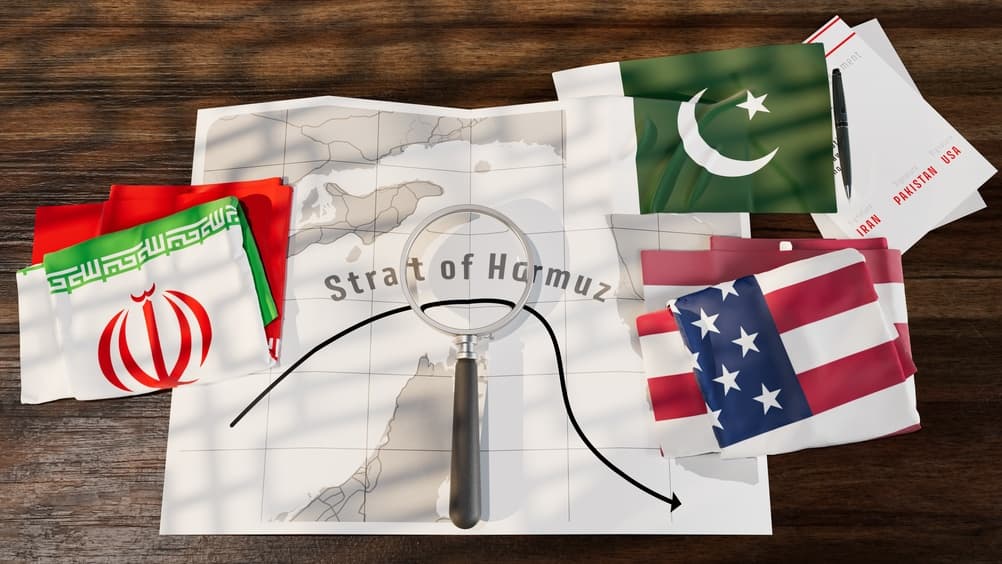
Milan (AsiaNews) – For weeks, Pakistan has been trying to carve out a mediating role in the conflict between Iran and the United States, a move that appears to be the result of a combination of opportunity and necessity rather than Islamabad's new structural centrality, this according to Namita Barthwal, a research analyst at the Military Affairs Centre of the Manohar Parrikar Institute for Defense Studies and Analyses (MP-IDSA), one of India's leading strategic think tanks.
Pakistani leaders have moved on several fronts in recent days, marked by signs of a possible de-escalation. Prime Minister Shehbaz Sharif is on a four-day tour of Saudi Arabia, Qatar, and Turkey, to consolidate economic relations and secure financial support. Meanwhile, the chief of Defence Forces, Field Marshal Asim Munir, flew to Iran, acting as an informal intermediary between Tehran and Washington. This diplomatic activism also reflects the need to contain the regional fallout of a conflict that Pakistan cannot afford, either economically or politically, Namita Barthwal told AsiaNews.
Regarding Pakistan's current diplomatic engagement between Iran and the United States, some observers see this "shuttle diplomacy" as a form of strategic opportunism. How sustainable is this role? Is Islamabad truly a credible mediator?
Pakistan's mediation effort looks more tactical than structurally sustainable. It has gained traction because it hosted direct US-Iran talks in Islamabad, which failed to get a breakthrough, and because Army Chief-turned-Field Marshal Asim Munir went to Tehran carrying a US message. Pakistan can keep channels open but it cannot play a major role in bridging those substantive gaps on the nuclear programme, sanctions relief, or sovereignty over Hormuz.
The balancing act is also constrained by Pakistan's own vulnerabilities. It is still operating under a US$ 7 billion IMF programme, had foreign exchange reserves of about US$ 16.4 billion at the end of March, facing a US$ 3.5 billion repayment to the UAE this month, and required an additional US$ 3 billion Saudi deposit plus an extended US$ 5 billion rollover arrangement to protect reserves and stay near IMF targets. Fuel-price hikes, school closures, austerity steps, and market stress linked to the regional conflict. That makes diplomacy partly a stabilisation tool for Pakistan itself: reducing war spillover, preserving investor confidence, and staying in good standing with Gulf and Western patrons.
Pakistan is a facilitator. It has access to Washington, Riyadh and Tehran, and even the United Nations Security Council. But Islamabad could damage itself by overplaying in the mediation process, especially because it must simultaneously balance Iran, Saudi Arabia and the US while dealing with instability on its Afghan frontier and sectarian sensitivities at home. What I see is that Pakistan's civil-military leadership is using foreign policy prominence to project competence and central authority at a time when domestic politics remains tightly managed. This does not make the diplomacy fake, but it does make it heavily self-interested.
From an Indian perspective, how is Pakistan's new visibility perceived? What implications does it have for India's strategic interests, particularly in Iran?
From New Delhi’s perspective, Pakistan’s sudden diplomatic visibility is being watched with some discomfort, but not with panic. India’s official instinct appears more restrained than reactive: preserve strategic autonomy, protect maritime and energy interests, and avoid entering the mediation theatre merely for optics.
India’s main concern is not Pakistan’s profile by itself, but whether the crisis threatens India’s strategic equities in Iran and the Gulf. New Delhi does not want to let go of Iran, which it still sees as important for access to Central Asia and for the Chabahar route. India has tried to reassure Tehran that ties with the United States and Israel are critical to Indian national security, while maintaining stable ties with Iran.
Chabahar remains central to that logic. India signed a 10-year contract in May 2024 to develop and operate the port, specifically to connect with Afghanistan and Central Asia while bypassing Pakistan, and Washington granted India a six-month sanctions waiver in October 2025 to keep operating it. So the current instability does affect Chabahar, but mainly by raising sanctions and shipping risk, not by eliminating its strategic value.
India seems to be recalibrating its Link West policy into a more risk-managed version focusing on what can be done such as humanitarian assistance to Iran. That is an inference from the evidence: New Delhi is preserving Chabahar, keeping channels with Tehran open, engaging Washington on waivers, highlighting maritime security, and diversifying energy sourcing rather than deepening dependence on Iran. India resumed limited Iranian oil and gas purchases under a temporary US waiver, that two VLCCs[*] reached Indian ports, and that Iran’s ambassador said Chabahar and economic ties would remain stable. At the same time, India is unlikely to cross US red lines once waivers expire and would shift to Russia, the US, Australia, and others. So Link West is not being abandoned; it is being de-risked.
Is Field Marshal Asim Munir's growing power changing Pakistan's foreign policy?
Munir’s consolidation of power has clearly made Pakistan’s foreign policy more centralised and military-led. The November 2025 constitutional amendment created the post of Chief of Defence Forces, put the navy and air force under Munir’s command in addition to the army, and granted him lifetime legal immunity after office. That formalises what was already a large de facto role.
Pakistan’s diplomacy runs through a leader who also controls the military instrument and manages Pakistan’s regional security partnerships. With no doubt one can say that Munir has been central to Iran diplomacy. Pakistan’s balancing with Iran is now being handled by a system led by the military chain of command. This gives Pakistan speed and coherence, but it also sharpens the contradiction. Pakistan cannot appear anti-Iran because it shares a border with Iran, has sectarian sensitivities at home, and wants to avoid a two-front western crisis. But it also cannot dilute its Saudi security commitments, because Saudi Arabia is both a financial backstop and a defence partner. In that sense, Munir’s rise has not solved the Saudi-Iran contradiction; it has merely moved its management more decisively into military hands.
What is the state of the internal opposition, particularly the Pakistan Tehreek-e-Insaf (PTI), the party of former Prime Minister Imran Khan, who is currently in prison?
PTI has been severely repressed. The state has clearly degraded its organisational capacity. After a sweeping crackdown on Khan’s party and dissenting voices, with anti-terrorism laws and military trials used after the 9 May 2023 protests, in January 2026, a Pakistani anti-terrorism court sentenced eight journalists and commentators to life imprisonment in absentia over online support linked to pro-Khan protests. That shows the state is still treating the PTI ecosystem as a live threat.
At the same time, the fact that the establishment continues to clamp down so aggressively suggests PTI has not been fully neutralised in legitimacy terms. The 2024 election showed that Khan-backed independents performed strongly enough to disrupt the expected result. PTI is no longer free to compete on equal institutional terms, but it still retains enough popular resonance that the establishment does not feel safe ignoring it.
How is Pakistan's strategy toward Afghanistan evolving, and what role is China playing?
The present pause on the Durand Line looks tactical. Islamabad has not fundamentally changed its view that the Taliban are unwilling or unable to curb anti-Pakistan militants, especially the TTP. What has changed is the method. After the February-March escalation, Pakistan entered China-mediated talks in Urumqi focused on ceasefire terms, border reopening, trade and travel, and both sides were reported to have agreed not to take steps that would further escalate the conflict. That points to a tactical repositioning: Pakistan is pausing overt military pressure long enough to test whether diplomacy can produce verifiable security gains, while keeping the option of renewed coercion in reserve.
China has repeatedly tried to bring the two sides back to the table through revived foreign ministers’ mechanisms, which has linked political dialogue with counter-terrorism and the possible extension of CPEC[†] to Afghanistan. That suggests Pakistan is not merely pausing because of goodwill; it is trying to fold Afghanistan back into a more regulated, China-backed regional framework where its own security concerns receive diplomatic backing.
Is China using Pakistan as a "diplomatic proxy"? And what are the implications for India?
Calling Pakistan a full Chinese “diplomatic proxy” may be a bit too strong. A more accurate way to put it is that China is using Pakistan as a useful diplomatic channel. In other words, Beijing seems happy to let Islamabad do more of the visible talking and outreach, while China stays slightly in the background.
This makes sense from China’s point of view. China wants stability in the Gulf because the Strait of Hormuz is critical for global energy flows, and China has major oil and economic interests tied to that region. So Beijing has every reason to support ceasefire efforts and back any process that reduces the risk of wider war. At the same time, China does not seem eager to put itself fully on the line as the main guarantor of peace. It wants influence, but not the full burden or risk that comes with direct ownership of the process.
For India, this growing China-Pakistan coordination is uncomfortable for a few reasons. First, it can make Pakistan look more diplomatically relevant at a time when India also has major interests in West Asia. Second, it strengthens a wider regional pattern in which China uses Pakistan as an affordable strategic instrument in India’s extended neighbourhood, whether in the Gulf, Afghanistan, or broader regional diplomacy. Third, if Pakistan gains more diplomatic backing from China, more financial support from Saudi Arabia, and more international visibility through mediation, that can make India’s own western strategy harder to manage – especially on issues like Chabahar and its broader Link West policy.
[*] Very Large Crude Carriers.
[†] China Pakistan Economic Corridor.