Moscow (AsiaNews) - Last week, the Moscow prosecutor’s office requested that criminal proceedings be opened against comedian Aleksandr Dolgopolov for “rehabilitating Nazism”. According to the Baza agency, the charge was reportedly prompted by a joke made during a cabaret show: “Sometimes I walk around Berlin and think: ‘Wow, they killed my grandfather’”.
In this case, it is clear exactly which joke a comedian is being prosecuted for in Russia, but this is not always the case: comedians can be prosecuted or declared foreign agents for remarks not always clarified by official charges.
In Russia today, one cannot joke about the war, and several comedians have been persecuted for jokes related to military operations. In September 2024, the Ministry of Justice added comedian Ruslan Belyj to the register of foreign agents for his anti-war stand-up comedy show Still, in which, among other things, he said that “if Kaliningrad wanted to secede from Russia tomorrow, the last people I’d want to see there would be those bloody Germans asking: ‘Where have you been for the last 70 years?’”.
Another forbidden topic is mobilisation: Belyj posted the following on his YouTube channel: “I’m generally a simple person. When I hear the word ‘mobilisation’, you already know I’m screwed. I’m very mobile in that sense,” after which he had to move to Spain.
Last February, comedian Artemij Ostanin was sentenced to six years and nine months in a labour camp for making a joke about a disabled man who had lost his legs in the war, with whom he had clashed on the underground. “I couldn’t think of anything better to do than lean over and say: ‘Well, don’t go so fast’.”
Sergei Zaitsev, leader of the ‘Call of the People’ movement, filed a complaint against Ostanin, arguing that jokes mocking ‘a soldier who lost his legs in the North Caucasus Military District cross every moral and ethical boundary’.
The comedian was accused of inciting hatred and of violating human dignity, and was placed on the list of terrorists and extremists. The comedian fled to Belarus, where he was arrested by local security forces, beaten, tortured and suffered a spinal injury.
You cannot joke about Russians and Russian citizens of various ethnicities: in January 2023, comedian Dmitry Gavrilov posted and subsequently deleted a recording of a performance in Georgia, where he had travelled following the announcement of mobilisation.
It contained a joke: “To keep my cool, I wrote ‘To hell with the Russians’ on the wall of my house, just to remind myself where I am.” On his return to Russia, Gavrilov was initially sentenced to 13 days’ administrative detention for “incitement to hatred”.
The court ruled that his jokes contained “signs of humiliation of human dignity based on nationality, language and origin”. The comedian was then fined 30,000 roubles for “discrediting” the army.
Obviously, one cannot joke about religion and the Russian Orthodox Church. In 2020, the Ministry of the Interior launched an investigation following a complaint filed by a resident of the Moscow region against Aleksandr Dolgopolov, as he had taken offence at his joke about the Virgin Mary allegedly calling Jesus by the Russian name Bogdan.
In November last year, the Forty Quarantine movement filed a complaint with the Investigative Committee against Nurlan Saburov, Aleksey Shcherbakov and Sergey Detkov, presenters of the programme “What Happens Next?”, for making jokes about Jesus in an old episode. In 2026, Saburov was banned from entering Russia for 50 years and Shcherbakov’s concerts were cancelled. It is unclear whether this was linked to jokes about religion. The Ukrainian Detkov left the programme in 2020 and now lives in Europe.
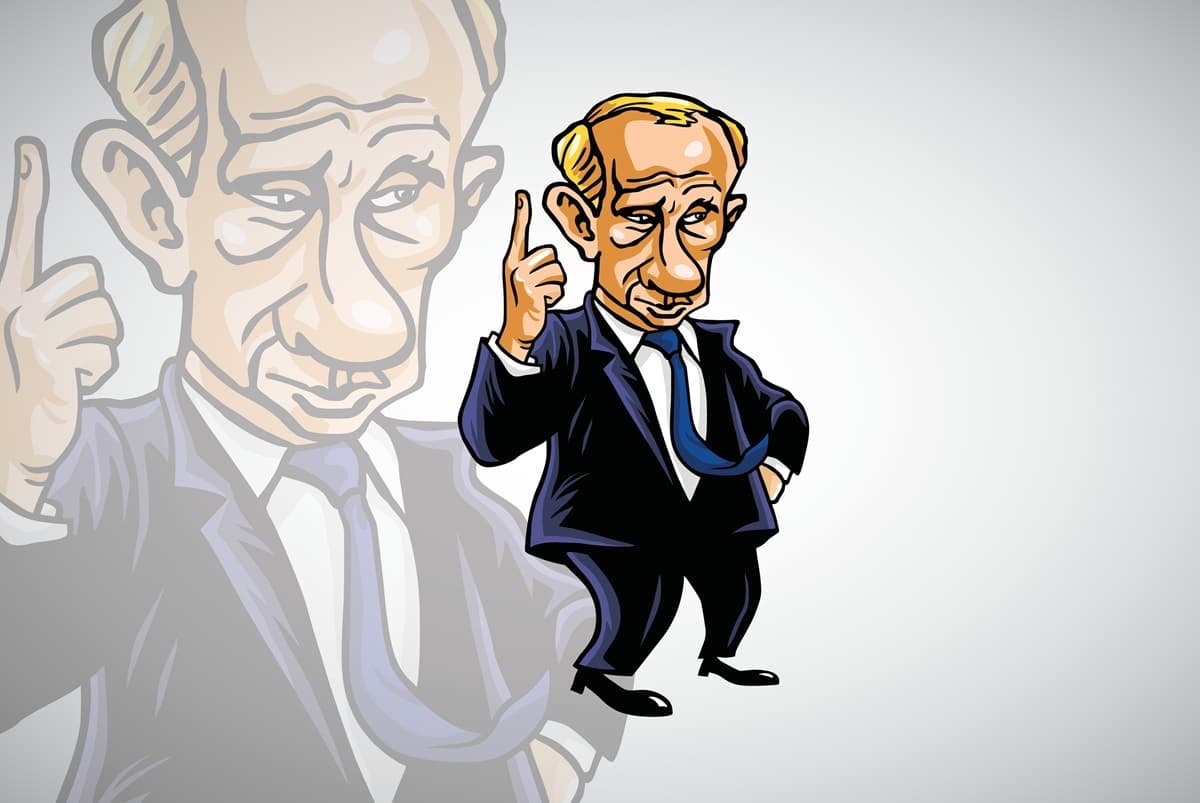
Nor can one joke about Vladimir Putin; in rejecting Semen Slepakov’s appeal, the court cited his book “Song of the Patriot”, written from the perspective of a Russian proud of the fact that Vladimir Putin would use nuclear weapons if necessary: “Ours will kill us, gosh!” The court found that the author “ridiculed the President of the Russian Federation, who intends to use weapons when Russia’s sovereignty and territorial integrity are threatened”.
Irony and sarcasm were the only weapons to resist the oppression of Soviet totalitarianism, when the jokes of Radio Armenia, a semi-underground group of Russian and Caucasian comedians who, with an Armenian accent, mocked party leaders and international political events, were circulating throughout the country.
Even on state television, there was no shortage of appearances by actors who were very at ease with jokes and satire on every subject, whilst Putin’s Russia has proven itself to have sunk to an even lower and bleaker level, forbidding the people even from having a laugh.