








Blast kills dozens in a country where one in three is starving
Stored gelignite reportedly caused a massive explosion that killed at least 55 people in a village in Shan State. The catastrophe has put the spotlight on the TNLA, a controversial militia that struck a deal with China. Meanwhile, according to the United Nations, more than 16 million people in Myanmar are currently suffering from acute food insecurity. International organisations are appealing for help for one of the world's least-funded emergencies.
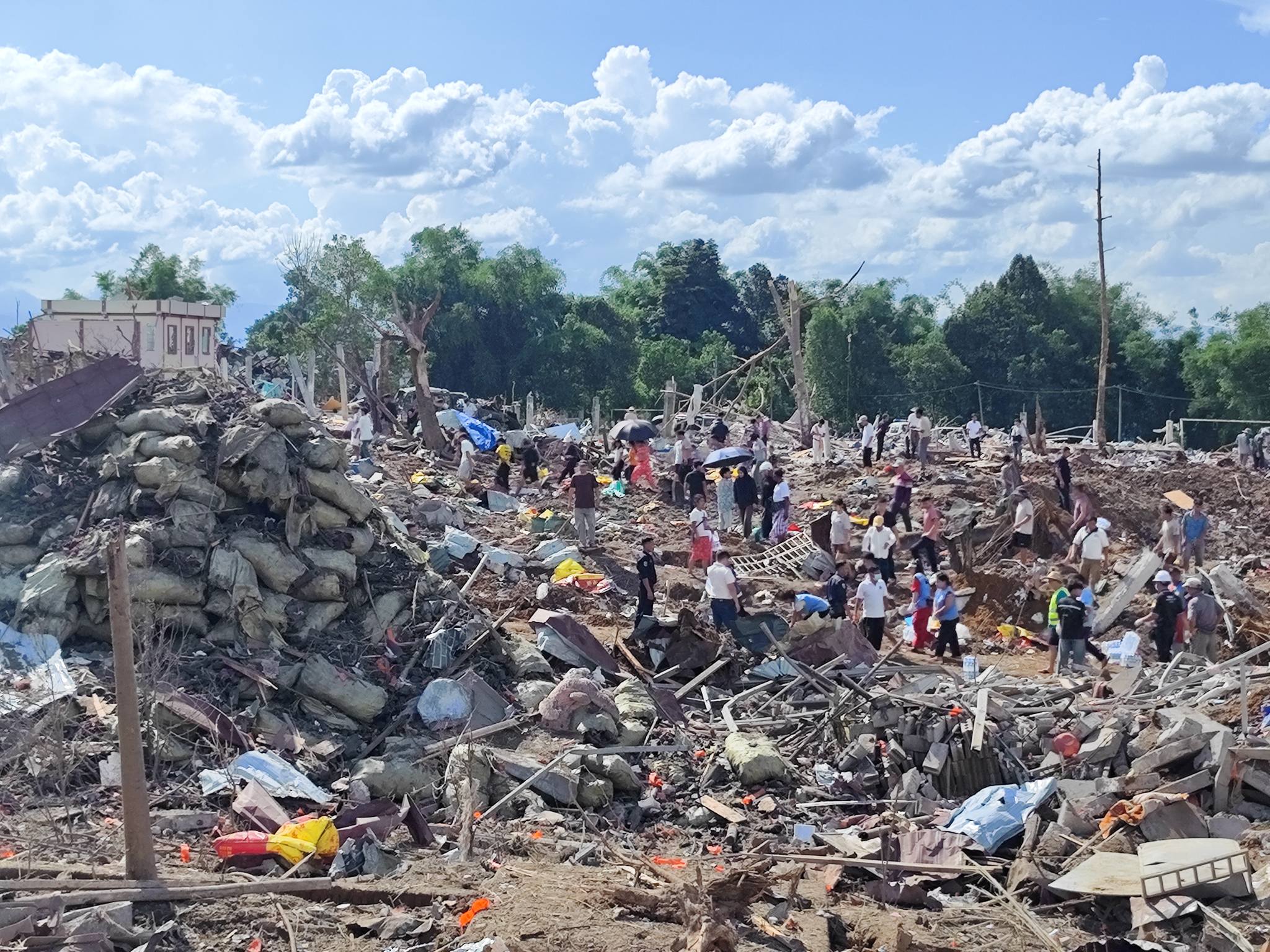
Yangon (AsiaNews) – A massive explosion at a warehouse storing mining explosives in a village in northeastern Myanmar killed at least 55 people and injured dozens of others, in yet another dark chapter in Myanmar's ongoing crisis.
This comes in a country already on its knees from five years of civil war, burdened by a grave humanitarian emergency, and the interaction of various interests at the local level.
The explosion occurred around noon in Kaung Tat, a village in Namhkam Township (Shan State), destroying a building used to store large quantities of explosives for mining operations in the region. At least six children were among the victims.
The blast left a huge crater while the shockwave destroyed houses not only in Kaung Tat, but also in the nearby settlement of Pan Lone.
TNLA admits responsibility
Namhkam Township is under the control of the Ta'ang National Liberation Army (TNLA), an armed ethnic militia that captured the area in a coordinated offensive against Myanmar’s military junta in late 2023.
In a statement, the TNLA confirmed the tragedy, attributing the explosion to improper storage of gelignite, an explosive widely used in mining that can become unstable and prone to accidental detonations if stored improperly or for too long.
The armed militia promised a full investigation, stating that anyone found responsible for unsafe storage of the material will be held accountable. Residents, for their part, say that they were never informed that explosives were stored in their community.
The disaster has intensified an already heated debate over the TNLA's role within Myanmar's resistance movement. Although the group has fought effectively against the junta and administers large swathes of land in northern Shan State, it has faced growing criticism in recent years for some of its political decisions.
In early 2024, it signed a ceasefire agreement with the Myanmar military, a deal brokered by China primarily to protect cross-border trade and mining investments along the border with China’s Yunnan Province. Many anti-junta resistance groups and pro-democracy activists have accused the TNLA of abandoning the nation-wide insurgency at a crucial time.
Critics also allege that the group is closely linked to Chinese economic interests, as it plays a role in protecting silicon and rare earth mining, whose output is largely bound for China. The Namhkam explosion has thus given renewed vigour to these accusations.
A raging food crisis
This tragedy has increased suffering in a country already mired in a deep crisis, currently experiencing one of the world's worst food crises.
According to the United Nations Humanitarian Plan for 2026, at least 16.2 million people in the Southeast Asian country are in need of humanitarian assistance, while the most recent Hunger Hotspots Report, compiled by the FAO and the World Food Programme (WFP), estimates that 16.7 million people, about a third of its population, are acutely food insecure.
This represents a significant increase from the 13.3 million in 2024, placing Myanmar in fifth place in the world in terms of the number of people affected by hunger.
For Veronica Collins, the EU's humanitarian aid officer for Myanma, “Myanmar's food crisis is spiralling” out of control. As “one of the worst food crises in recent history,” it “is unfolding in plain sight, yet remains unnoticed by the world.”
Compared to pre-coup levels, the cost of food has increased fourfold. The situation has been further worsened by the 7.7-magnitude earthquake that struck the country in March last year. In many areas already devastated by war, the destruction caused by the quake has increased the level of malnutrition.
In Rakhine State, home to the Rohingya Muslim minority, the situation is critical. According to the WFP, 57 per cent of families in the central part of the state can no longer meet their basic food needs. In the northern areas, which are harder to reach due to ongoing fighting and restrictions imposed by the authorities, conditions could be even worse.
In many regions, farming has been made nearly impossible by the threat of landmines and active fighting. Markets function intermittently, and prices continue to go up, partly due to the crisis in the Middle East.
The war launched by the United States against Iran has impacted fuel prices, which have tripled in Myanmar since the end of February. More than 400,000 children and mothers with acute malnutrition survive on nutrient-deprived diets of plain rice or watery porridge.
For many families, survival now depends on desperate measures. More and more parents are going without meals so their children can eat, while some families are forced to sell their possessions or accumulate debt to buy food.
Humanitarian organisations say they lack the resources necessary to respond to the emergency. In 2025, only a quarter of the funds requested by the United Nations humanitarian plan were made available. In 2026, front-line agencies expect to assist 4.9 million people, down from 6.7 million the previous year.
“The crisis in Myanmar is almost invisible," said Gwyn Lewis, UN's interim Humanitarian Coordinator in Myanmar, noting how international attention has gradually shifted to other global emergencies.
Photo: Myanmar Now

.png)
13/03/2023 18:13
26/03/2018 15:07
10/03/2026 16:09
26/07/2024 20:00
10/07/2024 17:01










