








Blue Marists: Christmas in Syria, between an ‘unclear’ situation and an ‘uncertain’ future
The US Congress has decided to lift sanctions against Syria, including the infamous Caesar Act (waiting only for Trump's signature). In their 51st letter from Aleppo, the Christian group paints a picture of a country marked by critical issues one year after the fall of Assad. Concerns are growing over a possible Islamist constitution and the plight of women and minorities.
Aleppo (AsiaNews) – The situation in Syria "remains unclear" with several unresolved issues: the formation of parliament, the poor representation of women and religious minorities, doubts over the new constitution, and the fear that it may be inspired by Sharia, Islamic law.
These are some of the dark clouds that hover over the country's future, highlighted by the Blue Marists in their 51st “Letter from Aleppo," published ahead of Christmas. Amid this, the group of religious and secular people highlights ethnic violence against Alawis and Druze, tensions with the Kurds, and attacks on Christians.
A year after the fall of Bashar al-Assad and the rise to power of the formerly radical Islamic movements led by Hayat Tahrir al-Sham (HTS), headed by the current leader and interim President Ahmed al-Sharaa, Syria is still facing critical issues and instability. This event, the Blue Marists of Aleppo write in their letter, “has so shaken our daily lives and made our future uncertain that we want to share our thoughts with you.”
Meanwhile, the United States Congress has just voted to lift sanctions against Syria, starting with the infamous Caesar Act, which was aimed at the Assad family, but drove a large segment of the population into poverty. The law was approved in 2019 during the first Trump administration; however, for the repeal to be effective, it must be signed by the president. This confirms the openness shown by the US leader and Western governments to the new leadership in Damascus, despite the many unresolved issues mentioned by the Blue Marists in their testimony.
Below are extensive excerpts from "Letter from Aleppo" number 51:
I am sending you our Letter No. 51 one year after the fall of Assad and the former Syrian regime, and the takeover by the former Islamist rebels. This event has so shaken our daily lives and made our future uncertain that we want to share our thoughts with you.
In one year, many realities have changed in the lives of the Syrian population, whether in terms of security, education, politics, economics, or even sociology. It was so unexpected.
Where do we stand today?
It goes without saying that the situation remains unclear... Indeed, we are still waiting for the formation of a parliament made up of 210 deputies, of whom 70 will be appointed by the interim president. As for the other 140 deputies, they have already been "elected" by electoral commissions also appointed by the president; women and ethnic and religious minorities are underrepresented, the vast majority are of the “same color”. This parliament's main mission will be to draft a new constitution for the country.
Furthermore, all military personnel, police officers, and many public service employees in the country have been dismissed. Since December 2024, they have been unemployed with no compensation. This reality has completely changed their family and social lives.
Several security incidents have also marked this first year: On the coast, with the Alawite community, in the south with the Druze minority, while in the northeast of the country, relations are tense with the Kurds.
In Damascus, on 22 June 2025, a terrorist opened fire in the Greek Orthodox Saint Elijah Church on worshippers attending the Eucharist and blew himself up inside.
The attack killed at least 25 and injured 63. Since that date, police officers have been permanently stationed at the doors of all churches in Syria to prevent possible attacks.
Important changes have been made to school programs: everything related to the former regime (photos, words, images) has been removed from textbooks, and four weekly religion periods have been imposed for Muslim students, etc.
On the economic front, the use of foreign currencies, such as the US dollar and Turkish lira, is now permitted. Although there has not been a significant increase in salaries, prices are soaring. Up to this day, despite repeated announcements in the media, sanctions have not yet been lifted!
Electricity has improved: it has increased from 2 to 6 hours per day. However, in the meantime, tariffs have been raised in a staggering manner.
On the political front, Syria is regaining its place in the world. This is evidenced by the visits the president has made to numerous countries and the support he has received from various heads of state.
Diplomatically, the Minister of Foreign Affairs does not stop flying to world capitals to obtain recognition for the regime and support for the country. Western governments are reopening their representations in Damascus.
The most important thing remains a certain fear that has settled in the hearts of the citizens: it concerns the future of the country. Several questions then arise in people’s minds: Will the new constitution establish an Islamic state inspired by Muslim Sharia? What will become of the different components of the Syrian social fabric?
The Pope in Turkey and Lebanon
On another note, in recent days the visit of Pope Leo XIV to Syria’s two neighboring countries, Turkey and Lebanon, has been noteworthy.
He pleaded, before the Turkish authorities, for respect for religious freedom and emphasized the need to build bridges, reject fanaticism and religious fundamentalism, and work together for the common good by engaging in diplomacy centered on peace and mutual respect.
Meanwhile, two weeks ago, a conference was held in Damascus organized by the Syrian Catholic NGO “The Church, House of Charity”. Several Christian associations from all over Syria participated, along with four international Catholic organizations: L’Œuvre d’Orient, Aid to the Church in Need, Misereor, and the Pontifical Mission.
The goal was to reflect and propose solutions to the most urgent needs of Christians in each region of Syria; a country where the number of Christians has decreased by 80% since the beginning of the war in 2011. The various working groups agreed to prioritize the following needs: schooling, health, housing, and employment.
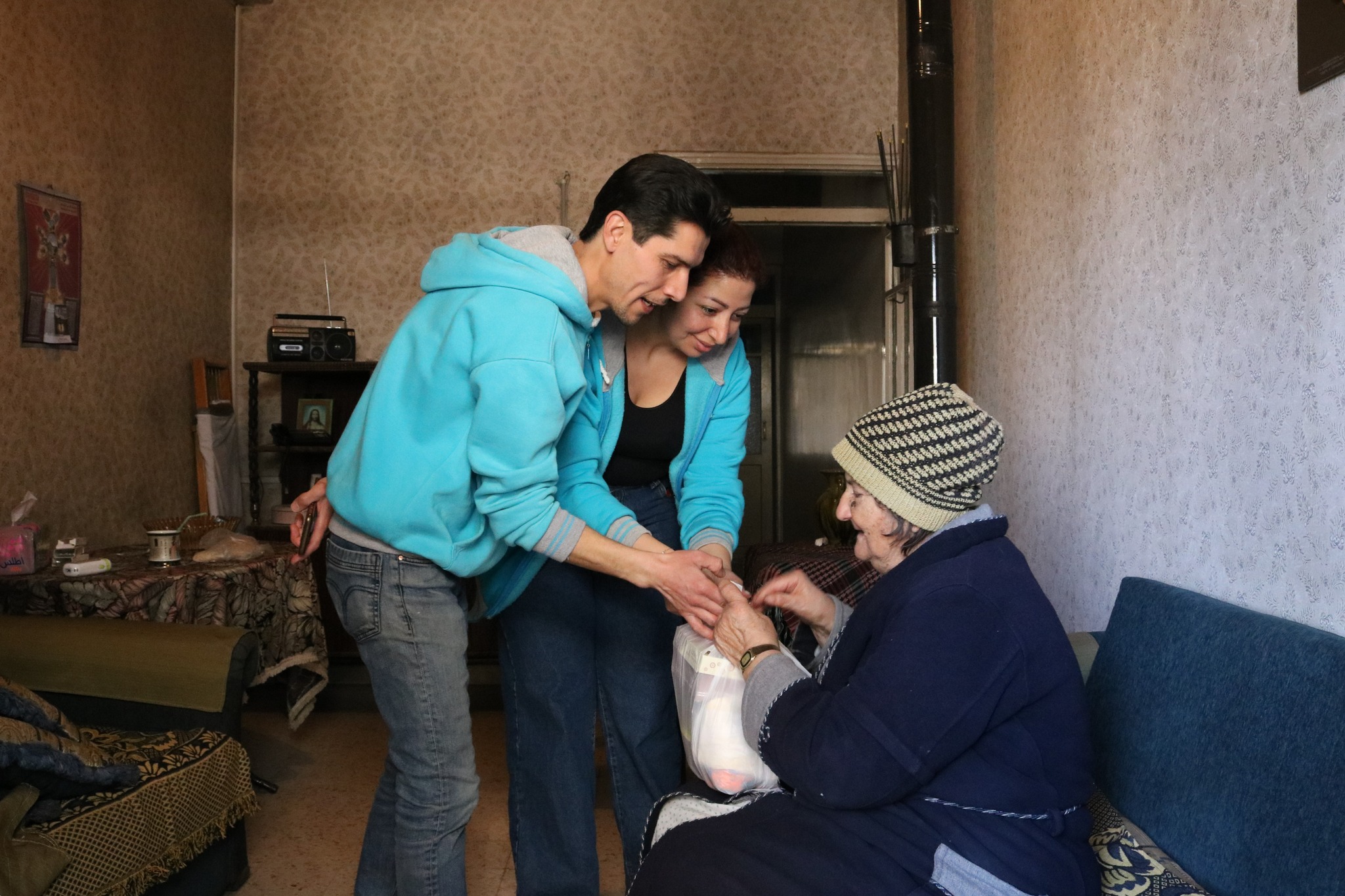
As for us, the Blue Marists, we respond to all these needs – and many others – through our 14 projects.
The Gospel indeed shows that this poverty touched every aspect of Christ’s life. From his entry into the world, Jesus experienced the difficulties associated with rejection. The evangelist Luke, recounting the arrival in Bethlehem of Joseph and Mary, who was about to give birth, observes with regret: ‘There was no room for them in the inn’ (Lk 2:7).
At the beginning of his public life, he is driven out of Nazareth after announcing in the synagogue that in him the year of grace that brings joy to the poor is fulfilled (cf. Lk 4:14-30). There is no welcoming place, not even for his death: they lead him outside Jerusalem to crucify him (cf. Mk 15:22). This is the condition that clearly characterizes the definition of the poor: they are the outcasts of society.
May the child of Bethlehem bless us and grant us his PEACE.

.png)
14/03/2025 14:24
13/03/2018 10:06
16/03/2023 14:07










