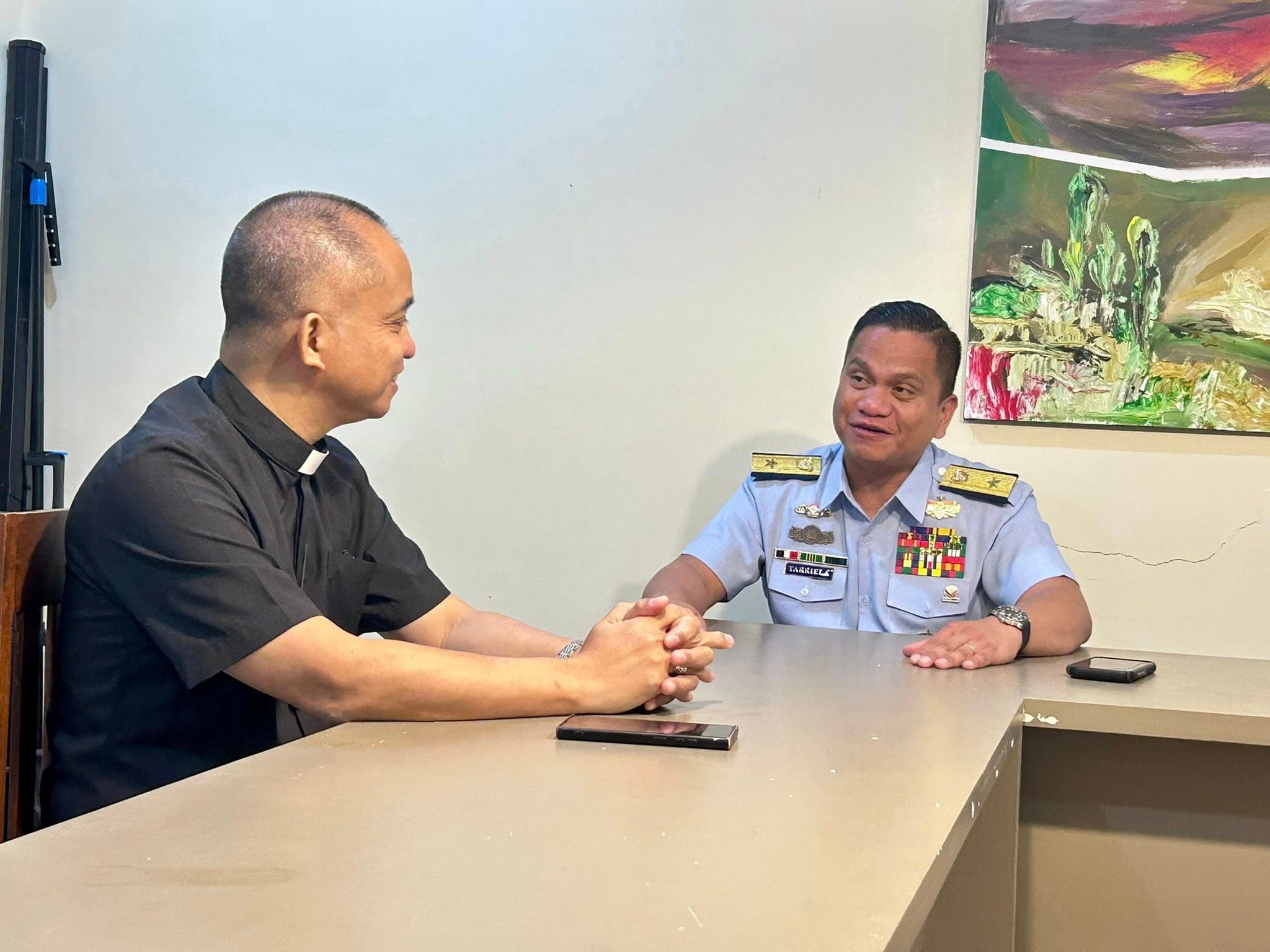
Manila (AsiaNews) – The Philippine Catholic Church plans to establish a pastoral presence on Pag-asa Island, part of the Spratly Islands, in the South China Sea, which are claimed by both China and the Philippines.
For the Church, this is more important than any territorial dispute. To this end yesterday, it held talks with the Philippine Coast Guard to discuss the feasibility of establishing a church on the small island, which is part of Kalayaan municipality.
Home to the only civilian outpost in the West Philippine Sea, the Philippine name for this part of the Asia-Pacific, the island has been in the middle of a long-running dispute between China and Southeast Asian nations over its control and the exploitation of its resources, like fishing and seabed natural gas.
Commodore Jay Tarriela, spokesman for the West Philippine Sea Command, and Bishop Socrates Calamba Mesiona, Apostolic Vicar of Puerto Princesa (Palawan Province) met to discuss the timing and methods of building the place of worship on Pag-asa.
The goal is to have initial preparations completed by the end of March, while the church, the prelate noted, could be, at least initially, a mission station and not a full-fledged parish.
In fact, for the Church, a mission station is typically established in places where a Catholic community exists but is not yet large or stable enough to be transformed into a parish. This designation would allow for regular pastoral care to be provided while also ensuring its long-term sustainability.
For Commodore Tarriela, the groundbreaking ceremony for the Pag-asa place of worship is expected to take place in late March, while the church's name and patron saint will be determined in coordination with Church authorities.
The senior navy officer dismissed concerns that the construction could provoke increased Chinese activity, noting that a foreign maritime presence around the island goes back a long way, regardless of developments on the ground.
Bishop Mesiona welcomed the initiative on behalf of the Church, offering prayers for peace, justice, and national dignity.
On Pag-asa, the small resident Catholic community includes civilians, members of the Philippine Armed Forces, Coast Guard personnel, maritime group soldiers, as well as police personnel.
This “would be a welcome development for them if the Catholic Church were really willing to construct a church and even send a Catholic priest there to lead the Masses every Sunday," Commodore Tarriela said.
The Philippines claims Pag-asa Island based on geographic proximity, effective occupation, and international law.
Recently Senator Risa Hontiveros participated in a Coast Guard maritime surveillance (MDA) flight over the Kalayaan island group.
Her team carried out a medical and dental mission for the more than 400 residents. They also distributed food and donated 47 desalination machines to troops stationed in Philippine-controlled areas, reiterating the country’s exclusive right to the territory, which it does not intend to give up.
“The Philippines is made up of thousands of beautiful islands, including Kalayaan,” the senator said. “This place is beautiful, just like other islands and natural resources in our country. We must protect and defend it with all that we’ve got,” she added.
For some time, the Philippines – but also other countries, like Vietnam – has expressed growing concern over Chinese "imperialism" in the South and East Seas.
China claims a huge portion of the South China Sea (nearly 85 per cent), including sovereignty over the Spratlys and Paracel Islands, which are also claimed by Vietnam, Taiwan, the Philippines, Brunei, and Malaysia.
The United States backs Southeast Asian countries, viewing China’s demarcation line, the so-called cow tongue line (also known as the nine-dash line) as illegal and irrational.
Yet, the ruling of the Permanent Court of Arbitration in The Hague in favour of the Philippines on 12 July 2016 was of no avail.
Ultimately, since up to a third of global maritime trade goes through this sea, whose seabed is rich in oil and natural gas, anyone who controls it has a strategic advantage.