

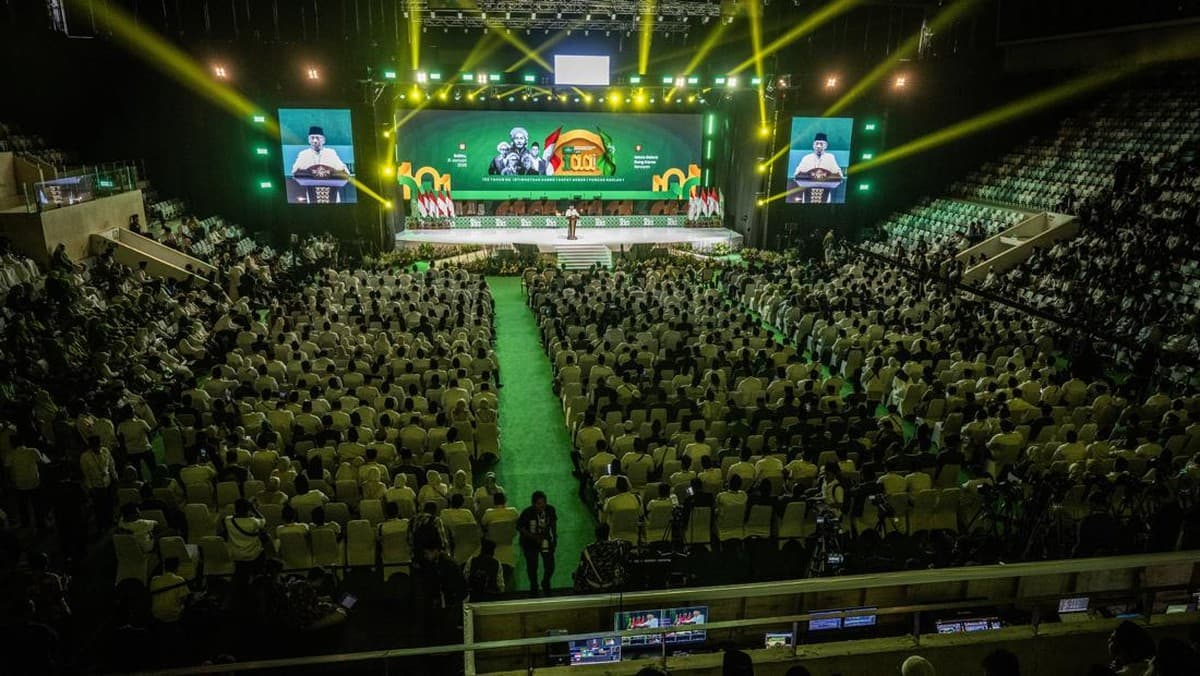
Jakarta (AsiaNews) – On 31 January, the Nahdlatul Ulama (NU), Indonesia's largest and most moderate Islamic organisation with at least 100 million members, marked its centenary. Over this period, it has dedicated itself to dialogue, interfaith exchange, the fight against extremism, and an open society ready to oppose every form of fundamentalism, expressing the country’s version of the Muslim faith.
Founded on Rajab 16, 1344 (31 January 1926 in the Gregorian calendar) in Surabaya, the provincial capital of East Java, the group has come a long way, becoming the largest Islamic organisation in the country.
After commemorating 100 years according to the Hijri calendar in 2023, this further milestone represents a moment of reflection and recommitment to ukhuwah (brotherhood), independence, and the well-being of both the Muslim community and the nation.
One hundred years is no small span for a religious organisation with millions of followers in a country of over 286 million people.
The NU's resilience is sustained not only by its organisational structure, but also by its spiritual ties, the tradition of pesantren (Islamic boarding schools), and the moral authority of its scholars.
Since it was founded by Hadratussyekh KH M. Hasyim Asy'ari and his fellow ulama, it has safeguarded tradition in an ever-changing social and political context.
The theme of the Gregorian centenary, "Safeguarding Indonesia's Independence, Towards a Noble Civilisation," carries two main mandates.
The first is historical. The NU played a vital role in the struggle for the Republic and its consolidation, as reflected in the Jihad Resolution of 1945.
The second is civilisational. The NU must not only protect formal independence, but also contribute to the nation's moral quality, social justice, and public ethics.
Safeguarding independence today means addressing new challenges: economic inequality, a crisis in public ethics, a weakening of substantive justice, and declining trust in state institutions.
In this context, the Nahdlatul Ulama is called upon to remain a moral force, capable of working in synergy with the state while maintaining a critical distance whenever power deviates from the principles of public welfare.
However, its second century also presents the challenges of digital transformation.
The fragmentation of religious authority means that the ulama are no longer the sole point of reference for religious knowledge. Social media have produced instant figures often detached from academic discipline and ethical chains of transmission.
Therefore, the NU's task is not only to be present in the digital sphere, but also to ensure that humility (tawadhu'), ethical dissent (adab al-ikhtilaf), and intellectual depth remain the foundation of religious life, especially for the younger generations.
Furthermore, issues related to economic independence, including involvement in natural resource management, pose an ethical challenge.
While organisational self-sufficiency is important, every economic step must remain within the framework of social responsibility and ecological justice.
The culmination of the centenary commemoration was held at the Gajayana Stadium in Malang on Sunday, in the presence of hundreds of thousands of Nahdliyin and Indonesian President Prabowo Subianto.
The head of NU East Java, KH Abdul Hakim Mahfudz, stressed that national and organisational life must be built and founded on compassion and brotherhood.
The participation of various groups, including members of the Muhammadiyah and local Church communities, symbolised the spirit of harmony that has long characterised NU's mission. The centenary is not just a celebration of age, but a moral promise.
This is why the second century will be the true test: whether it can remain faithful to its fundamental commitment to culture and nationhood, guide consciences, and present religion as the source of a peaceful and noble civilisation, not just a mere symbol of social power.














