








Exams in China and a generation’s struggle for survival
June in China is the month of the Gaokao (the university entrance exam) and the Zhongkao (the secondary school entrance exam), with the usual mobilisation of families anxious about their children’s future. But the structural limitations of China’s current economic system, with 320 million ‘flexible’ workers, are turning yesterday’s dreams into a mere struggle for survival.
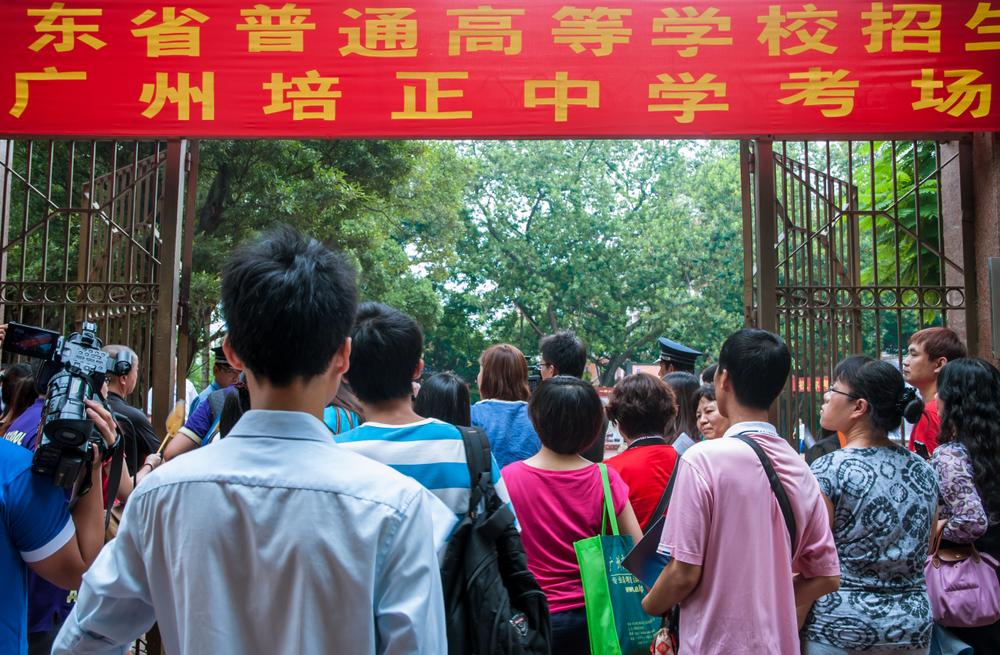
Beijing (AsiaNews) - June is ‘exam month’ for countless Chinese families. At the start of the month, the Gaokao (the national university entrance exam) had just concluded, and immediately afterwards, in the second half of the month, came the Zhongkao (the secondary school entrance exam).
According to statistics, in 2026 the number of secondary school pupils who sat the Gaokao reached 12.9 million, whilst the number of junior high school pupils registered to sit the Zhongkao was close to 17.5 million. Both the Zhongkao and the Gaokao continue to be regarded, in the traditional view, as decisive moments in which ‘a single exam determines one’s entire life’. Not only do the students give their all, but parents also throw themselves into all manner of ritual practices and ‘counselling’ both before and after the exams.
The families of candidates wish to mobilise all their resources to support their children. They continue to weigh up career prospects – which are difficult to distinguish between genuine and false – and the harsh choices imposed by the ‘Zhongkao system’; they calculate scores, estimate results and meticulously plan every step.
However, today, in a context where there is widespread talk of ‘new high-quality productive forces’ and ‘artificial intelligence’, whilst academic qualifications are rapidly becoming devalued and office jobs are dwindling drastically, everyone is well aware of one thing: university no longer holds the value it once did.
This mobilisation of the whole family no longer serves merely to ‘secure a bright future’; it increasingly resembles an attempt to help children avoid, in advance, the risks posed by a situation where ‘a degree goes hand in hand with unemployment’.
The Gaokao of yesterday and today
Looking back at history, since the Gaokao was reinstated in 1977, countless people have changed the course of their lives through this exam.
For a long time, success in this competition – in which ‘thousands of soldiers and ten thousand horses cross a single log bridge’ – was tantamount to securing an ‘iron rice bowl’ (i.e. a secure job for life): free education, guaranteed accommodation, monthly allowances provided by the state and, upon graduation, direct placement in a state body or public enterprise.
Whilst the reinstatement of the Gaokao at that time was linked to the need to rebuild a devastated country and the urgent demand for talent, in the early 1990s, with the transition of the Chinese economy towards a market-based system, higher education also underwent a transformation:
From the pilot introduction of scholarships and student loans in the early 1990s, through the gradual implementation of the principle of ‘autonomous choice of employment and mutual selection’, to the full introduction of university tuition fees in 1997 and the definitive abolition of state-assigned jobs. This was followed by university mergers and a massive expansion in enrolment: higher education gradually moved towards ‘industrialisation’, with the continuous emergence of giant universities. But the industrialisation of education cannot create employment opportunities for everyone out of thin air.
With the slowdown in economic growth and the structural contraction in demand in recent years, universities have, to a certain extent, become reservoirs that delay students’ entry into the labour market. The pathway through which education once enabled a change in social class is narrowing ever further: ‘a degree equals unemployment’ has gone from being a concern to a cruel and harsh reality.
Fierce competition and 320 million ‘flexible’ workers
Geopolitical tensions, the withdrawal and reallocation of foreign capital, as well as the collapse or downsizing of certain private enterprises, have further exacerbated structural employment pressures. Nationwide, the workforce engaged in so-called ‘new forms of employment’ (so-called ‘flexible work’: self-produced media bloggers, freelancers, ride-hailing platform drivers, home delivery couriers, part-time workers…) has reached 320 million people, accounting for over 20 per cent of the total population. It has therefore now become the main outlet for youth employment.
Data from the spring 2026 recruitment season show an extreme imbalance between supply and demand: 12.7 million university graduates compared with just 5.67 million positions actually available through recruitment campaigns for recent graduates. The cost of job-hunting has also risen dramatically: a recent graduate must send out, on average, between 150 and 200 CVs to secure perhaps just a single interview opportunity.
Competition for positions at the top of the pyramid has descended into an extreme form of cut-throat competition. For many sought-after roles (such as positions at the headquarters of state-owned enterprises or major internet giants), the ratio of applicants to successful candidates has even exceeded 1,000 to 1.
This fierce competition has even spread to entry-level positions. Recently, a standard administrative post in a rural municipality in northern China attracted as many as 8,908 applicants.
Faced with such slim chances of success, the prestigious aura of the university student – once regarded as the ‘favourite son of heaven’ – has been completely shattered.
From free choice to passive defence
In this context, the evolution of the term “tangping” (lying low) precisely reflects the shift in the collective mindset of young people: from autonomous choice to passive defence. Initially, “tangping” represented a free deconstruction of the traditional way of life by young people.
In April 2021, a young man using the online pseudonym ‘The Gentle Traveller’ published a blog post on social media entitled Tangping Means Justice. He recounted having lived for over two years without working, spending just 200 yuan a month and travelling twice a year. He declared: ‘Tangping is my movement of the wise. A reflective life need not conform to society’s expectations; people need not seek artificial excitement for a meaningless existence.”
This short text immediately struck a chord with the collective sense of powerlessness and disillusionment felt by ordinary people in the face of the pressures of survival and the solidification of social classes. ‘Tangping’ quickly replaced the previous term ‘Buddhist style’ (foxi), becoming a national catchphrase.
Whilst the original tangping still retained a certain idealistic and voluntary flavour – expressed in the deconstruction of the injustices of social norms and resistance to the labour regression of the ‘996’ model (six days’ work a week, twelve hours a day from 9 am to 9 pm – ed.) – it subsequently gradually transformed into a passive defence mechanism against grand narratives and societal pressure.
In May 2022, a video went viral across the internet: some workers in protective suits (‘the big white ones’) warned a young couple that, if they did not cooperate with the anti-pandemic measures, this ‘would affect three generations of your family’. The man replied calmly and politely: ‘We are the last generation. Thank you.” This categorical response became the metaphor of an era.
In the years following the pandemic, phenomena such as choosing not to marry, not having children, not working and passively relying on one’s parents became increasingly common. The collapse in the birth rate and the number of marriages represents precisely the concrete manifestation of this silent protest.
Channelling rather than genuine education
Faced with this collective passive resistance, the tone of public discourse has also begun to shift. In late April 2026, the Ministry of State Security published an article attempting to define ‘tangping’ as the result of interference and infiltration by Western forces.
According to this interpretation, foreign forces hostile to China, by funding tangping influencers and deliberately amplifying social anxiety, are instilling in young Chinese people the negative idea that ‘making an effort is pointless’ and that ‘those who struggle lose out’, in an attempt to destroy their faith in the spirit of sacrifice and struggle. Propaganda departments have also promoted public opinion campaigns in an attempt to revive the dominant values of socialism.
However, when the ratio of applicants to successful candidates for a single post reaches nearly nine thousand to one, and when 320 million people can only find a livelihood through ‘new forms of employment’, this sort of grandiose, slogan-driven rhetoric is clearly incapable of untangling the intractable dilemma faced by the younger generation, caught between the burden of survival and a sense of existential emptiness.
The Zhongkao and the Gaokao are the guiding principles of the education system and also obstacles that those who practise ‘tangping’ today have themselves overcome in the past. Faced with such a harsh employment reality, what role has the Chinese education system actually played?
In recent years, numerous highly discerning individuals have engaged in profound reflection on this issue. Professor Lin Xiaoying, of the Faculty of Education at Peking University, states very clearly in her book *The Children of County Schools: The Educational Ecosystem of Chinese Counties*: ‘The fundamental function of the education system today is channelling; but the most essential function of education is to shape human beings. If an education system retains only the function of channelling, then it becomes a selection machine.”
Unfortunately, the current education system has never regarded ‘becoming better people’ as its objective. It merely eliminates and selects in an efficient and ruthless manner. To escape the merciless crush of this education system, more and more middle-class families are choosing to send their children to study abroad. And most of the young people who remain – those who cannot escape county schools – continue to give their all in the frenzied rush of June.
Outside the exam halls, parents continue to support their children with every possible ‘metaphysical’ practice; whilst inside the halls, those young people on whom enormous expectations are placed may already have built, in their hearts, defensive mechanisms ready at any moment to allow them to ‘exit the stage’ and ‘lie down’.

.png)










