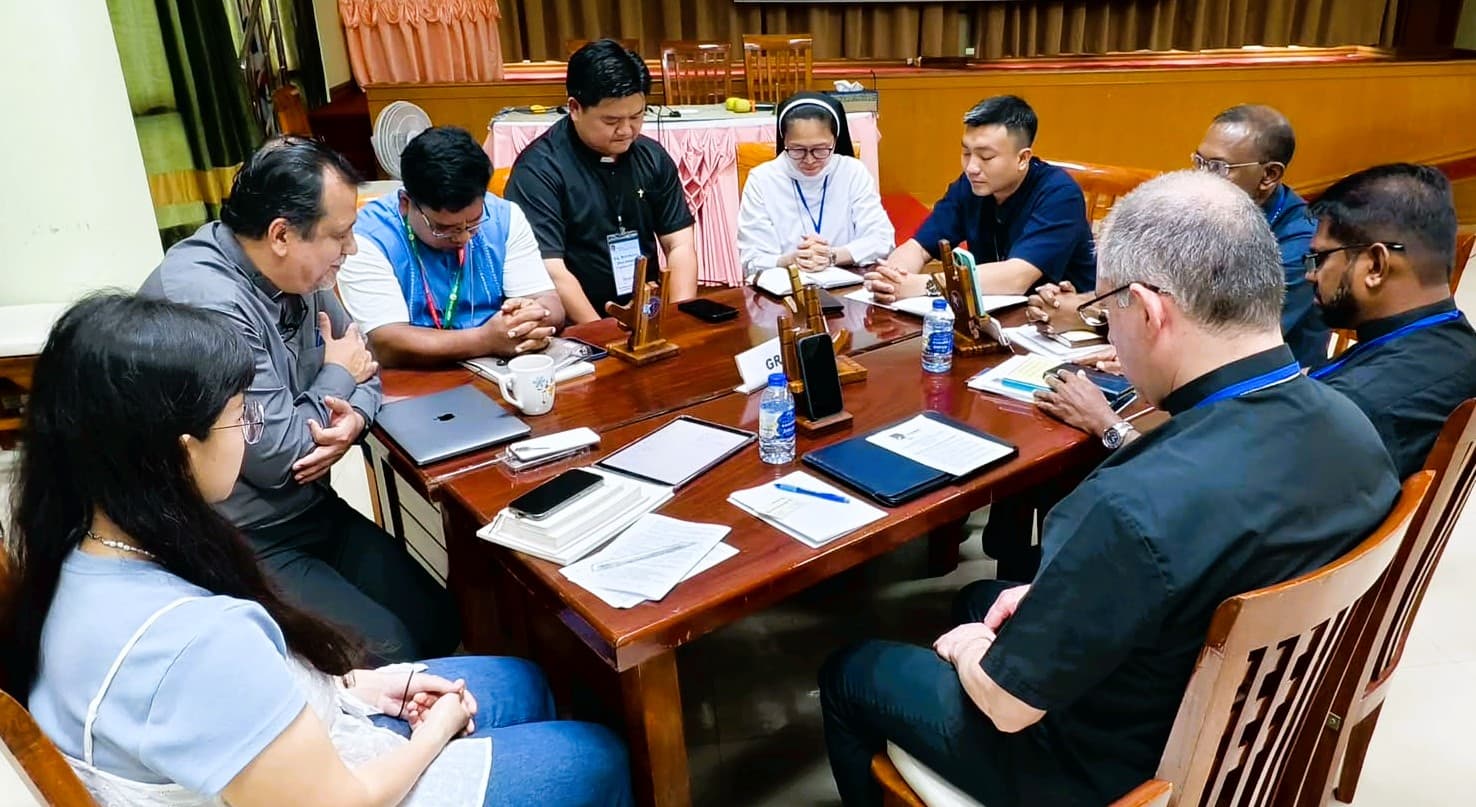
Bangkok (AsiaNews) - Church leaders, priests and lay representatives from across Asia gathered in Thailand for a five-day synodal assembly to reflect on the vocation and future of Christian families in a rapidly changing continent. Held from 11 to 15 May at the Camillian Pastoral Centre in Bangkok, the meeting was organised by the Federation of Asian Bishops’ Conferences (FABC) through its Office for the Laity and the Family (OLF) on the theme “The mission and future prospects of the Christian family in Asia today”.
The assembly was attended by 52 people from 11 countries: Bangladesh, India, Sri Lanka, Vietnam, Malaysia, South Korea, the Philippines, Taiwan, Japan, Indonesia and Thailand. Among them were two cardinals, nine bishops, priests, nuns, youth representatives and lay faithful. The meeting aimed to discern the role of Christian families in Asia today, listening to the guidance of the Holy Spirit. The participants exchanged experiences on family ministry in their respective countries, examining the achievements made, as well as the difficulties and future strategies.
In his opening address, Bishop Emmanuel K. Rozario of Barishal, president of the FABC Office for the Laity and the Family, described the office as one of the largest within the Federation, working closely with young people, women and Basic Ecclesial Communities (BECs). He emphasised the importance of a synodal and participatory Church that upholds dignity. “Young people are not only the future of the Church, but its vibrant present,” he said. Stressing the need to view families as “homes of the Word of God”, he encouraged deep spiritual listening and discernment through “conversation in the Spirit”, adding that this is a fundamental characteristic of the synodal process.
The assembly’s programme included daily Eucharistic celebrations presided over by leading figures of the Church in Asia: Cardinal Tarcisius Isao Kikuchi from Japan, Cardinal Pablo Virgilio S. Davide from the Philippines, and Archbishop Francis Xavier Vira Arpondratana from Thailand. A central session of the meeting focused on pastoral reflections on Familiaris consortio (1981) and Pope Francis’s apostolic exhortation Amoris laetitia (2016). These sessions were led by Fr Vimal Tirimanna, who emphasised the need for inclusive pastoral approaches within the multi-religious context of the Asian continent. Tirimanna, a Redemptorist, urged Church leaders not to marginalise interfaith families, but to recognise them as “bridges of harmony” capable of fostering dialogue and coexistence. Drawing inspiration from Pope Francis’ vision, he described them as “basic human communities” that embody the Church’s commitment in multicultural societies.
Cardinal Pablo Virgilio David delivered a powerful message on evangelisation, stating that the future of the Church in Asia depends less on institutional programmes and more on faith lived out within the family. “The future of evangelisation in Asia depends far more on the regular reading of the Word of God and prayer within the family than on any grand institutional programme,” he said. He outlined the three stages of the Church’s synodal journey: listening to the faithful, discernment by the bishops, and putting it into practice. He noted that the Church has now entered a crucial phase requiring concrete changes.
The assembly concluded with the drafting of a roadmap in line with the Bangkok Document, released in 2023, aimed at strengthening family ministry across Asia. Through group discussions and shared reflections, participants identified priorities for collaboration between ecclesial bodies, particularly in promoting the participation of women, young people and communities. An evaluation tool was introduced to assess how the teachings of Amoris laetitia are being put into practice at the diocesan level. This includes exploring “catechumenal journeys” for married life and deepening collaboration between commissions serving families, young people, women and the elderly.
Speaking to AsiaNews, Fr Bikash James Rebeiro, executive secretary and national youth coordinator for Bangladesh, said the assembly had been a valuable learning experience. “This Synodal Assembly has taught me a great deal and will help me guide young people in understanding synodality,” he said. “The meeting was very fruitful for us.” The Bangkok meeting marks another step in the ongoing synodal journey of the Asian Church, emphasising listening, dialogue and shared responsibility in strengthening Christian families as the foundation of faith and society.