








Father Faltas: In Christian schools, healing the human and social wounds from the Gaza war
The clergyman talked to AsiaNews about the challenges and issues facing schools in the Holy Land, starting with young people who “have lost their smiles” and “their confidence”. Talking and listening help defuse the desire for revenge and attacks. The dispute with Israel over teachers' permits has been almost resolved. Being a teacher is a “vocation”. Meanwhile, Christians continue to leave.
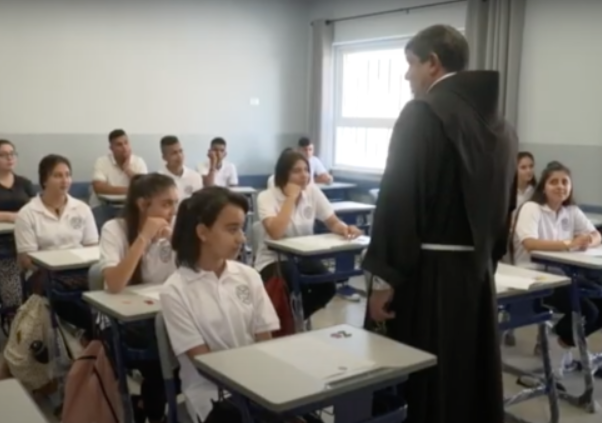
Milan (AsiaNews) – Teachers and students at schools run by the Custody of the Holy Land, important centres of excellence, face huge hurdles and difficulties at present, this according to Father Ibrahim Faltas, Franciscan friar and director of the Custody’s schools.
The picture the clergyman draws from the reality on the ground is one of enduring suffering fed by, among other things, Israel’s restrictions on teachers’ permits; the enduring trauma cause by the war that broke out on 7 October 2023, which has claimed hundreds of lives despite a fragile truce, more theoretical than real; and the makeshift classes in Gaza where schools, like most other buildings, have been razed to the ground.
The war “has inflicted severe trauma that is still visible today in all its potency,” the clergyman explained. Students “have lost their smile, they have lost their confidence, they have lost everything, and they have changed. They are no longer the same kids they were before."
“Students often ask questions, and it's hard to answer them. Like a 10-year-old girl who asks, ‘Where is God in all this?’ It's normal for hatred to grow, which we ourselves must try to defuse,” Fr Ibrahim said.
“Some have told us that they wanted to carry out attacks, but we responded with talking and listening. We spoke with them” to prevent acts of violence or revenge.
“This too is rubble, human and social wounds left by the war. It will still be difficult to rebuild, much more so than the walls of a building. It's a huge challenge, especially for the new generations.”
Father Ibrahim, a Franciscan born in Egypt, graduated in philosophy and theology. He served as parish priest in Jerusalem, and is responsible for the Status Quo of the Basilica of the Nativity.
From 2016 to 2022, he was a member of the discretorium of the Custody, then vicar and director of schools, advisor to the Custody, director of the Casa Nova in Jerusalem, and a member of the John Paul II Foundation.
"The children," he said, "still remember when the war began. It was the start of the school year, and while we were reciting the prayer of Saint Francis, we saw a missile pass by. At first, no one understood anything, then I got the students to safety, and their parents came to pick them up.
“We went 15 days without classes, and when they returned, they had changed. Five- and six-year-old children asked to call home every half hour, to make sure their parents were alive and that they wouldn't be orphaned like their peers in Gaza.”
“Others," he added, "didn't want to eat anymore, out of solidarity with their brothers and sisters in the Strip. We had enormous problems."
For the Franciscan, “Being a teacher in the Holy Land is a mission, a vocation in a historic institution. Christian schools are the oldest not only in this area, but in the entire Middle East, because the Franciscan school in Bethlehem, dating back to 1598, is the first in the entire region.”
Without this institution, which has grown, setting up facilities in Jerusalem, Gaza, the Galilee, Haifa, Nazareth, and Jaffa, as well as Beit Jala and Ramallah, “it is not possible to continue the educational process.”
Christian schools are high quality institutions, not only for their level of education, but also for the model of coexistence and sharing they have always represented.
“We have a music school," the priest explained, "that welcomes Christians, Jews, and Muslims. The other schools are attended by both Christians and Muslims, with the latter the vast majority.”
“We always try to keep them to teach coexistence," despite challenges, not least the ongoing exodus of Christians. “At least 185 Christian families fled the Bethlehem area alone, a wound that keeps bleeding.”
Recently, after the Christmas break, at least 12 Christian schools in Jerusalem went on strike in January after Israel did not renew the work permits of at least 171 teachers from the West Bank for entry during weekends.
The decision has affected more than 10,000 students from schools considered among the best in the Holy City. As a result, the latter decided to halt classes in solidarity with the teachers who, at least on some days, were turned back at checkpoints (over a thousand, according to Father Ibrahim).
The permits are temporary authorisations issued by the Jewish state to allow Palestinians from the West Bank to enter Israel and carry out regular work. They are subject to security checks, are limited in time, and are tied to the employer or working hours.
The vast majority were revoked after 7 October in response to Hamas’s attack that triggered the war in Gaza, with the sole exception of those issued to teachers and healthcare workers.
"The situation is being resolved,” Father Ibrahim explained. “At the start of the second semester, 335 teachers were affected by the measure, preventing them from travelling on Saturdays when we have classes. Later, they were blocked from travelling on Fridays and Sundays, and we protested this too. Now, almost 90 per cent of teachers can travel all week, without restrictions.
"The problem is almost settled, even if the rationale behind the measure is unclear. We spoke with the Ministry of Education and the military, but no one was able, or willing, to provide an explanation. However, critical issues and burdens remain because some teachers in our schools in Jerusalem come from Hebron and get up at 4 am to arrive at eight for the start of classes.”
Father Ibrahim also spoke about education in Gaza, specifically at the Holy Family Latin parish, which bid farewell yesterday to Father Youssef Asad, who served as assistant parish priest for eight years, experiencing firsthand the atrocities of war when, during long months the parish priest, Father Gabriel Romanelli, was unable to return due to the blockade imposed by the Israeli authorities.
In Gaza, "everything is destroyed," but the parish is doing what it can to hold some classes, but the buildings have collapsed. “One example is Rosary School, an excellent facility that no longer exists, along with many others.”
“We are trying to do something, but the situation is inhumane; people, especially the youngest, are dying of cold… it's tragic, terrible.
“Everything is still on hold, aid isn't enough even if some is coming in, and people continue to die. In 110 days of truce, more than 500 people have been killed by hunger, bombardments, cold, and thirst. For three years, there has been no schooling in Gaza, but education is just one of many emergencies.”

.png)
16/05/2022 19:00
21/02/2006
02/11/2021 16:14










