








Fuel crisis and expats killed: The war on Iran also affects Dhaka
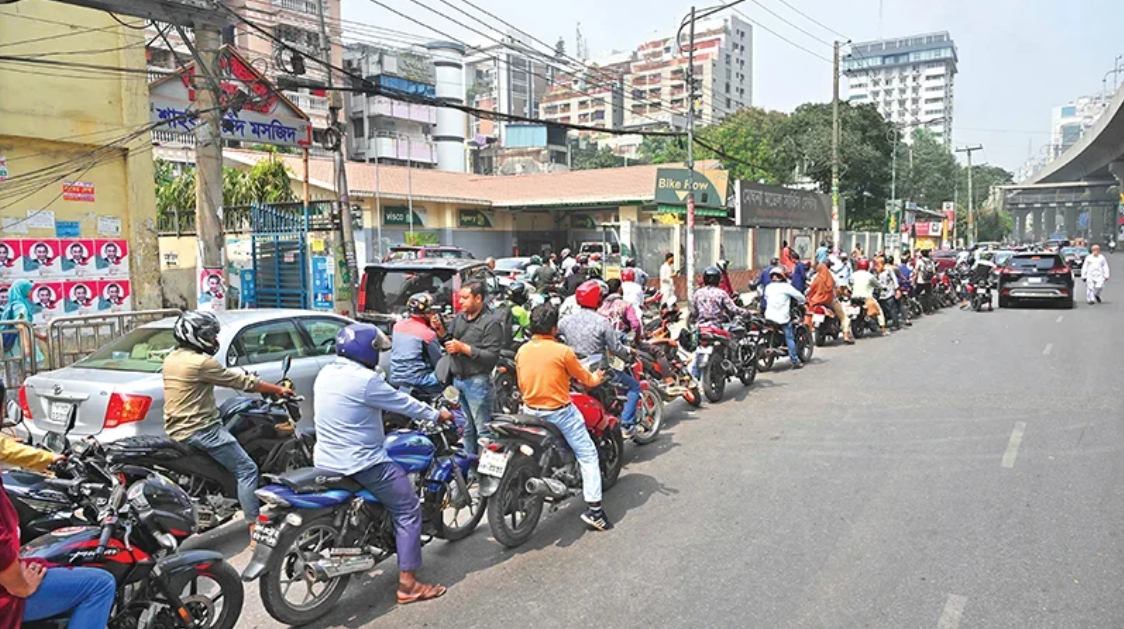
Yesterday, long queues of vehicles formed at petrol stations; the panicked population fears that stocks will run out and prices will escalate. Arguments and tensions among motorists in the queues. Power cuts also reported by large industrial groups. In Saudi Arabia, another Bangladeshi migrant worker killed by an Iranian missile strike on a residential complex.
Dhaka (AsiaNews) - The war in the Gulf is already having a serious economic impact on Bangladesh, while another migrant worker has died in the last few hours following an Iranian missile strike on a residential building in Saudi Arabia.
In addition to his compatriot, the third since the start of the conflict after those in Bahrain and the Emirates in the early days, an Indian man also died and 12 other people were injured. Returning to the domestic front, long queues of vehicles formed yesterday at the main petrol stations in Dhaka, with the population in a state of panic and uncertainty, wanting to stock up in fear of an escalation of the military crisis triggered by the Israeli and US attack on Iran.
Many stations in the capital ran out of fuel in the morning, forcing hundreds of motorists to wait for hours until new supplies arrived in the afternoon. Similar scenes were reported outside Dhaka, where arguments and tensions broke out among customers frustrated by the inability to refuel.
Large industrial groups also reported disruptions, saying they were receiving far less than they needed from depots to keep production and transport running. Factories without gas connections are entirely dependent on boilers and generators, and industry leaders warn that the shortage is already slowing production.
The tension stems from the fact that the Bangladesh Petroleum Corporation (BPC) has reduced fuel allocations to petrol stations by about 25% compared to the same period last year. Government officials insist that national reserves are adequate, but say that supplies are being limited to manage costs during an unstable global situation, exacerbated by regional conflict.
Officials acknowledge, however, that widespread panic leading to compulsive buying, fuelled in part by rumours circulating in traditional and social media, is putting additional pressure on the system.
In response, the BPC has asked the government to deploy the army to protect major fuel depots across the country. In two letters signed by Chairman Rezanur Rahman, the company warned that sudden spikes in demand have prevented retailers from replenishing fuel supplies from several depots, increasing the risk of ‘undesirable situations’ at strategically important facilities from the Patenga area in Chittagong to the Barisal depots.
The company classified these sites as critical national infrastructure and requested the immediate deployment of the army, along with a police reinforcement at petrol stations to prevent unrest.
Amid this climate of uncertainty, yesterday the Foreign Ministry formalised the recall of five senior diplomats around the world. Four ambassadors appointed on a contractual basis during the interim government, posted to Portugal, Poland, Mexico and the Maldives, have been ordered to return to Dhaka. The High Commissioner to the United Kingdom, Abida Islam, has also been reassigned to headquarters. The ministry has ordered all five to report immediately.
At the same time, the government says it is closely monitoring the safety of Bangladeshi expatriates in the conflict-affected regions. Minister of Labour, Employment and Overseas Employment Ariful Haque Chowdhury said Dhaka is in constant communication with expatriate communities and is preparing contingency plans in case evacuation is necessary. Speaking yesterday in Moulvibazar, the minister said a high-level committee comprising officials from the Foreign Ministry, the Expatriate Welfare Ministry and civil aviation authorities has been formed to monitor developments and coordinate any repatriations.
The minister confirmed that the government is assisting the families of two migrant workers who recently died abroad, one in Barolekhar and the other in Sylhet. Efforts are underway to repatriate their bodies once authorisation has been obtained from the local authorities. He also warned that many compatriots abroad have already lost their jobs, as offices and courts in some conflict-affected countries remain closed. The government, he said, is working to ensure food and essential support while the situation remains uncertain.
Despite preparations for possible evacuations, the minister noted that air routes to the affected regions are currently closed, making immediate repatriation impossible. Further decisions will be made depending on how the situation evolves. He finally addressed concerns ahead of Eid, the festival marking the end of Ramadan, saying that six monitoring teams led by joint secretaries had been tasked with ensuring that factory workers receive their salaries and bonuses on time.

.png)










