





-65093.html&is_video=&description=Galgamuwa%3A+an+%E2%80%98underpass%E2%80%99+to+protect+elephants+%28and+people%29)


Galgamuwa: an ‘underpass’ to protect elephants (and people)
A long-awaited solution to avert the long-standing human-elephant conflict (HEC). In the area, over 300 people have died and dozens have been left disabled in incidents involving the elephants. For local residents, it is a ‘key project’ that should have been completed ‘decades ago’. Experts say at least a year of monitoring is needed to assess its effectiveness.
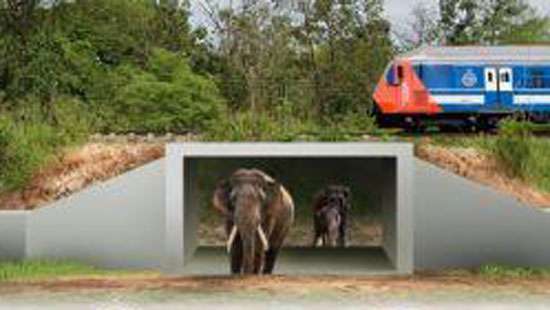
Colombo (AsiaNews) - A solution to the long-standing conflict between humans and elephants (HEC) that has been ongoing for some time in Sri Lanka. This is how experts and environmentalists describe the new wildlife “underpass” in Galgamuwa, in the North Western Province, which is due to be completed by the end of the month. Galgamuwa is part of the “Mahaweli Development Project”, the largest and most multifaceted in the entire country.
Currently, construction of the elephant underpass is nearing completion beneath the Kasikote railway line, between Galgamuwa and Ambanpola, an area well known for frequent elephant crossings. The project involves the construction of a tunnel beneath the railway tracks to allow wild elephants to move safely, thereby reducing the risk of railway accidents and curbing the conflict between humans and animals.
In 1977, when the Mahaweli Accelerated Development Programme was launched, vast tracts of forest land were cleared to facilitate new settlements. This led to the elephants losing their habitats. According to the engineers, the construction work ‘is expected to be completed in March 2026’, with a slight delay compared to the original forecast of ‘early in the month’, due to the need to monitor ‘elephant movements towards the villages’. During the rainy season, the slope – experts explain in a statement – which had already been excavated, was full of water. Therefore, these issues had to be addressed before its completion”.
When interviewed by AsiaNews, J.K. Ratnayaka and Siyadoris Menikrala, residents of Galgamuwa, emphasise that “this is a key project that should have been completed several decades ago, as over 300 people have died in the area due to the HEC”. To these, they continue, must be added “over 50 people left disabled” in incidents linked to clashes with elephants in search of food. “For many years, we have spent sleepless nights fearing the elephants that roam the villages at night. One or two officers from the Department of Wildlife Conservation (DWC) – they conclude – cannot manage multiple elephants at the same time.”
Environmentalists Ramesha Attanayaka and Manuth Alwis explain that “due to new settlements, there is a lack of food along the elephants’ migration routes. To avoid encounters with the animals, most villagers have erected electric fences, which are useless as the elephants cross the fences by felling large trees onto them”. In 1989, the authorities declared the Kahalla-Pallekele sanctuary a national park, an area extending as far as Kala Wewa and Balalu Wewa. Yet, despite this measure, “illegal land grabbing and human activities have disrupted the migration routes that elephants have used for many years”.
Subsequent governments have dug trenches, thinking they would deter elephants from heading towards villages, but this measure too “has not been successful. Elephants now destroy electric fences because of a lack of maintenance. When fodder is scarce, they go into people’s yards – environmentalists point out – in search of vegetables and fruit grown in domestic gardens”.
In some areas of the Galagamuwa community, seasonal fences have been erected along the rice fields to prevent clashes between humans and animals. These measures have met with some success because there is a direct incentive for farmers to maintain and monitor the fencing, as their crops are at risk of being raided by elephants.
In 2024, around 300 seasonal rice paddy fences were erected by farmers’ organisations and supported by the Department of Agricultural Development, which contributed significantly to the reduction in incidents. In fact, the number of elephant deaths fell from 488 in 2023 to 386 in 2024, partly because people kill elephants mainly when they raid their crops, whether these are vegetables in home gardens or rice fields.
Researchers believe that, although the project will be completed by the end of the month, it ‘must be monitored constantly for a period of at least one year’ to determine whether the elephants become accustomed to using the underpass, a development that may ‘not happen immediately’.

.png)
07/02/2019 17:28
11/08/2017 20:05










