








In Malabo, Pope Leo XIV calls for courage ‘to pursue countercurrent politics'
Leo XIV told Equatoguinean authorities to “dismantle the obstacles to integral human development.” Citing Pope Francis a year after his death, he reiterated the Church’s opposition to “an economy of exclusion and inequality.” God “must never be invoked to justify choices and actions of death.” In a letter to the pontiff, Equatorial Guinea’s exiled political opposition laments that, "The country has been captured by the president’s family."
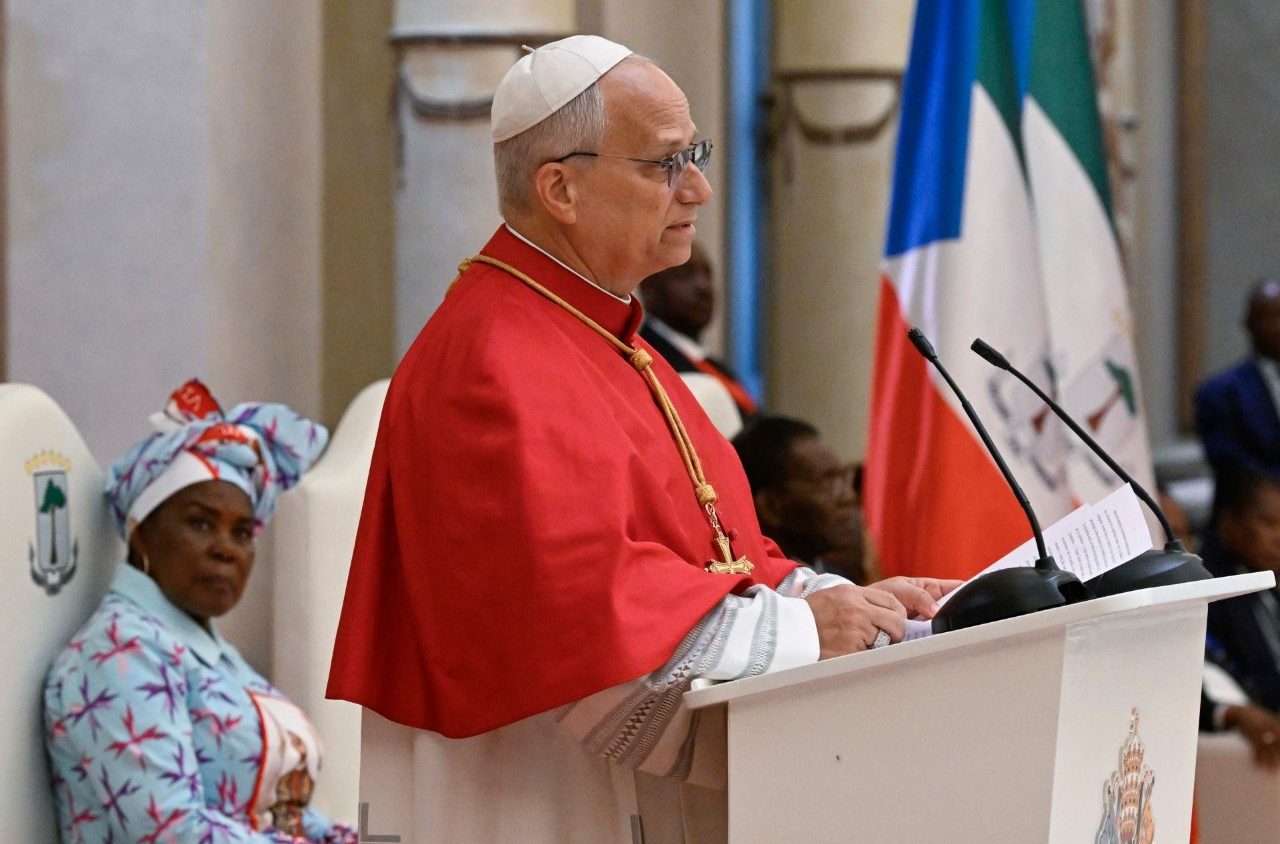
Malabo (AsiaNews) – Leo XIV delivered his first speech in Equatorial Guinea on the last leg (21-23 April) of his apostolic journey to Africa. Speaking in Malabo, the former capital, the pontiff addressed the authorities, in the colonial-era Presidential Palace. “Mr President, ladies and gentlemen, let us walk together, with wisdom and hope, towards the city of God, which is the city of peace,” he said.
In his speech, Leo mentioned the "proliferation" of armed conflicts and the use of technologies "primarily for warlike purposes”, warning that “the destiny of humanity risks being tragically compromised”. And “God does not want this.”
Leo said that he hopes the name of the new capital, Ciudad de la Paz, which replaced Malabo in January 2026, will “prompt every person to ask themselves which city they wish to serve”.
This is a reference from his address at the start of the year to the Diplomatic Corps accredited to the Holy See, in which he noted the distinction Saint Augustine made between the earthly city, centred "on proud love of self (amor sui), on the lust for power," and the heavenly city, the "true homeland" of men and women on Earth, to be looked upon with "the ancient realization of living on earth as a pilgrim."
For Leo, “It is essential to discern the difference between that which lasts and that which passes, remaining free from the pursuit of unjust wealth and the illusion of dominion,” remarks heavy with meaning when said standing next to Equatoguinean President Teodoro Obiang Nguema Mbasogo, in power since 1979.
Pope Leo XIV cited Pope John Paul II who visited the central African country in 1982. At the time, the Polish pope said that the president was “the symbolic center to which the living aspirations of a people converge for the establishment of a social climate of authentic liberty, justice, respect and promotion of the rights of every person or group”.
On the occasion of Leo’s visit to the country, the Central Committee of the National Alliance for the Restoration of Democracy (ANDR), an exiled Equatoguinean political opposition group, released a letter to the pontiff, highlighting the total control the Mbasogo clan exercises over the entire country.
The ANDR writes that the country is "under the control of the presidential family". The death penalty has been in place since 2012, and there are "many more police officers than teachers, doctors, and nurses," and "more prisons than schools."
Brutal repression is meted out at political opponents, who are frequently "tortured and murdered." "True state terrorism prevails, with the disappearance of many people," reads the letter.
"The country enjoys great wealth in raw materials and minerals: oil, natural gas, gold, etc.” But “The profits from the sale of these products mostly go directly to the president's family and his henchmen.”
In Equatorial Guinea, human rights organisations "are not authorised to operate,” and young people "cannot find work and leave the country because the government does not care for them."
Speaking at the Presidential Palace, the pontiff stressed that “it is the imperative duty of civil authorities and of sound politics to dismantle the obstacles to integral human development”.
He warned against the kind of technological development that is accelerating “speculation regarding raw materials,” which undermines “the safeguarding of creation, the rights of local communities, the dignity of labor and the protection of public health.”
Exactly a year after his death, Pope Leo XIV remembered his predecessor, Pope Francis, and the plea he made in Evangelii Gaudium to say no to “an economy of exclusion and inequality.”
For Leo XIV, “the proliferation of armed conflicts is often driven by the exploitation of oil and mineral deposits, occurring with no regard for international law or the self-determination of peoples.”
Still, he hopes to see “a change of direction in the assumption of political responsibility” and “respect for institutions and international agreements.”
What is more, God’s name “must not be profaned by the will to dominate, by arrogance or by discrimination; above all, it must never be invoked to justify choices and actions of death.”
Leo XIV urged Equatorial Guinea to place itself “in the service of law and justice.”
“In a world wounded by arrogance, people hunger and thirst for justice. It is necessary to encourage those who believe in peace and to dare to engage in ‘countercurrent’ politics — those which place the common good at their very center.”
The pope also noted that the “Church’s social teaching offers guidance to all who seek to address the ‘new things’ that destabilize our planet and human coexistence,” including exclusion, which “is the new face of social injustice.”
He offered the country’s authorities the Church’s help to develop “free and responsible consciences, enabling you to advance together toward the future” since her mission is to provide the “moral criteria and authentic ethical principles – all while respecting individual freedom and the autonomy of nations and their governments”.

.png)
29/04/2026 17:51
13/04/2026 19:34
25/02/2026 18:14










