








From Hormuz to Malacca: Singapore calls for freedom of navigation at ‘chokepoints’
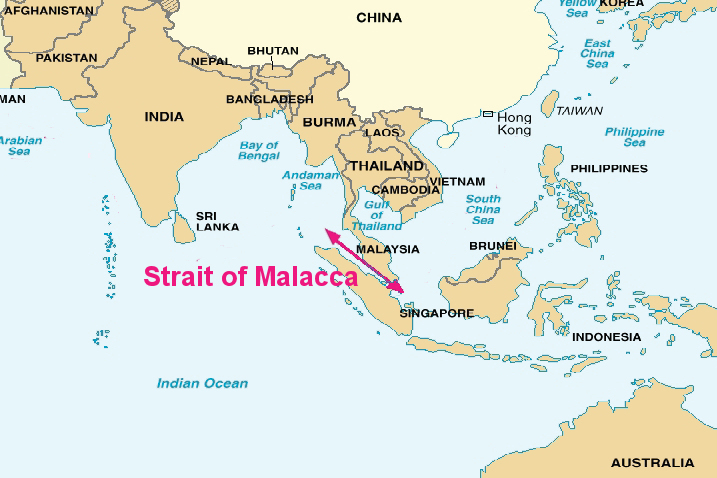
In light of the crisis in the Strait of Hormuz, Singapore has drawn attention to ‘chokepoints’, starting with the Strait of Malacca, through which nearly a third of the world’s oil and the majority of global trade passes. The “Malacca dilemma” has prompted China to diversify its routes and infrastructure to reduce its strategic vulnerability.
Singapore (AsiaNews) - In recent days, during a parliamentary session, Singapore’s Foreign Minister, Vivian Balakrishnan, was keen to reiterate that maritime trade routes must remain free of obstruction. Freedom of navigation is a right, not a privilege, he stated, emphasising that “it is not something to beg for” nor should there be any need to “pay a toll”.
These are not idle remarks. The war launched by the United States and Israel against Iran and the ensuing economic and energy crisis caused by the blockade of the Strait of Hormuz have refocused attention on the so-called “bottlenecks” or “chokepoints” (literally, chokepoints), geographical locations through which global trade passes and which, due to their configuration, can be easily blocked, causing disruption worldwide.
The second most important “chokepoint” in the world after the Strait of Hormuz is the Strait of Malacca. On 13 April, Singapore’s Minister for National Security, K. Shanmugam, echoed the Foreign Minister’s words, stating that “no one can impose tolls” and “selectively decide which ships may pass”, and pointed out that at its narrowest point, the Strait of Malacca measures less than two nautical miles, ten times narrower than the Strait of Hormuz. In the event of a military threat, the economy would risk suffering far more than it does now.
While around a fifth of the world’s oil passes through the Strait of Hormuz, almost a third (29%) transits past Singapore, amounting to 23.2 million barrels a day. It is the busiest oil transit corridor, linking Middle Eastern producers to the industrial economies of East Asia. In fact, almost half (48%) of the oil flowing through it ends up in China, amounting to a flow of 7.9 million barrels a day, according to data from early 2025. This quantity corresponds to 80% of all the crude oil it imports and 60% of its requirements.
In the event of a ‘bottleneck’, Singapore would have everything to lose. All the energy it needs passes through there, whilst the maritime sector, which employs over 170,000 people, accounts for around 7% of its gross domestic product. According to some studies, a total blockade could cause daily losses of around million.
But beyond energy, the Straits of Malacca and Singapore are the busiest in the world in terms of shipping volume, carrying 24% of all maritime trade and a third of all global trade. So whilst Hormuz is causing problems because some of the main sources of energy supply (the Arab Gulf monarchies) are located nearby, a closure of the Strait of Malacca could have a significant impact on deliveries. Europe and North America depend on this route for automotive components, pharmaceuticals and various other consumer goods. Not to mention the semiconductor industry: a blockade would create problems in the supply of essential components for smartphones, electric vehicles and cloud computing services.
China has long been aware of these issues. Since 2003, it has spoken of the ‘Malacca dilemma’, a term coined by then-General Secretary Hu Jintao to describe China’s dependence on that single geographical point for its energy and trade, to the extent that a simple naval blockade could bring the Dragon to its knees.
To avoid ending up with a shattered economy, Beijing has therefore equipped itself with land-based infrastructure that allows it to bypass the Strait. It has invested heavily in a gas pipeline and an oil pipeline linking the port of Kyaukphyu in Myanmar, on the Bay of Bengal, to the southern province of Yunnan. Operational since 2013, they reduce transit times and have remained operational even after the outbreak of the civil war in Myanmar in 2021. Transfers amount to around billion a year and generate over 5 million in foreign exchange reserves annually for the military regime.
Beijing also utilises oil and gas pipelines from Kazakhstan and Russia. However, it is the strategic ports that form what it calls the ‘string of pearls’, which, in addition to Kyaukphyu, also includes the port of Gwadar in Pakistan, which connects to Xinjiang, the port of Hambota in Sri Lanka, and Djibouti.
Furthermore, aware that a blockade of the Strait of Malacca would risk throwing the entire technology sector into chaos, China has ensured it becomes the main centre for rare earth refining, guaranteeing that technology-intensive sectors and renewable energy production (which is now proving more essential than ever) remain dependent on its processing capabilities.

.png)










