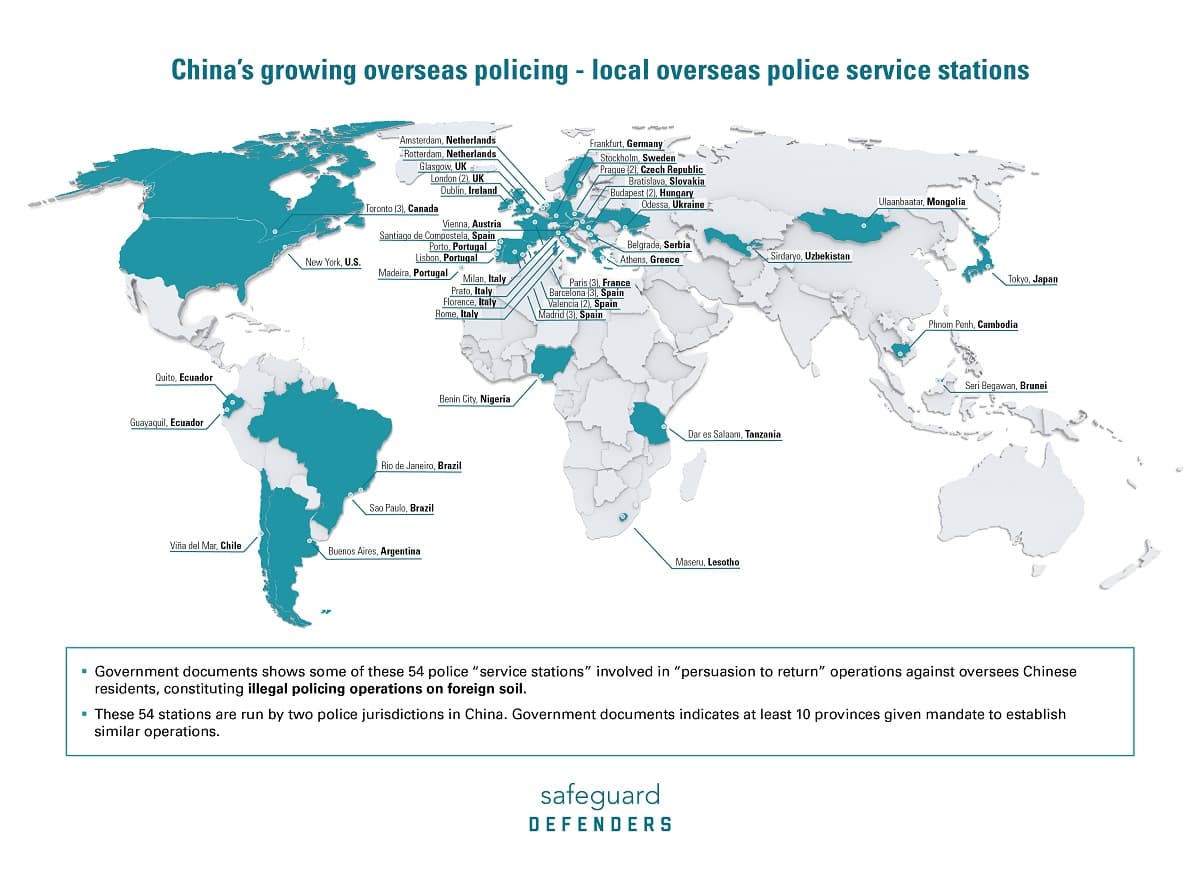
Rome (AsiaNews) – Last Thursday, 5 February, Italy expelled eight Chinese nationals accused of spying on Chinese dissidents on behalf of their government.
Italian daily newspaper Il Foglio reported the development, explaining that the decision was made following "an intense investigation" by Italy’s General Investigations and Special Operations Division (DIGOS) and the Turin Prosecutor's Office, which documented the operations of the network of China’s so-called overseas police stations.
Three Chinese nationals were immediately expelled, while four others had already left Italy. An eighth person, a woman, is reportedly in detention awaiting the outcome of her asylum application.
According to Safeguard Defenders, an advocacy group for human rights in China, the expellees allegedly harassed and stalked a well-known online dissident named Teacher Li.
"Over the past three years, my team and I have steadfastly upheld press freedom, documenting and disseminating social events within China that are censored domestically,” said Teacher Li.
“Simultaneously, we have endured prolonged transnational repression by the Chinese government. Myself, my team, and our families have faced persistent and comprehensive harassment, threats, and violations,” the activist explained.
“We are heartened to see the Italian government take action against China's overseas repression. This represents not only protection for us, but also the defense of fundamental democratic principles and the rule of law,” he added.
The Italian case is not an isolated one. The presence in several Western countries of overseas Chinese police stations has long been known.
Formally, these facilities are presented as administrative assistance centres for the Chinese diaspora, where, for example, people can renew their papers; however, several media investigations have revealed that in some cases they are used to monitor members of the overseas Chinese communities who are critical of China’s government.
In recent years, local authorities in several countries have conducted enquiries. In 2023, in the United States, the FBI arrested two people accused of running one of these facilities in Manhattan as part of a Chinese community association.
According to the indictment, the office operated on behalf of the Fuzhou City public security department, gathering information on dissidents living in the United States.
In Canada, the Royal Canadian Mounted Police launched investigations into alleged similar centres in the province of Quebec, while in the Netherlands, the government ordered the closure of two facilities after a media investigation revealed surveillance activities on the diaspora.
Similar incidents have also been reported in Ireland, Germany, and Spain, where the authorities have sought clarification from Chinese diplomatic missions.
In 2023, the United Kingdom closed several such overseas police stations, deeming their activities extremely concerning. In October 2022, a Hong Kong pro-democracy protester was dragged into inside the Chinese consulate in Manchester where he was beaten.
British police opened an investigation, and six Chinese officials subsequently left the country before they could be questioned; the British government said China had "removed" them.
China has always presented these operations as part of broader anti-corruption campaigns called "Fox Hunt" and "Sky Net," launched in 2014. According to official data released by Chinese authorities, thousands of people have been repatriated for this reason over the past decade.
However, human rights organisations argue that in some cases, the repatriations occurred following pressure, intimidation, or expedited deportation procedures, without the guarantees provided by international law.
Spain is one of the few major European countries willing to cooperate with China’s extradition requests. In 2019, Madrid authorised the extradition of 94 Taiwanese nationals to China, accused of being part of a telephone scam network.
The decision, made under the extradition treaty signed between the two countries in 2005, sparked strong protests from human rights organisations and the Taiwanese government, which demanded that the suspects be transferred to the island and not to the People's Republic.
However, cooperation between Madrid and Beijing continued in the years that followed. According to Spanish daily newspaper El País, Spain is now the only major European country that continues to authorise extraditions to China, despite concerns expressed by several international bodies over the risk of torture, degrading treatment, or unfair trials in China’s judicial system.
The European Court of Human Rights had requested that the risk of torture be assessed on a case-by-case basis. Between 2023 and 2024, the Spanish government authorised nine extraditions, and at least one person has already been handed over to Chinese authorities.
Other European countries have boosted cooperation with China in recent years. In 2024, Serbia signed an extradition treaty, part of a broader strengthening of strategic relations with China.
The agreement allows for the mutual surrender of individuals wanted by judicial authorities, a decision that has drawn criticism from human rights organisations fearing the possible repatriation of dissidents or activists.
A similar development is also taking place in Hungary, where the government led by Prime Minister Viktor Orbán signed an agreement allowing Chinese police officers to patrol certain cities where Chinese tourists and residents are concentrated alongside Hungarian law enforcement.
Although the agreement has been presented as a tool to improve security and international cooperation, several observers believe it is an agreement to strengthen Beijing's control over the Chinese diaspora.
china, italy, canada, united kingdom, serbia, spain, hungary, overseas police stations, dissidents, repression