

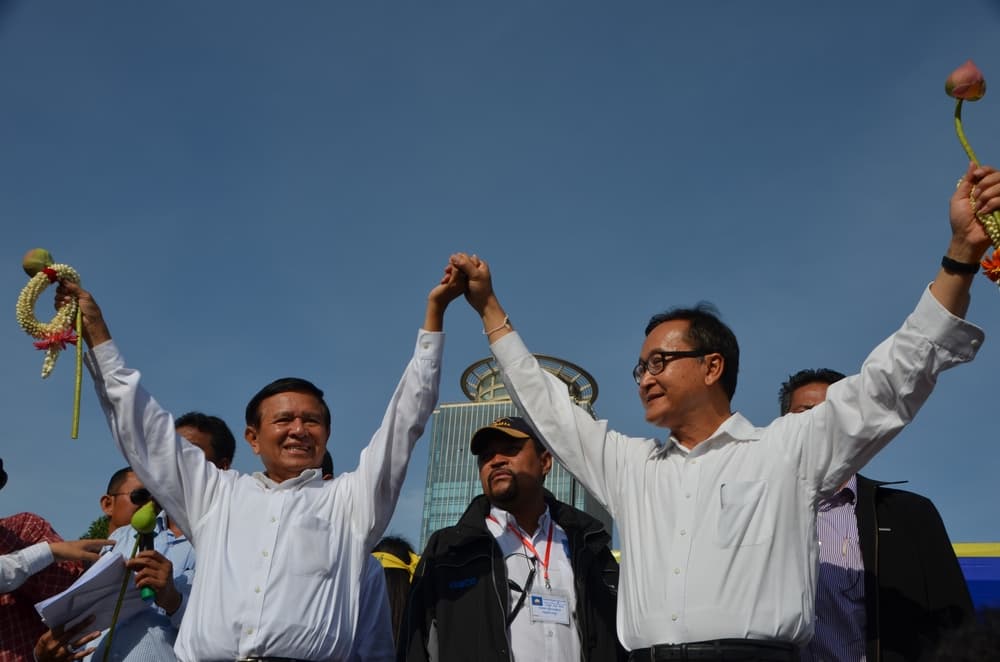
Phnom Penh (AsiaNews) – After more than eight years in prison and house arrest, Cambodia's leading opposition leader Kem Sokha has received a royal pardon signed by former Prime Minister Hun Sen, who remains the country's strongman despite the formal handover of power to his son Hun Manet in 2023.
The decision, announced on Monday, ends the detention of the former leader of the Cambodia National Rescue Party (CNRP), but does not lift his conviction for treason or his ban on engaging in politics or leaving the country for the next five years.
Sokha's release comes as Phnom Penh is trying to clean up its international image, especially vis-à-vis the United States and Europe, which has deteriorated in recent years due to increasing political repression at home and dependence on China abroad.
Many observers see the decision to grant clemency as a calculated move to boost the legitimacy of the government led by Hun Manet and present it as more moderate than his father’s.
Still the balance of power in the country has not changed. As of 2025, at least 88 people were held in the country as political prisoners.
Kem Sokha, 72, was arrested in September 2017 on charges of conspiring with the United States to overthrow the government. The prosecution relied as its main evidence a video in which the opposition leader talks about the support received from US organisations committed to promoting democracy.
The United States slammed the charges as “fabricated”, and international human rights groups denounced Sokha’s trial as a sham designed to eliminate the only real challenger to the Cambodian People's Party (CPP), which has been in power for decades.
The arrest marked a turning point in Hun Sen’s authoritarian grip. The former prime minister now serves as president of the Cambodian Senate.
The Supreme Court ordered the dissolution of the CNRP, paving the way for the 2018 elections, which the CPP easily won, effectively turning the country into a de facto one-party state.
Around the same time, several independent media outlets were closed, including the Cambodia Daily, which was forced to cease print publication (after a disputed US$ 6.3 million in back taxes) and now operates online only from abroad.
Its last edition before closure carried the headline, “Into Outright Dictatorship”, and featured a picture of Sokha in handcuffs.
Since then, several other journalists and activists have faced repression by the regime. Even after Hun Manet took over the reins of power, trade unionists and opposition members continued to be arrested, intimidated, and prosecuted.
The other longtime CNRP leader, Sam Rainsy, has been living in exile since 2015 to avoid prison.
In recent years, Phnom Penh has also been accused of engaging in a "transnational crackdown" against dissidents who fled to other countries, especially Thailand.
In January last year, former opposition MP Lim Kimya was killed in Bangkok in an attack that Amnesty International believes was linked to the climate of persecution in Phnom Penh.
Kem Sokha entered politics in the 1990s, initially with the Buddhist Liberal Democratic Party, then with the monarchist FUNCINPEC[*] party.
In 2002, he founded the Cambodian Center for Human Rights and, subsequently, the Human Rights Party, building his public image as a defender of civil liberties and political rights.
In 2012, he helped found the Cambodia National Rescue Party (CNRP) along with Sam Rainsy. In the 2013 elections, the two achieved an unprecedented result, mobilising young people in particular by denouncing fraud and intimidation.
In 2014, Sokha was elected deputy speaker of the National Assembly (Cambodia's parliament), the first opposition figure to hold that position.
According to Human Rights Watch, Sokha's pardon only “partially reverses a grievous injustice,” since Cambodia’s political system continues to deny fundamental freedoms to opponents.
While remaining China's main ally in Southeast Asia, Cambodia is under increasing pressure from the United States, particularly over the proliferation of scam centres, compounds dedicated to online scams located in border areas in Southeast Asia, often tied to criminal groups involved in drug and gem smuggling, as well as human trafficking.
Several journalists have also faced repression by the Cambodian government for trying to expose how some businessmen who run scam centres have political and economic ties to members of the ruling elite.
Kem Sokha, in a letter released after his pardon, spoke of the need for “national reconciliation and solidarity through dialogue among Cambodians.”
Yet, there are no concrete signs of a reopening democratic space: the CNRP remains dissolved, its leaders continue to be prosecuted, and any real political alternative to the ruling party still appears unlikely.
Photo: Kem Sokha and Sam Rainsy at an opposition rally, 2013
[*] French acronym for Front uni national pour un Cambodge indépendant, neutre, pacifique, et coopératif, or National United Front for an Independent, Neutral, Peaceful, and Cooperative Cambodia.













