








Lebanon distances itself from Hezbollah's war, seeks truce with Israel
The Lebanese government is working for a ceasefire through diplomatic channels. On the ground, Hezbollah continues its asymmetrical fight with the Jewish state. Christian residents are resisting evacuation orders. Originally scheduled for next May, Lebanon’s parliamentary elections are set to be postponed.
Beirut (AsiaNews) – On the sixth day of Lebanon's involvement in the ongoing Mideast war, every political and diplomatic effort is being made to achieve a ceasefire and stop the fighting between Israel and Hezbollah, which broke out overnight last Sunday, and for which all of Lebanon is paying a price.
In this struggle, where the forces involved are vastly asymmetrical, Hezbollah is trying to counter the Israeli offensive with fierce ground attacks.
Yesterday, an Israeli army officer was seriously wounded, and another was moderately wounded during clashes with Hezbollah, according to Israeli military sources. Hezbollah claimed to have targeted Israeli soldiers with a guided anti-tank rocket.
After leaving five observation posts set up in Lebanese territory, Israel announced its intention of a deeper “forward defensive line”. However, this is hampered by the guerrilla war waged by Hezbollah and the reluctance of Christian civilians to leave.
In Khyam, journalist Katia Kahil reports that resistance fighters and Israeli soldiers are facing off, while Christian residents in towns like Marjeyoun, Kley'a, Bourj el-Moulouk, Deir Mimas, Rmeich, and Ain Ebel have refused to comply with evacuation orders.
Residents fear above all a ground offensive, since the Israeli army twice called on people living south of the Litani River "to leave the region and not return”. According to military expert Khalil Helou, Israel will not risk such an offensive until it has achieved irreversible results on the Iranian front.
It should be noted that in Israel, as the Haaretz newspaper noted, some voices are urging Israel not to repeat the unfortunate experience of a “buffer zone”, but rather take advantage of a change in circumstances to align its efforts with those of the Lebanese government to weaken Hezbollah.
Collective punishment
Still, the Israeli military continues its strikes and targeted attacks across the country to dismantle Hezbollah’s infrastructure and eliminate its leaders. Yesterday, it ordered residents population of Beirut’s southern suburbs to evacuate before nightfall “with a ban against heading south.”
This order, issued during the Ramadan fast, is being treated by the press as an act of “collective punishment” that “has forced tens of thousands of families onto the roads.”
Those without any alternative had to endure the humiliating ordeal of a night outdoors, in the dead of winter, on the seafront promenades and Beirut’s public spaces. Overnight, the temperature in Beirut was 7 degrees Celsius.
The Ministry of Social Affairs, the Lebanese Red Cross, and many state and private organisations mobilised yesterday to provide relief and temporary shelter to people.
Those better off went to stay with relatives or friends, or in hotels. But even there, Hezbollah operatives were not safe, as evinced by the raid that killed one of them in a hotel in the predominantly Christian Baabda District.
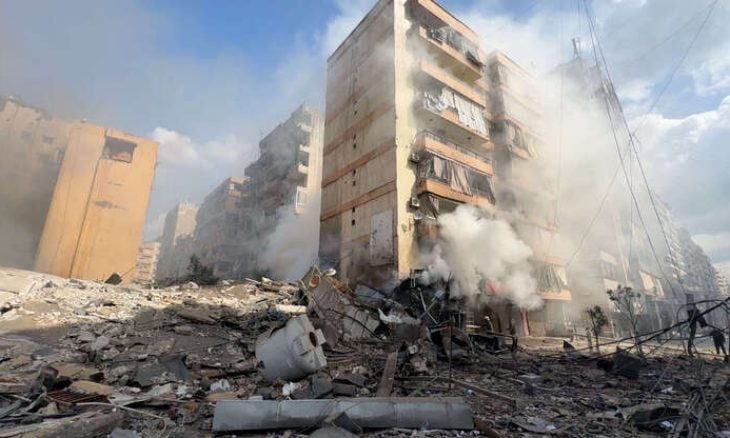
Last night, Israel launched eleven raids on this suburb, claiming to have struck “command centres”, one of which was used by Hezbollah's air force, which is responsible for drone strikes.
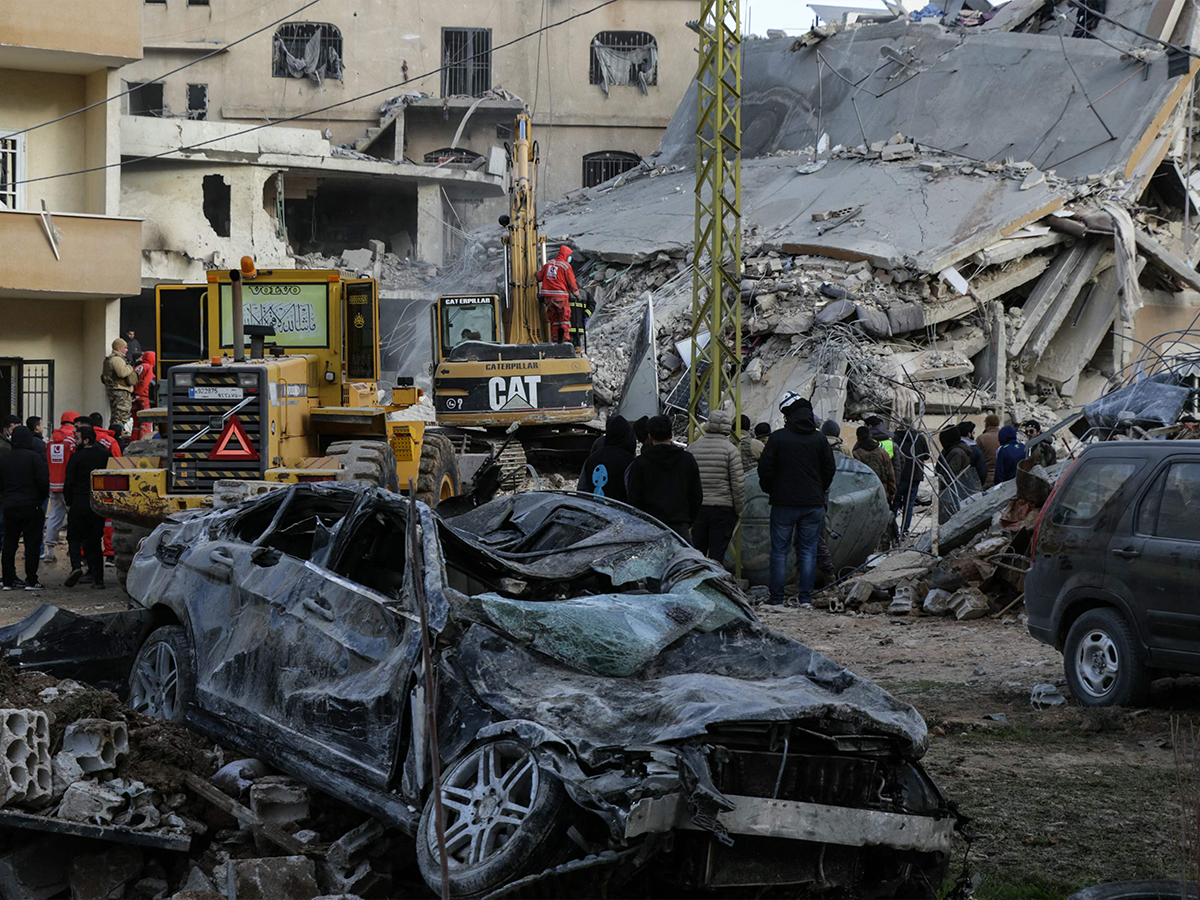
This claim is difficult to verify, given the lack of on-the-ground assessments or a statement from Hezbollah. What is certain is the enormous material damage inflicted on the suburbs. Raids continued at a sustained pace throughout Friday.
The number of people killed in Lebanon since fighting resumed has risen to 77, and the number of wounded has reached 527, the Lebanese Ministry of Health reported yesterday. It is hard to know how many victims are civilian. The Lebanese Ministry of Health had previously stated that seven children had been killed.
For a new ceasefire
Meanwhile, Lebanese leaders are making every effort to achieve a new ceasefire with Israel and extricate the country from the ongoing conflict.
After outlawing Hezbollah's "security and military" activities, the Cabinet, chaired by Prime Minister Nawaf Salam, decided to expel everyone associated with the Islamic Revolutionary Guard Corps (IRGC), the Pasdarans, living in Lebanon, and to ban Iranians from entering Lebanon without a visa.
For its part, the Israeli military issued an ultimatum to the IRGC, giving the group 24 hours to leave Lebanese territory before beginning to target them.
According to Axios journalist Barak Ravid, the Iranian officers who left Lebanon were primarily members of the Quds Force, the IRGC's elite unit, who were “military advisors to Hezbollah with significant influence over the group’s operations,” some working out of the Iranian embassy.
It is worth noting that Iran’s influence played a significant role in Hezbollah’s entry into the war.
Joseph Aoun calls Macron
Furthermore, responding to concerns raised by Hezbollah, Prime Minister Salam said that a military reinforcement on the Syrian border, presented as a threat to Lebanon, "is merely a measure aimed at strengthening Syrian internal security.” “Similar measures have also been taken on the Syrian border with Iraq," he added.
Meanwhile, President Joseph Aoun called his French counterpart, Emmanuel Macron, who reportedly discussed Lebanon with President Trump and Israeli Prime Minister Benyamin Netanyahu.
Finally, the recent outbreak of war has led to the postponement of Lebanon’s parliamentary elections scheduled for May. Lawmakers are scheduled to meet next Monday, 9 March, to examine and approve a bill to that effect. The postponement would be for six months or a year.

.png)
15/04/2026 17:14
09/04/2026 17:19










