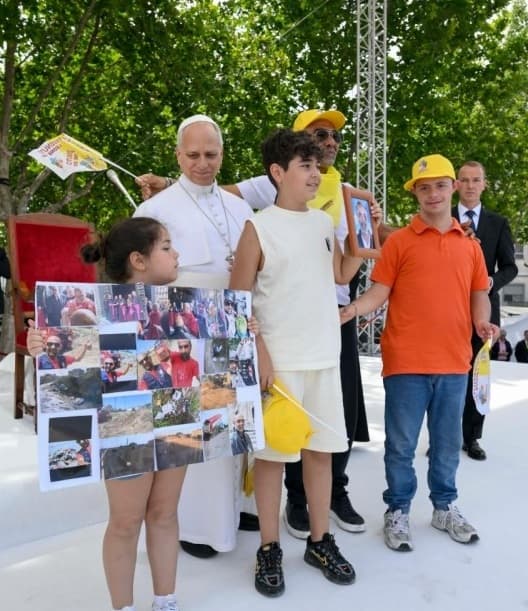
Acerra (AsiaNews) – “I have come first and foremost to gather the tears of those who have lost loved ones,” said today Leo XIV greeting the families of the victims of the "land of fires" in the cathedral of Acerra, in the Italian region of Campania, a place where environmental devastation, criminal trafficking, political collusion, and the very violation of human life come together.
The area visited by the pope this morning has been disfigured for decades by illegal toxic waste dumping. By contaminating land and dispersing dioxin in fires lit to clear it away, illegal dumping sites have seriously undermined the health of thousands of people.
At least 150 children and young people have died from cancer or serious respiratory diseases, contracted at an abnormal rate that can only be explained by pollution.
In Acerra, the pontiff first mentioned Pope Francis's unfulfilled desire to visit the place, scarred by environmental pollution and eco-mafias, pointing to his encyclical Laudato si' as a moral compass for addressing a crisis that is not only environmental, but also human and spiritual.
Speaking to the faithful, priests, and families affected by the pollution-related deaths, Leo echoed the “cry of creation and of the poor" made even more tragic by “a deadly combination of obscure interests and indifference to the common good”, harsh words that denounce decades of environmental devastation caused by "unscrupulous individuals and organizations" capable of operating with impunity.
The heart of the pope’s address revolved around the great biblical vision of the prophet Ezekiel and the valley of dry bones (Ezekiel 37:1-10).
The pontiff invoked the Old Testament to symbolically interpret the tragedy of the Land of Fires, once a fertile land, Campania Felix, transformed into a place of death.
“We can identify with the prophet's dismay at the expanse,” he stated, linking the biblical image of the dry bones to the environmental and moral devastation suffered by the area.
According to Leo, faced with this reality, there are only two possible attitudes: "indifference or responsibility,” acknowledging the merit of local communities and the Church in Acerra for choosing the second path, and embarking on "a journey of commitment and pursuit of justice."
The pope praised those who “dared to speak out and be prophetic, to gather the people in hope,” and repeatedly emphasised the theme of collective conversion. The question posed by God to Ezekiel – “Can these bones live?” – has been turned into a question addressed to society as a whole.
“[D]eath seems to be everywhere, injustice seems to have triumphed, crime, corruption and indifference still kill,” Leo said, acknowledging the weight of discouragement. However, the Christian response cannot be surrender: "We believe and say: ‘O Lord God, thou knowest!’”
Leo XIV then linked this hope to the teaching of the encyclical Laudato si', mentioning the passage in which Pope Francis spoke of a "stubborn resistance" of goodness and authentic humanity even within a civilisation harmed by technology and selfishness.
To this end, the pope asked the faithful to bear witnesses to this resistance: "Be the answer yourselves," he said, pointing to a united community and shared commitment as the path to the area’s rebirth.
The pope’s reflection then turned to the slow process of social reconstruction. Commenting on the biblical passage in which the bones gradually reunite and become clothed in flesh, Leo noted that "the miracle does not happen all at once."
In his message to a land struggling with organised crime, unemployment, pollution, and mistrust for years, Leo warned: "If you stop, you go backwards” – calling for perseverance in the fight for environmental and social justice.
Particularly touching was the passage dedicated to families who have lost children, parents, or relatives to pollution-related diseases. The pontiff asked them not to leave room for resentment but to "generate new life," instiling in young people a sense of responsibility and care. “Let resentment die; be the first to practise the justice you seek," he said.
No less stern was his warning to the clergy and civic authorities. Leo slammed “A culture of privilege, of arrogance, and irresponsibility” that contributed to the degradation of many parts of the country. He also said that “no injustice can erase beauty.”
Instead, for him, priests and religious men and women can embody "the authority of service," made up of proximity, forgiveness, and the ability to take the first step.
The address ended with an invocation to the Holy Spirit, that "an ‘army’ of peace" may arise capable of healing Campania’s wounds. “No longer a fire that destroys, but a fire that revives and warms," said Leo XIV, juxtaposing toxic fires with the fire of solidarity, civil responsibility, and faith.
Speaking before the crowd gathered in the square, Leo broadened his perspective from the Church experience to the civil and political aspect of rebirth, insisting that the environmental crisis cannot be separated from the social question.
To address this issue, there must be concrete cooperation between ordinary people, government, and educational establishments. For the pontiff, true change cannot arise solely from laws or controls, but from a moral transformation of people.
“For the transformation of the world always begins in the heart,” he said, calling on everyone to build a culture of legality and mutual care.
Finally, the pontiff launched an appeal for active hope, noting that the rebirth of the Land of Fires will depend on the communities' ability to remain united. Only this way, for him, will it be possible to transform a wounded land into a laboratory of justice, responsibility, and fraternity.