





-64960.html&is_video=&description=Mideast+war%3A+Beijing+stands+with+Tehran+but+from+afar+%28and+waiting%29)


Mideast war: Beijing stands with Tehran but from afar (and waiting)
No statement has come from Xi Jinping yet, while the condemnation of the attack on Iran has been entrusted to Foreign Minister Wang Yi, who spoke today with his Israeli counterpart, Gideon Sa'ar. The evacuation of Chinese citizens from Tehran has been completed, with 200 choosing to stay. Trump's trip to China (31 March-2 April) is still on the agenda, for now, matching the "four weeks" the US leader gave yesterday as the timeframe for war.
Milan (AsiaNews/Agencies) – The People's Republic of China (PRC) stands with Iran without allowing itself to be dragged into a conflict that remains far from its own "backyard”, aware that the stakes are very high, but also confident for the moment that it can largely come out of it unscathed.
Four days after the outbreak of hostilities in the Middle East, this summarises Beijing’s attitude towards the crisis created by the United States and Israel, which, following the assassination of Ali Khamenei, has inflamed the entire Gulf region.
For now, on the eve of the crucial Two Sessions meeting, which opens tomorrow, Xi Jinping is silent on the matter, leaving it to his trusted Foreign Minister Wang Yi to speak.
This is the same pattern used with the Venezuela case. Thus, a strong condemnation was made but no concrete action taken, despite Iran’s membership in the Shanghai Security Organisation since 2023 and joint military exercises just three months ago.
There has been much talk in recent hours about China’s purchases of Iranian oil, but in the end, it represents no more than 13 per cent of its seaborne oil imports. According to estimates by Société Générale, the PRC has sufficient reserves to withstand up to 200 days without oil imports.
This also explains why Chinese leaders are taking a wait-and-see approach, counting on the Revolutionary Guards to maintain control over the country while Washington's involvement in a war whose objectives are difficult to achieve with air power alone plays in Beijing’s favour.
At the diplomatic level, China presents the face of a "stable and reliable" power in a turbulent world.
Today, Beijing announced that Foreign Minister Wang Yi met with his Israeli counterpart Gideon Sa'ar, at the latter's request, who presented the Netanyahu government's position.
According to the official Chinese statement, Wang reiterated that China supports the resolution of international and regional crises through dialogue and consultation and that it has been committed for years to promoting a political solution to the Iranian nuclear issue.
Meanwhile, the United States and Israel reportedly began their attack just as talks with Iran were making progress, including addressing Israel's security concerns.
The Chinese foreign minister called for an immediate cessation of military operations to avoid further escalation and called on Israel to guarantee the safety of Chinese personnel and facilities, a request Sa'ar accepted.
Chinese authorities reported yesterday the death of a Chinese national in Iran, killed in the bombings. Today, the Global Times added that, according to reports from the Chinese Embassy in Tehran and the Iran Federation of Chinese Organisations, most Chinese citizens have already left the country.
Tan Xiaolin, who is vice president of the Iran Federation of Chinese Organisations and head of the temporary evacuation task force, said in an interview that the last two groups, approximately 210 people, left yesterday.
It is understood that some 200 remain in cities like Tabriz and Qom who, for work or personal reasons, have decided not to leave for the time being.
“Since the military operations launched by the US and Israel against Iran on Saturday, we have arranged five batches of evacuations, totaling around 400 people. Since the situation in Iran became more complicated at the end of last year, more than 3,000 Chinese citizens have been evacuated cumulatively," said Tan Kai, president of the Iran Federation of Chinese Organisations.
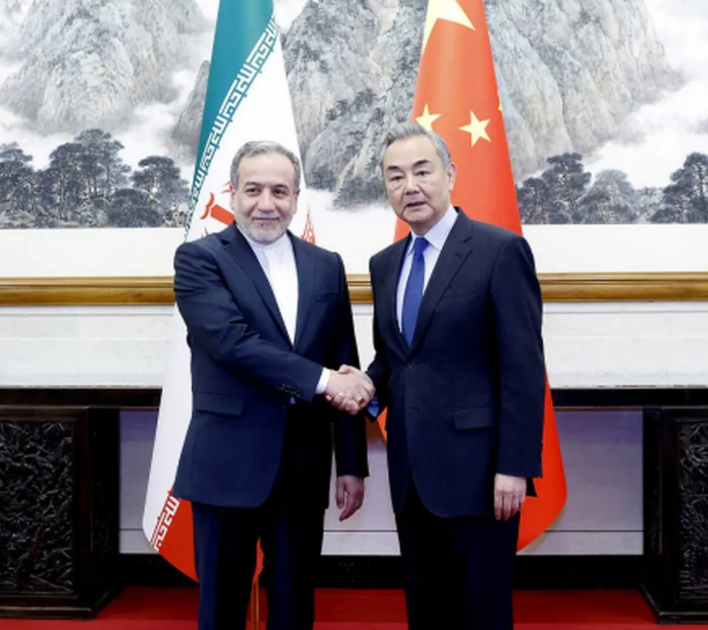
Yesterday, Wang Yi himself had a telephone conversation with Iranian Foreign Minister Abbas Araghchi, to whom he said that Beijing “cherishes the traditional friendship between China and Iran, supports Iran in defending its sovereignty, security, territorial integrity, and national dignity, and supports Iran in protecting its legitimate rights and interests”.
Meanwhile, in a subsequent conversation with French Foreign Minister Jean-Noël Barrot, Wang warned that the world was at risk of “regression to the law of the jungle”.
Presently, the crucial upcoming event is Trump's visit to China, set for 31 March to 2 April, which, perhaps not coincidentally, coincides with the "four weeks" Trump mentioned yesterday as the timeframe to end the war in the Middle East.
In response to a specific question at the daily press conference, foreign ministry spokeswoman Mao Ning said that she had no information on the matter.
Despite strongly condemning the strikes against Iran, Beijing has no intention of cancelling the state visit, waiting for the situation to evolve before truly playing its cards.

.png)










