








Monks warn Dissanayake of “threats to the country's Buddhist tradition”
Hundreds of religious leaders gathered by the Sangha have issued a ten-point statement and launched a petition on which they are collecting signatures from the faithful. They claim that the current government is pursuing a de facto separation between state and religion despite the role reserved for it by the Constitution. They have called for protection for temples, statues and religious teaching, but also for action against those who denigrate the Buddhist faith on social networks.
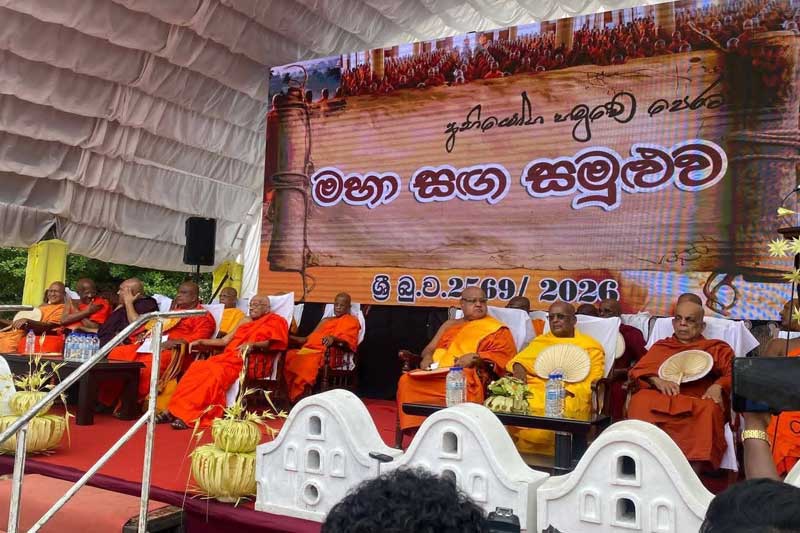
Colombo (Asia News) - Leaders of the Buddhist community in Sri Lanka are currently protesting against the government of President Anura Kumara Dissanayake, complaining about the government's alleged lack of respect for their religion and the violation of the long-standing tradition that they must be consulted on matters of state.
Hundreds of monks took part in a convention promoted by the Sangha, which was held on 20 February at the headquarters of the All Ceylon Buddhist Congress in Colombo, to ‘inform the public about the pressure currently being exerted on Buddhism and the Maha Sangha’. During the meeting, a Sangha Declaration was collectively proclaimed by all the country's monks and Buddhist leaders to address the social crises currently affecting the Buddhist community in the country.
The declaration will soon be officially presented to the president, according to Agalakada Siri Sumanan Thero, chief abbot of Moratuwa Lunawa Bodhirajaramaya and head of the Sinhala Department at the University of Colombo. Meanwhile, a programme has been launched to collect signatures for a public petition against the separation of state and Buddhism in Sri Lanka. Over 70% of the 22 million inhabitants are Buddhists in a country where Hindu, Muslim and Christian minorities also live.
The Sangha Declaration is structured in ten points that draw on the historical link between Buddhism and the country's institutions, which dates back to the 3rd century BC. ‘When the Arahant Mahinda Thera brought the Sacred Dhamma to this land and established it here,’ the text reads, "it was with the full patronage of King Devanampiyatissa, then ruler of Sri Lanka. From that moment on, the state and Buddhism in Sri Lanka have been closely intertwined, and on the basis of this relationship, the responsibility for building a moral nation was entrusted to both the sovereign and the religion." In this regard, they cite both the Kandy Convention of 1815 and the Constitutions of 1972 and 1978 (the Charter still in force, ed.), which, while affirming religious freedom, oblige the government to protect and promote Buddhism.
Recalling that ‘neither the colonial powers nor the LTTE (the Tamil militias during the long war that lasted until 2009, ed.)’ succeeded in destroying the relationship between the laity and the Buddhist clergy in the country, the monks argue that according to the Scriptures, ‘the irreligious should not rule this land; and that government must therefore be exercised in accordance with Buddhist political philosophy’.
In concrete terms, the Sangha is asking the government to intervene against ‘disrespect’ towards Buddha statues, ‘still deeply revered today’, and to pay ‘due attention to Buddhist educational principles in the development of curricula’. The monks also criticise the downgrading of the Ministry of Buddha Sasana: “previously supervised directly by the presidents, it has become inactive, weakened and ineffective due to the absence of a responsible minister; thus, officials no longer serve efficiently the monks and lay people who require services from the Department of Buddhist Affairs”.
‘We emphasise,’ the document continues, ‘that Buddhist archaeological sites, sacred places and temples are not the private property of monks but the heritage of the nation, and that the government has a responsibility to ensure their protection against any form of damage.’ "While monks throughout Sri Lanka behave with moral discipline and dignity, engaging in selfless service for their own well-being and that of the wider community in this life and the next , the document concludes, actions that undermine the dignity of the clergy - such as derogatory statements, the dissemination of hostile opinions, derision, insults and accusations by activists on social media - must not be permitted under the authority of the State."

.png)
24/01/2007
05/12/2023 16:21










