








Myanmar women invisible on Thai construction sites
A ruling against the builder of a condominium that collapsed in the Mandalay earthquake put the spotlight back on the 2025 earthquake that also killed several Myanmar workers on the other side of the border in Thailand. An investigation shows that thousands of migrant workers continue to work for low wages on Thai construction sites without adequate protections.
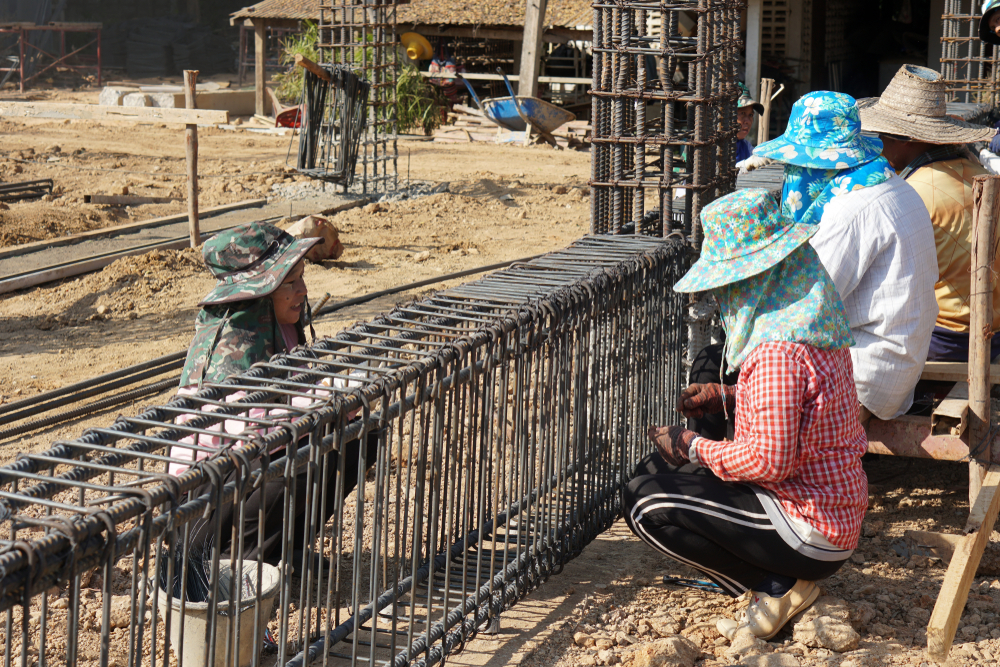
Yangon (AsiaNews) – Naing Tun Lin, owner of NTL Construction, the company that built the Sky Villa condominium in Mandalay that collapsed from the 7.7-magnitude earthquake in March 2025, has been sentenced to five years in prison with hard labour for manslaughter, Eleven Media reported, citing a Mandalay court source. Naing Tun Lin was charged in February but was initially released on bail.
The collapse of the Sky Villa building alone killed more than 200 people, while the overall death toll from the quake has been estimated at several thousands, this in a country, Myanmar, already reeling from a civil war that broke out after the 2021 military coup. The last body still under the rubble of the Sky Villa building was recovered only in September 2025.
The same earthquake also caused the collapse of a 30-story skyscraper under construction in Bangkok's Chatuchak District, the only building in the Thai capital to completely crumple, killing approximately 95 people. Among the victims were at least ten migrant workers from Myanmar and one from Cambodia.
Investigations have so far found serious flaws in the materials (including the use of substandard steel) and the construction design, while a parallel probe is looking at allegations of collusion in the awarding of the contract, which allegedly involves dozens of public officials.
The two legal cases, however, do not address a key issue reported by a local NGO, namely the hundreds of thousands of Myanmar nationals who, fleeing the civil war in their country, found themselves working on Thai construction sites.
The Baan Dek Foundation, an organisation active since 2002 in the protection of minors and migrant families, recently published its first report on the conditions of female workers, in collaboration with the Institute of Human Rights & Peace Studies at Mahidol University.
The research notes that the construction sector represents nearly 8 per cent of the Thai economy and employs approximately 700,000 migrant workers, primarily from Myanmar, Cambodia, and Laos.
Women make up approximately 36 per cent of this workforce, yet remain almost invisible in terms of protection policies and corporate strategies.
The study, based on interviews with 39 migrant workers in Bangkok and Chiang Mai, highlights how, for female workers, vulnerabilities overlap – being a woman, a migrant, and employed in a male-dominated sector means having less bargaining power, lower wages, and limited access to essential services.
On construction sites, women are almost always assigned tasks considered “less skilled”, such as cleaning and painting, and are paid less than men's. At one of the sites visited by researchers, for example, men earned 380 baht a day (around US$ 11.35) compared to 350 baht for women (US$ 10.45).
Many female workers end up considering this difference normal, because men do work considered harder, even if they start at the same pay level.
Being relegated to tasks perceived as less demanding, the report notes (although many women reported working in extreme heat, lifting heavy materials, and operating machinery), prevents women from learning new skills and accumulating overtime, the only other way to supplement their basic income.
After the day on the construction sites is over, the work continues at home. The interviewees said they are almost exclusively responsible for preparing meals, cleaning, caring for their children, and sending remittances to their families back home. The financial burden of medical care and family expenses often translates into further stress and insecurity.
Then there is the issue of papers. Employers or subcontractors often refuse to provide workers with work permits, which can cost up to 17,500 baht (about US$ 520), which women often have to pay themselves.
This makes it impossible to leave because changing jobs would mean losing the guarantee of legal residence in Thailand.
This situation is exacerbated by domestic violence. Without papers, women are forced to stay with those who abuse them. At the same time, women prefer irregular immigration channels because Thailand bars entry to women with dependent children.
Solidarity networks among workers have thus become one of the main forms of protection. In the Chiang Mai camps, for example, some women have received training to mediate conflicts, coordinate activities, and offer support to other residents.
At the same time, relationships among compatriots, visits to temples, and video calls with families back home have become essential tools for coping with isolation and homesickness.
In workers’ camps, people live in sheet metal shacks or converted containers, but bathrooms and showers are often not separated by gender (causing discomfort for girls during menstruation and forcing older women to accompany young women and teenagers worried about their safety) and are insufficient for the number of residents.
In one case, researchers documented the presence of only one bathroom and two showers for 16-17 families. These facilities are unsuitable for pregnant women and newborn care.
Finally, many women forgo health insurance because the required contribution is perceived as too high compared to their wages, preferring to pay directly pharmacies or small clinics, when necessary, thus saving for the remittances they send back home.

.png)
11/08/2017 20:05
15/11/2005










