Beirut (AsiaNews) – Although fighting between Israel and Hezbollah decreased in intensity since the Washington agreement (26 June), the festering climate the two maintain is leading to horrific tragedies.
While waiting for the agreement's implementation on the ground that would see the Lebanese army take control of "pilot zones" under US supervision, a drone attack yesterday targeted a car travelling in Nabaṭiyya al-Fawqā, killing its four occupants.
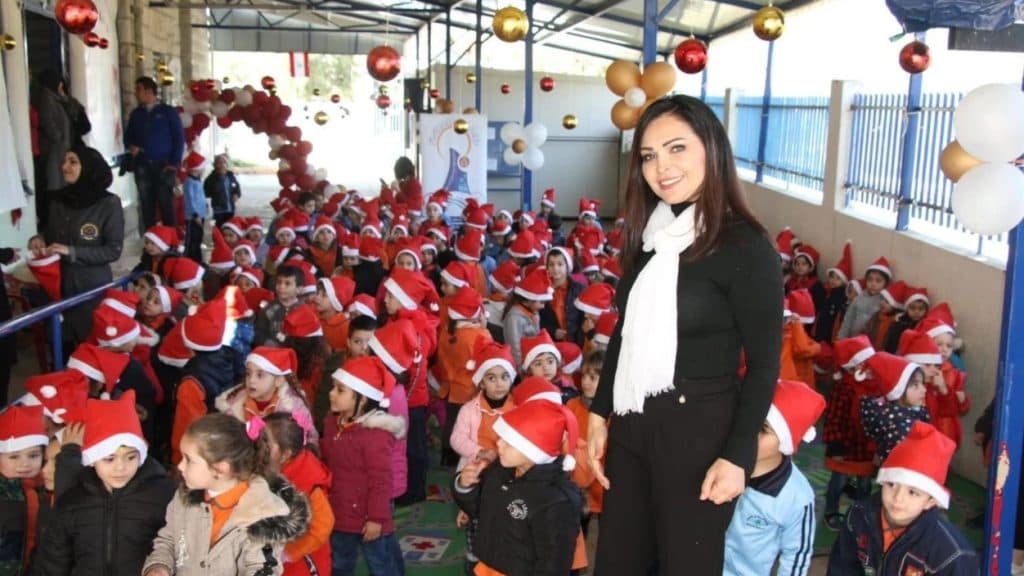
The strike killed Esperanza Ghandour, the principal of the Youssef Chamoun public school in Nabaṭiyya al-Fawqā (222 students), as well as her mother, a foreign employee, and a Syrian worker. The victims were driving in the area to inspect her family home, ostensibly a threat to “Israel's security”.
The killing of the head of an educational institution is even more shocking at this time, following UNICEF's recent warning that at least 100,000 children in Lebanon could be left without a school next year due to damage to the school buildings.
Local sources report that the principal's phone displayed the message, "You must not cling to anything in this life, except God." These words appeared on the screen after she realised the family home had been completely destroyed.
According to residents, the victim had "taken risks" by crossing an army checkpoint and "entering a 'gray zone' hoping of getting out alive." The Israeli army announced that it would “investigate the incident”.
Growing weariness
People in southern Lebanon are weary of the current situation in which the war had trapped them.
Yesterday, Christian villages spurned a statement made on Sunday by Israeli Prime Minister Binyamin Netanyahu, undoubtedly motivated by electoral considerations, according to which some Christian villages in South Lebanon had "asked to be annexed to Israel" out of fear of Hezbollah.
“Christian villages in Lebanon, some of them have actually asked to be annexed to Israel, because we protect them against the Hezbollah, Hezbollah fanatics who want to kill them, and we do the same things with Christians everywhere," Netanyahu told Fox News’s show, The Sunday Briefing. He did not, however, name the villages.
With the Jewish state occupies about 620 square kilometres of southern Lebanon along the border, these remarks can further inflame an already tense political situation in which the Lebanese are currently living.
“No village in the South has made such a request,” Hanna al-Amil, head of Rmaysh Municipality, the largest Christian border villages, told Lebanon’s National News Agency (NNA) yesterday.
Some 5 villages in southern Lebanon (including Rmaysh) signed a statement categorically denying the Israeli claim, with the communities describing the Israeli leader’s remarks as "completely fabricated and unrelated to reality."
"We remain committed to the Lebanese state and its legitimacy, having never wavered from this position despite the extremely difficult conditions imposed by the war, and we reject any attempt to distort our position or exploit our suffering to serve agendas that are foreign to us," the statement reads.
Several of these villages also have Druze and Sunni residents, in addition to Christians.
Christian villages were “surprised” by Netanyahu’s statement, said Ghenwa Farah, a resident of Ain Ebel contacted by telephone, by Suzanne Baaqlini, senior reporter at L’Orient-Le Jour.
“Ask for help and protection from an enemy state? Certainly not! Especially since three of our compatriots in Ain Ebel were martyred in this war,” she said. The three men were killed on 12 March in an Israeli drone strike while installing an Internet antenna on the roof of a house.
Netanyahu and negotiations
“It’s certain that no one in our villages asked the Israelis for protection,” said a resident of the neighbouring village of Debel, speaking on condition of anonymity. “We have been cut off from the rest of the country and without work for months. We can hold out for another year, after which a solution will be necessary,” he added.
“That’s our whole tragedy,” a man originally from the South but living in Beirut told AsiaNews. “As the agreement reached in Washington stipulates, we want two things: our land and the disarmament of Hezbollah. Unfortunately, our only ally in achieving this second objective is also our enemy.”
For Verena el-Amil, a lawyer for the Rmaysh municipal council, her hometown, the Israeli Prime Minister “is trying to improve his chances in negotiations with Lebanon through a thinly veiled threat of annexing territory.” At the same time, “He is also probably trying to convince the Israeli public, during this election period, that his war is ‘just’ and that it’s producing results.”
Political scientist Sami Nader believes that Netanyahu is sending messages in several directions, but primarily to the administration of US President Donald Trump.
“The Israeli prime minister is well aware of how sensitive Trump's electoral base and members of his administration, such as his Vice President J D Vance, who come from a community of Christian Zionists, are to the issue of Christians, and particularly Christians in the Middle East," he explained.
According to him, Netanyahu wants to show the US president that "he is defending the interests of this segment of the Lebanese population."
The Israeli prime minister, whose relationship with Donald Trump has deteriorated since the Iran-Iraq War, is expected to meet with the president in the White House this week.
Warnings: do not accept displaced people
Moreover, Christian villages in Marjayoun District yesterday reportedly received Israeli warnings prohibiting them from accepting the return of displaced residents to their communities, according to the press in southern Lebanon.
The head of the Al-Qlayaa Municipal Council, Hanna Daher, told local media that this message could be related to the return of some displaced people to the village of Jdeidet Marjayoun, who are considered to be from the neighbouring towns of Dibbin and Blat.
Regarding Al-Qlayaa, he confirmed that no displaced people are currently in the town; however, "This type of message keeps the residents in a constant state of anxiety and tension,” he said.
Similarly, the head of the Burj Al-Muluk Municipal Council, Elie Sleiman, told the press that he had received the same message on his phone, saying that no displaced people were present in the village. In fact, he said that his municipality had asked permission from Israel, via UNIFIL, for the return of 16 Christian families to the town, but the request was rejected.
Speaking to AsiaNews, Katia Kahil, Ici-Beyrouth’s correspondent in the region, stated that "the population is tired of the war and the restrictions placed on Lebanese people to meet."
“We have always lived together, and we need each other, to live, to share our goods. May this war finally leave us in peace and allow us to live again as we always have," she said, echoing an almost universal sentiment people are now expressing publicly. Meanwhile, she added, a semblance of public life is resuming in this part of the country.
Children killed or maimed every day
A report by UNICEF recently highlighted the senseless killing of adults and children, unrelated to the war; in fact, since fighting broke out between Israel and Hezbollah on 2 March, 247 children have been killed and 992 wounded, an average of 12 children killed or maimed per day.
According to Marcoluigi Corsi, UNICEF Representative in Lebanon, “More than 770,000 children are experiencing heightened distress from repeated exposure to violence, loss and displacement.”
In fact, “For more than three months, children in Lebanon have lived through experiences no child should ever endure. Many have fled their homes multiple times, witnessed violence first-hand, lost loved ones, and seen their schools, communities, and sense of safety shattered,” he added.
GATEWAY TO THE EAST IS THE ASIANEWS NEWSLETTER DEDICATED TO THE MIDDLE EAST. WOULD YOU LIKE TO RECEIVE IT EVERY TUESDAY? TO SUBSCRIBE, CLICK HERE.