








Pizzaballa: ‘God’s dream’ for Jerusalem, a city ‘torn by conflicts'
The Latin patriarch released a long pastoral letter on how to live as Christians in light of the "paradigm shift" that followed 7 October 2023, and the war in Gaza. Like the "New Jerusalem" in Revelation, the city could offer a way of being together that overcomes today's sectarianism and heals its wounds. He urges families to be examples of clean remembrance with their children, telling the truth without transmitting hatred.
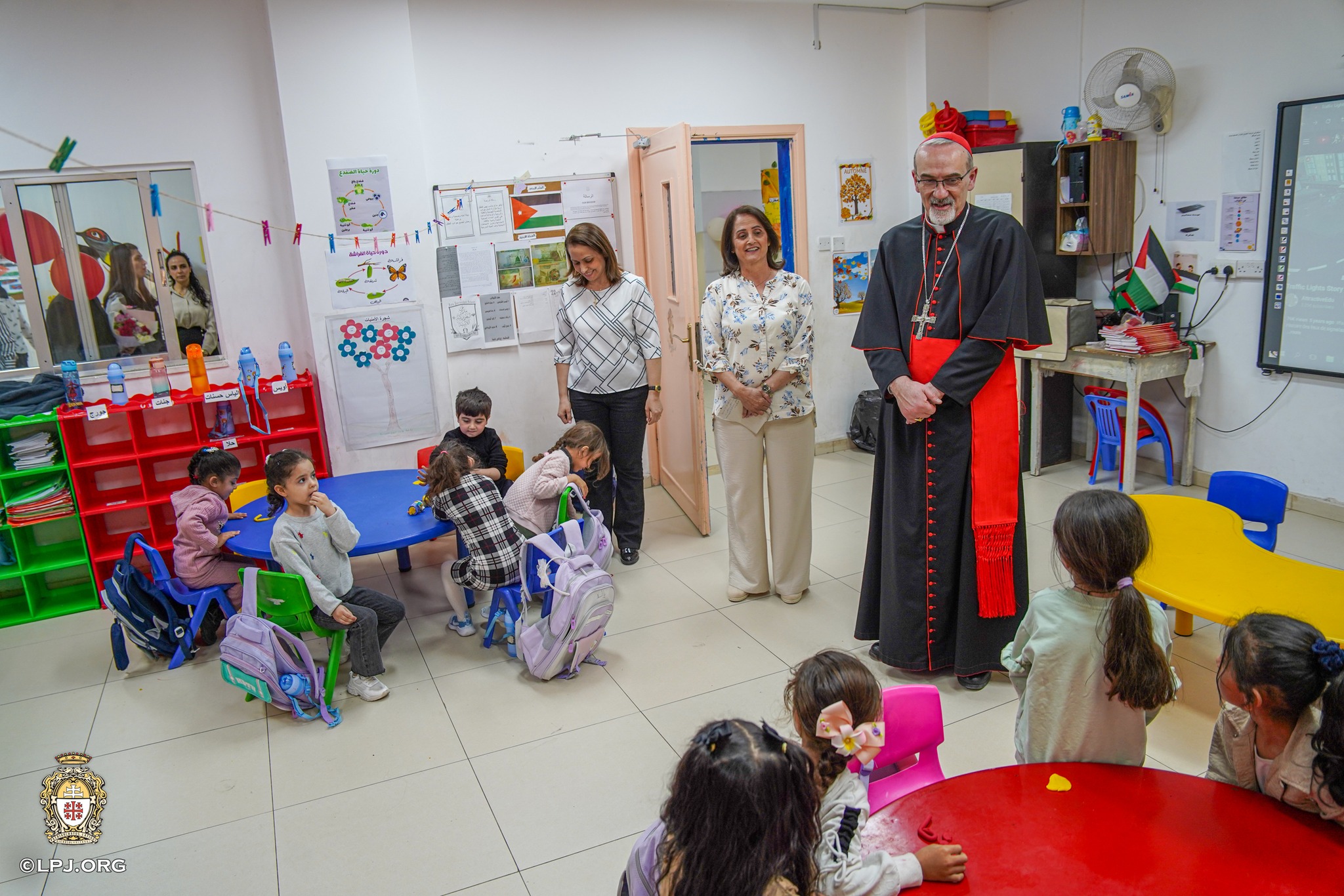
Jerusalem (AsiaNews) – Cardinal Pierbattista Pizzaballa, Latin patriarch of Jerusalem, released a long pastoral letter today. In it the prelate outlines today’s “challenges” and “suffering,” but also "the certainty that God has not abandoned history”.
The letter is addressed to a specific community, that of the Latin Patriarchate of Jerusalem at a difficult juncture in its history, cognisant that the Holy City, even with its present wounds, remains God's dream for all humanity and therefore holds a message for believers throughout the world.
As “A proposal for living the vocation of the Church in the Holy Land,” the letter offers the community and the faithful around the world some thoughts on how to live the Christian faith in the midst of conflict.
The long and detailed text, proposed as a starting point for reflection to be developed together in an ecclesial context, does not stop at "quick or partial" readings. Its words clearly transcend politics, but certainly not out of a desire to distance oneself from reality.
“Analyses and condemnations [. . .] remain necessary, and we cannot cease publishing them,” writes Card Pizzaballa, but “they do not establish horizons of trust. Even though there are those outside of our community who identify with these assessments, they are not enough.
“These statements must be accompanied by a reflection on what the Lord is asking of us at this moment. Furthermore, we must ask ourselves how we might express our faith in this difficult context”.
Such a “question has accompanied my ministry as pastor: how can we, as Christians, as an ecclesial assembly, navigate our way in this situation of conflict – political, military, spiritual – a conflict we fear will continue for years to come?”
To make this point, the letter is divided into three parts.
In the first, the patriarch attempts to interpret the reality of the conflict without compromise, focusing on what has truly changed in recent years in the Holy Land and, more generally, in the world we all live in.
If we want to reflect on how to navigate it as Christians, however, we cannot stop there: we must begin again from God's dream that Jerusalem is called to embody. And this is what Pizzaballa proposes in the second, central part of the letter.
Taking the heavenly Jerusalem described in the last two chapters of the Book of Revelation as a biblical icon of reference, he presents some specific features of the vocation of the Christian community called to live in the earthly Jerusalem.
Lastly, the third part focuses on a series of very concrete pastoral implications of this perspective.
Reading reality
The starting point is the "paradigm shift" that occurred on 7 October 2023, and the war that followed in Gaza, which marked not only the Holy Land, but the entire world.
“We are witnessing the return of force as the decisive tool for resolving every dispute. War has become the object of an idolatrous cult” that feeds on words and images.
New questions have also risen with the use of artificial intelligence in warfare. For instance, “How many people in these recent wars in our region have died because of ‘the decision of an algorithm’?”
For Cardinal Pizzaballa, all of this has sparked great chaos with consequences in everyone's life in five fundamental ways: first and foremost, the dissolution of relationships, poisoned by hatred and mistrust.
“Hatred has dug deep furrows. We witness a painful dehumanization of the other: when they become merely ‘the enemy,’ everything becomes permissible.”
Then, there is the fragmentation into enclaves and identity bubbles, amplified by social media algorithms: belonging experienced through opposition, where "us" is reduced to opposing identities.
Amid this great chaos, even key words such as coexistence, dialogue, justice, wither away.
For the patriarch, “everyone seems to have sacrificed the common good on the altar of partisan interests, albeit in different ways. It seems that everyone thinks only of themselves, of their own survival, of their own security, in a perpetual existential war, on increasingly distant fronts.”
This “reality imposes the strongest language. This reality, far beyond what we might think, feel, or believe, reminds us that we are destined to find ways to coexist. There is no alternative.”
Chaos has also thrown interreligious dialogue into crisis, plagued by conflicting memories and identity manipulation. The ecclesial community of the patriarchate itself is experiencing this general disorientation, sometimes struggling to reconcile the experiences of those living in different realities like Israel, Palestine, Jordan, and Cyprus, each with its own history and dynamics.
“Our Church has made its voice heard, attempting to speak a word of truth – honest, clear, with parrhesia (boldness) – even amidst this chaos, often at the cost of misunderstanding.
“But, I wonder, has this been enough? Or, in this most challenging period, have we at times chosen prudence and sought institutional survival, sacrificing our prophetic witness? How can we speak a word of truth without creating new barriers and new victims?” the prelate asks.
“It is a question that haunts me every day, and one that is never easy to answer. We must ask ourselves this question sincerely, first and foremost before the Lord, knowing that discernment means listening to God’s voice, converting to the truth, seeking justice, and choosing the good of our brothers and sisters.”
God's dream named Jerusalem
It is precisely here that "God's dream named Jerusalem" – to which the second part of the letter is dedicated – becomes the point of reference for finding the way, against the city of refuge built by Cain out of fear, God responds with the New Jerusalem, his gift of love. Its primary task is to attest to God's presence.
“Jerusalem,” Card Pizzaballa writes, “is not just a matter of political boundaries or technical arrangements. Its main identity [. . .] is that of being the place of God’s revelation.”
Debunking a widespread cliché, the patriarch explains that the very attempt to ignore this vertical dimension “is the deepest reason for the failure of the coexistence."
Nevertheless, the Book of Revelation also reveals an aspect that is more crucial than ever today: “I saw no temple in the City, for its temple is the Lord God the Almighty and the Lamb.” (Rev 21:22).
In Jerusalem, "God does not dwell in a building separated by exclusive boundaries, but in relationship,” the patriarch says. The Holy Places must be protected to “preserve freedom, not to stifle it”.
The various "status quos" (the rules that uphold the rights of each community) are necessary, “but we need the courage to build new models of life and relationships where common faith in God becomes an opportunity for encounter rather than for exclusion.”
To move beyond selective readings of history, the cardinal calls for a "city with open doors and a purified memory” since “God does not erase history, but recreates it on new foundations."
“What is needed instead is a rethinking of [. . .] the categories of ‘guilt,’ ‘justice,’ and ‘forgiveness’” to “generate a different future” that “is not a diplomatic operation, but a spiritual act”.
This is what gives Jerusalem its vocation universal: "what happens [here] affects the lives of billions of believers. It belongs to no one exclusively but is the heritage of humanity." This is why its mission is to heal the entire world of its wounds.
Pastoral implications
Being a visible expression of this “New Jerusalem” even in today’s painful situation becomes the task of the Church that lives in this earthly city.
For the patriarch, “We cannot seek to apply an abstract blueprint; rather, we need to find ways to be inspired in our daily lives, in our parishes, families, and institutions. It is a long and wearisome journey, but it is the only one that can fill us with confidence.”
The pastoral implications include the primacy of liturgy and prayer (“Not just prayers for peace – which also need to be promoted – but prayer as a constant and enduring atmosphere of life, giving shape to our days, our weeks, our communities. I am thinking in particular of the Liturgy of the Hours prayed in community, of lectio divina, of Eucharistic adoration”.
But this also includes the journey of families as domestic churches that educate in faith and reconciliation (“where the past can be recounted to children with sorrow and truth, but without transmitting hatred and revenge”).
Schools are “among the greatest gifts the Church gives to our planet,” plus hospitals and social works, "places where acceptance, dialogue, and healing are already lived realities”.
Together with interreligious dialogue, which is in difficulty today but which, for Christians, “is not only a vital necessity but the very form of our being Church. It must transition from the dialogue of elites and take root in daily life.” Hence, “we must dare to forgive, not to justify evil,” and thus, “break the chain of hatred.”
The rejection of violence, which includes language, “must be total and palpable, because it is never the path of the Gospel.”
How can all this be done? The cardinal is clear about this: “we cannot. At least, not alone. But we are not alone. Jesus awaits us in our parishes, in our faith communities, in our ecclesial groups and movements.”
He cites the final image of the Gospel of Luke, with the disciples after the ascension of Jesus, “‘returned to Jerusalem with great joy’ (Luke 24:52). They had been shocked, they had been afraid, they had doubted. Yet, in the end, they returned full of joy.”
“We, too, desire to return to our daily Jerusalem – our homes, our parishes, our communities, our daily commitments – with that same joy. Not a naïve joy that ignores hardships. But an Easter joy, that knows that light conquers darkness, that life defeats death, that love disarms hatred.”

.png)
24/06/2016 13:47










