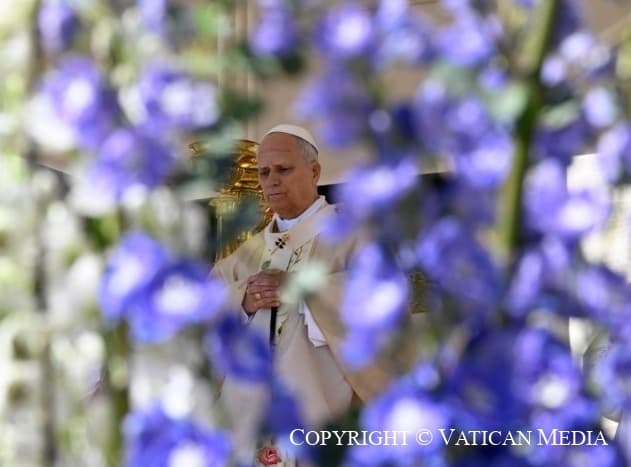
Vatican City (AsiaNews) - Easter is the victory of non-violence. It is the victory not of those who impose their rule, but of those who renounce arms in favour of a peace built through dialogue. This is the message Pope Leo XIV conveyed today to a world ravaged by war in his Urbi et Orbi address delivered from the Loggia of the Blessings at St Peter’s Basilica in the Vatican on the day when the Church joyfully proclaims, even amidst the tears and rubble of bombardments, the ever-new news of Jesus’ resurrection.
Through their battlefields and the impact on people’s lives, today’s wars now afflict the entire world. Perhaps this is why Pope Leo, in his message for Easter 2026, chose not to specifically mention any of the conflicts currently afflicting the world, as is traditionally done on this occasion. The Holy Land, Iran, Lebanon, Myanmar, Sudan, Haiti: he has spoken of them many times during the Angelus and in the general audiences of recent weeks. On the day of the proclamation of the Risen Christ, addressing the whole world, he prefers instead to highlight a theme that unites them all. He has also called for a gathering: a special prayer vigil which he will preside over in St Peter’s Basilica next Saturday, 11 April, to “make heard the cry for peace that springs from the heart”.
Easter is a victory, the Pope reminds us, quoting the words of the Sequence, the ancient hymn that the Catholic Church loves to sing on this day. Victory is the very word that even those who choose the path of war long to utter. But the victory proclaimed by the Risen One is a different one: that “of life over death, of light over darkness, of love over hatred”.
How did Jesus win? What is the power by which he rose from the dead, not returning to his former life, but entering into eternal life? “This strength, this power,” the Pope recalled, “is God himself, Love that creates and generates, Love faithful to the end, Love that forgives and redeems. Christ, our ‘victorious King’, fought and won his battle through trusting surrender to the Father’s will, to his plan of salvation. Thus he walked the path of dialogue to the very end, not in words but in deeds: to find us who were lost, he became flesh; to free us who were slaves, he became a slave; to give life to us mortals, he allowed himself to be killed on the cross”.
Here is this strength of Christ, “utterly non-violent”. The strength of the “grain of wheat which, having rotted in the earth, grows, breaks through the clods, sprouts and becomes a golden ear of corn”. That of the “human heart which, wounded by an offence, rejects the instinct for revenge and, filled with compassion, prays for those who have offended it. Brothers and sisters,” warned Leo XIV, “this is the true strength that brings peace to humanity, because it fosters respectful relationships at every level: between individuals, families, social groups and nations. It does not seek private interests, but the common good; it does not wish to impose its own plan, but to help design and realise it together with others.”
Easter is a victory that calls upon our freedom: “Before the empty tomb,” observes Prevost, “we can be filled with hope and wonder, like the disciples, or with fear like the guards and the Pharisees, forced to resort to lies and subterfuge rather than acknowledge that the one who had been condemned has truly risen.” Hence the appeal: “Let our hearts be transformed by his immense love for us! Let those who hold weapons lay them down! Let those who have the power to unleash wars choose peace! Not a peace pursued by force, but through dialogue! Not with the desire to dominate the other, but to encounter them!”
This is an Easter that, more than ever this year, comes to shake us up. A year after his farewell on the very day of the Risen Lord, Leo XIV recalls the words so often repeated by Pope Francis on the “globalisation of indifference”. “We are becoming accustomed to violence,” he observes, “we resign ourselves to it and become indifferent. Indifferent to the deaths of thousands of people. Indifferent to the repercussions of hatred and division that conflicts sow. Indifferent to the economic and social consequences they produce, which we all feel.”
But Pope Leo invites us to go to the root of this attitude. “We are all afraid of death, and out of fear we turn away; we prefer not to look,” he acknowledges. But he quotes a great piece of advice from St Augustine as a response: “If you fear death, love the resurrection!”, said this great Father of the Church. “Let us too love the resurrection,” urges Prevost, “which reminds us that evil is not the final word, because it has been defeated by the Risen One. He passed through death to give us life and peace.” A peace that “is not limited to silencing weapons, but touches and changes the heart of each one of us”. And which therefore calls on everyone to a “conversion to the peace of Christ”.
And this is also the meaning of the prayer vigil called for 11 April: “On this day of celebration,” the Pope urges, “let us abandon all desire for strife, domination and power, and implore the Lord to grant his peace to a world ravaged by wars and marked by hatred and indifference, which make us feel powerless in the face of evil. “To the Lord we entrust all hearts that suffer and await the true peace that only He can give,” he concludes. “Let us entrust ourselves to Him and open our hearts to Him! Only He makes all things new.”