








Pope in Madrid: Amid today’s ‘dark nights’, Europe can shed the light of unity
In the capital, where he began his long apostolic journey to Spain, Leo XIV urged “everyone to set aside divisive and polarizing narratives" and appreciate complexity rather than “identity-based approaches that [. . .] fill the world with ‘ghosts’.” He cited the examples of Saint John of the Cross and Saint Teresa of Avila, as well as the fruitful dialogue that took place at the time of the Islamic presence in Andalusia. He stressed that “religious freedom” is essential to reach out to others.
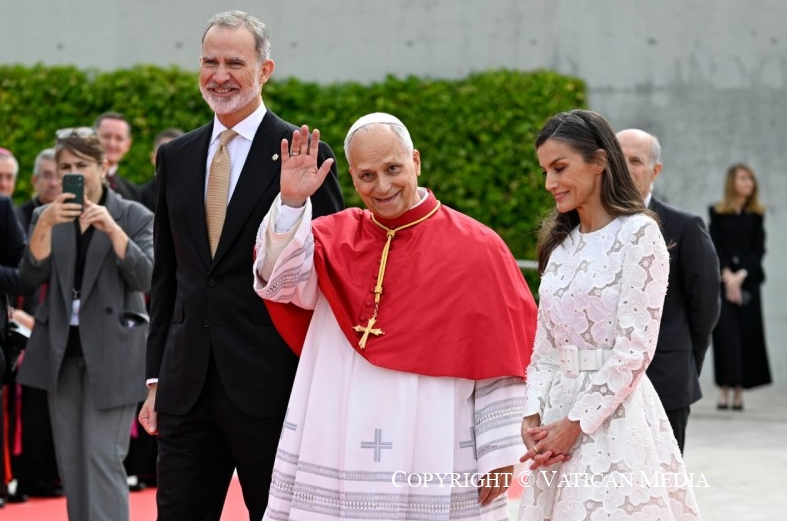
Madrid (AsiaNews) – Pope Leo XIV began his apostolic visit to Spain in Madrid today. In his first address, he said that, “Appreciating and studying complexity, learning not to deny it but to embrace it as a blessing, and fleeing from identity-based approaches that seem to explain everything yet only fill the world with ‘ghosts’ and enemies are the tasks” that Spain and Europe must undertake amid the “dark nights” and crises of today’s world.
The visit, which will last seven days, is packed with different activities, which will take the pontiff to Barcelona to bless the cross on top of the tallest spire of the Sagrada Familia, the masterpiece designed by Gaudí, and to the Canary Islands, a crossroads of migrant routes in the Mediterranean, just steps from tourist beaches.
On the plane after taking off from Rome, Leo greeted journalists who asked him the usual questions about ongoing conflicts around the world. His response was the same, expressing hope for dialogue in Ukraine and closeness to Lebanon. He also spoke about his expectations for this trip, especially the meeting with young people.
Upon landing at Madrid airport, he was greeted by the Spanish royal family and Prime Minister Pedro Sánchez. From there, accompanied by King Felipe, he travelled to the Royal Palace where he addressed the authorities, representatives of civil society groups, and the diplomatic corps in the Hall of Columns.
Stressing how much the Christian faith had shaped the culture of the country and still represents a reserve of hope and guidance for today's challenges, he defined Spaniards as “a passionate people who love life and express it!”
“I think of the expressions of popular piety that stand as an authentic dramatization of salvation in every city and town, in step with the rhythm of the year and life’s various contexts,” he added.
“I come among you to affirm, encourage and instill a renewed fidelity to the Gospel among believers, as well as a deeper reconciliation and collaboration among the various elements of this nation. After all, your own history suggests that a culture of encounter, not confrontation, is what fosters stability and prosperity.”
Leo XIV illustrated this by talking about the fruitful tensions between ideas and reality, proposed by Pope Francis in the apostolic exhortation Evangelii Gaudium, but also drawing on the mysticism, that of “open eyes”, of two great Spanish saints, namely John of the Cross and Teresa of Avila.
“In particular,” Leo said, “upon interpreting the transformations and weathering the tensions that make our age so dark, we can find it helpful to consider the theme of night, so dear to Saint John of the Cross, whose Jubilee Year we are celebrating. Paradoxically, in his thirst for light, he learned to appreciate darkness – the ‘happy night’ – as the time when the soul is freed from what it presumed to know and possess.”
Even today, the pope noted, “we need men and women who can perceive light in the darkness: a new beginning, like the dawn of a truth that as yet blinds us, but which – if we trust and find peace – will gently lead us toward itself.”
The other image he entrusts to Spain is Saint Teresa of Avila’s “interior castle”. “As one moves from room to room toward the innermost chamber – that is, toward one’s own heart, the sanctuary of truth – the space enlarges, the mind opens, challenges are overcome, tensions dissipate, others find their place, and the universe becomes a home.”
Such an inner path is not an escape into oneself, but an overture to God who is totally Other and ever New, opening us to the encounter with one another. This, Leo noted, is “the reason why religious freedom and freedom of conscience must be protected.”
He went on to explain that the Church does not want to impose herself but offer her service to quench the thirst for “culture, interiority, and free quality education; we need transcendence” to enter the human heart.
He called on “everyone to set aside the divisive and polarizing narratives of your societal reality and history, so as to overcome sterile simplifications through the fruitful appreciation of complexity. I see here a vocation particularly suited to Europe, in which Spain plays a unique and fundamental role. This is the gift that the ‘Old Continent’ can offer the world if it wishes to remain young”.
He urged “economic, political and institutional” leaders “to make a qualitative leap forward – a change of direction in investment in schools, universities and research, as well as in local communities and civil society as a nurturing ground for participation and cultural mediation.”
Regarding security, he warned that, “we all too often expect to find [it] in weapons and walls,” whereas Spanish history shows that “it is in fact best achieved by learning to move forward alongside one another, growing together, side by side.”
Speaking about historic Islam’s presence in the Iberian Peninsula, he said, “there was not only confrontation, but also an attempt to create a space for contact, conversation and dialogue on the meaning of truth among Christians, Muslims and Jews.”
He noted that, thanks to this encounter, the West discovered the thoughts of Averroes (1126-1198), the Muslim, and Maimonides (1138-1204), the Jew.
“The cities of Córdoba and Toledo,” he said, “became centers of dialogue between languages, religions and knowledge. This is the truth told by European cities: their historical stratification, the fabric of solidarity that has shaped their differences over the centuries, transforming inevitable conflicts into new beginnings.”
Another example is the great Spanish saint, Ignatius of Loyola, the founder of the Jesuits, who with the method of discernment showed how “trials and failures offer an opportunity for reevaluation.”
“The same can happen with the ‘novelties’ that unsettle us today and often cause division,” he said in a reference to his encyclical Magnifica Humanitas.
Finally, the pontiff expressed gratitude for Spain’s “faithful adherence to international law and multilateralism, which is reflected in an active commitment to peace and solidarity among peoples.”
He encouraged its leaders “to cultivate as well dialogue and civic friendship within your own country, to take into account the perspectives of the poor and the young when envisioning the future, to harmonize the claims for autonomy and unity, and to advance the cause of unity in Europe – not in opposition to other powers, but as a gift to the entire human family.”

.png)
18/08/2017 12:22










