








Pope tells human traffickers to ‘repent’ and ‘Return what has been taken’
Leo XIV spoke at the "Les Raíces" centre in Tenerife. “God’s love knows no borders, makes no distinctions,” he said, adding that, “all of us are migrants.” The pontiff led the Mass on the Solemnity of the Sacred Heart of Jesus, at the port of Santa Cruz, a "privileged place" for the poor in the Church's mission.
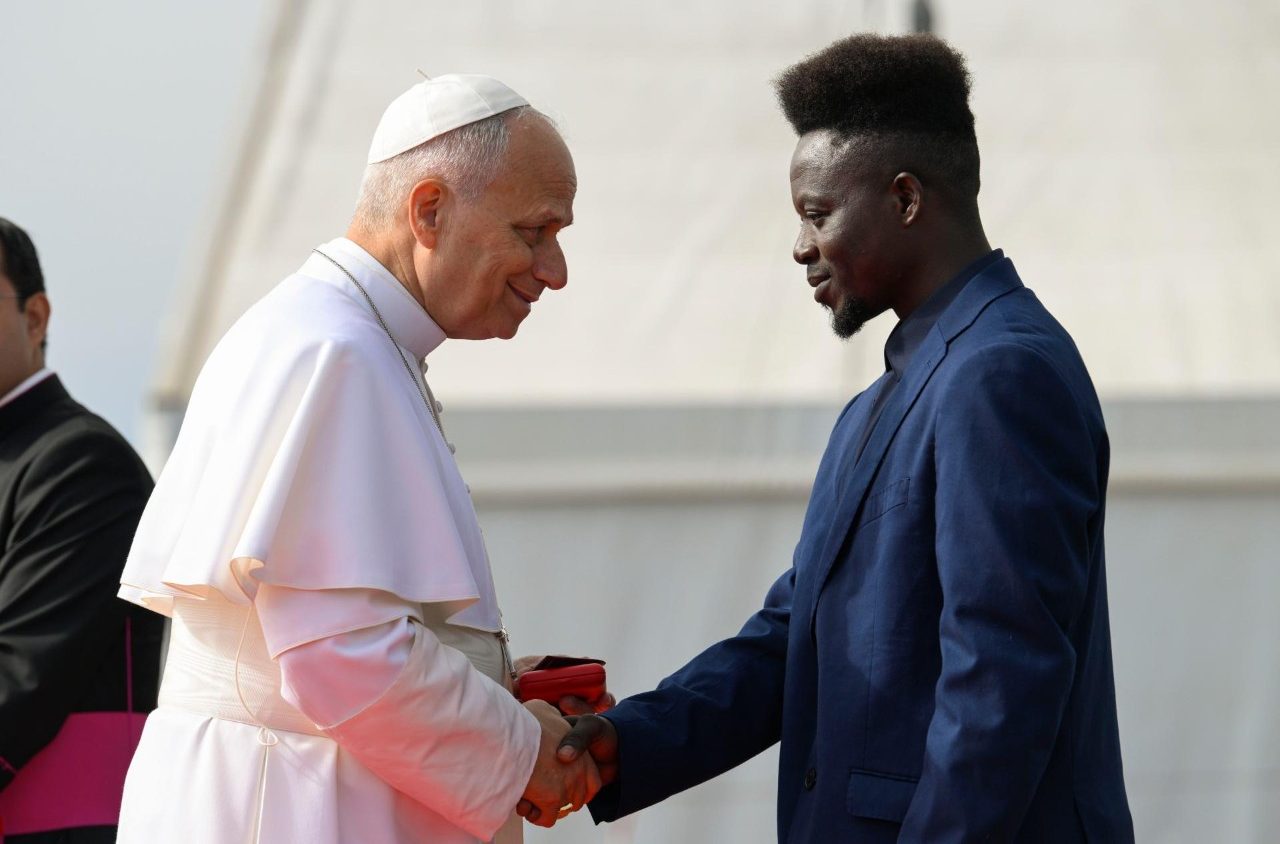
Santa Cruz de Tenerife (AsiaNews) – Pope Leo XIV, on the last day of his apostolic visit to Spain, travelled this morning from Gran Canaria to Tenerife, where, like yesterday, he met with migrants and members of organisations that welcome them, listening to many stories of suffering.
“Dear brothers and sisters, in a sense, all of us are migrants, for we are all pilgrims on our way to our heavenly homeland,” he said, meeting people like Mbacke, Khalid Allad, Thalia Johana Saldarriaga Diago, from Senegal, Morocco, Colombia, three migrants, not numbers, not files, but people who shared their stories with Leo XIV in Santa Cruz de Tenerife.
The first meeting took place at "Las Raíces" (Roots), the largest refugee reception centre in the archipelago, located in San Cristóbal de La Laguna, Tenerife, on the Solemnity of the Sacred Heart of Jesus, where 600 people were waiting to welcome him, including the facility’s director, Ernesto Mayoral, Bishop Eloy Alberto Santiago Raices of San Cristóbal de La Laguna, and Spain’s Minister of Inclusion, Social Security, and Migration Elma Saiz Delgado.
“God’s love knows no borders, makes no distinctions, is given to all and brings us together in unity,” Leo said.
Throughout his visit, marked by numerous encounters, the pontiff listened. “As I look at your faces and listen to your stories, I also think of your hearts – wounded by so many difficulties, yet also comforted by the love you have received from other open, generous and merciful hearts,” he said. Indeed, “Christ’s heart suffered and was pierced out of love, and he was also comforted by compassionate people who eased his pain.”
Leo XIV explained universal love by citing the parable of the Good Samaritan, “a stranger from a foreign town and another religion [who] took pity”. He also cited his immediate predecessor, Pope Francis, stressing the centre’s name, Las Raíces, roots, a term the latter used to stress “the importance of remembering our origins, staying united and trusting in the Lord.”
“May this image of roots also help you to be firmly rooted in the Lord (cf. Col 2:7), so that no storm may drive you away from his presence, which strengthens and gives life,” the pontiff said in San Cristóbal de La Laguna.
While the Canary Islands are known today for the arrivals of desperate people, whom the pope met, there are also those who left the islands, driven “by the love of God, which urges us to heal others’ wounds and to be charitable toward those who suffer”.
Leo cited Brother Peter and Saint Joseph de Anchieta, missionaries who left the Canary Islands in the 16th and 17th centuries to proclaim the Gospel in the Americas. “They too were migrants who ventured into the unknown, carrying faith, hope and charity as their greatest possessions,” Leo said. “In those unknown lands, the holy migrants and missionaries shared what they had and likewise welcomed the new things that were offered to them.”
The pontiff urged people listening to him to offer the humanity, dreams, and culture they bring with them, while remaining "open" to welcoming whatever new things they can receive.
“We must live this exchange responsibly, considering the future generations to whom we wish to bequeath the heritage of a civilization of love. Migration will play an important role in this, as it ‘can become an opportunity for encounter and mutual enrichment among peoples’,” the pope said, citing his first encyclical Magnifica Humanitas (81)
Drawing on the example of the missionaries who set out for the Americas, Leo stressed that we are all migrants and pilgrims, hence, we should ensure that the journey is "more humane for everyone.”
“In this regard, I am grateful for the collaboration of the government, various institutions and the many men and women of goodwill whose collaboration makes this concrete humanitarian aid possible, restoring hope and giving dignity to so many people.”
After visiting a tent housing several migrants and greeting them, Leo moved to the Plaza de Cristo, San Cristóbal de La Laguna, a city without walls, to discuss the reality of migrant integration.
“Perhaps this detail helps us to understand that the barriers that are the hardest to break down are not always made of stone,” he said. “Sometimes they lie in our attitudes, in fear or in indifference.” Instead, “we need to learn the language of closeness, which is understood more with hands than with words.”
In this "open" city, the pontiff said that, “Integration does not mean erasing the history of those who arrive or demanding that they leave behind everything that is part of their memory. Nor does it mean creating parallel worlds, closed off from one another, where people live side by side without truly encountering one another.” To integrate is “a reciprocal journey”.
Addressing fellow Catholics, the pope reminded them that, “integration [can]not be reduced to a social undertaking, however necessary that may be. Those who come to our parishes need bread, shelter, language assistance, work and protection. They also must find a community capable of offering paths to knowing Jesus Christ”, respecting the “conscience and freedom of each person”.
"Stop! Repent!" is the pope's terse call to those “who take advantage of people’s desperation”, those who organise "death routes”, and traffic "in human beings, withhold documents, exploit workers, threaten women, deceive families, and turn the suffering of others into a business.”
“For every life lost, every family deceived, every body subjugated, every woman threatened, every worker exploited, you will have to appear before divine justice,” the pope said.
This brings to mind remarks John Paul II made in 1993 in Agrigento (Italy) about people affiliated with organised crime, Cosa Nostra. “Break those chains and free those you hold in bondage (cf. Is 58:6). Return what has been taken and make amends as much as you can. Repent while there is still time, for God’s mercy can reach even the most hardened sinner, but it enters only through the narrow gate of truth, justice and conversion,” he said.
Before the farewell ceremony from Spain at Tenerife Norte-Los Rodeos International Airport, Leo XIV led Holy Mass in the port of Santa Cruz de Tenerife, before approximately 80,000 people, on the Solemnity of the Sacred Heart of Jesus.
“The sea before us evokes the infinite, and so does the sky; but even more boundless is the infinite longing that joins the heart of God to so many human hearts,” he said in his homily. “No human being is an island. The geographical location of this diocese and the pastoral challenges it faces bear witness to the fact that we are born for encounter,” he added.
Speaking to poor people, he cited the apostolic exhortation Dilexi te. With it, the pontiff stressed the “privileged place of the poor in divine Revelation and in the mission of the Church. This mystery resonates in a unique way on these islands, at the center of migratory routes that make them a place of initial welcome for brothers and sisters whose journey is generally exposed to unspeakable dangers and violence”.
Lastly, “The greatest grace is to allow ourselves to be evangelized by those we assist and to recognize the mysterious wisdom of God written in their very flesh.”

.png)
11/08/2017 20:05
29/09/2024 18:25










