





-65507.html&is_video=&description=Rakhmon%E2%80%99s+visit+to+Beijing+%28flanked+by+Trump+and+Putin%29)


Rakhmon’s visit to Beijing (flanked by Trump and Putin)
The Tajik president’s trip has confirmed just how strategic a region Central Asia is for China today, a strategic importance made all the more vital by the various geopolitical fault lines. Beijing is banking on the gas pipeline running through the region, but also on its significance for the security of its own borders. And in relations with local governments, its proximity – not just geographical – gives it an advantage over its Western rivals.
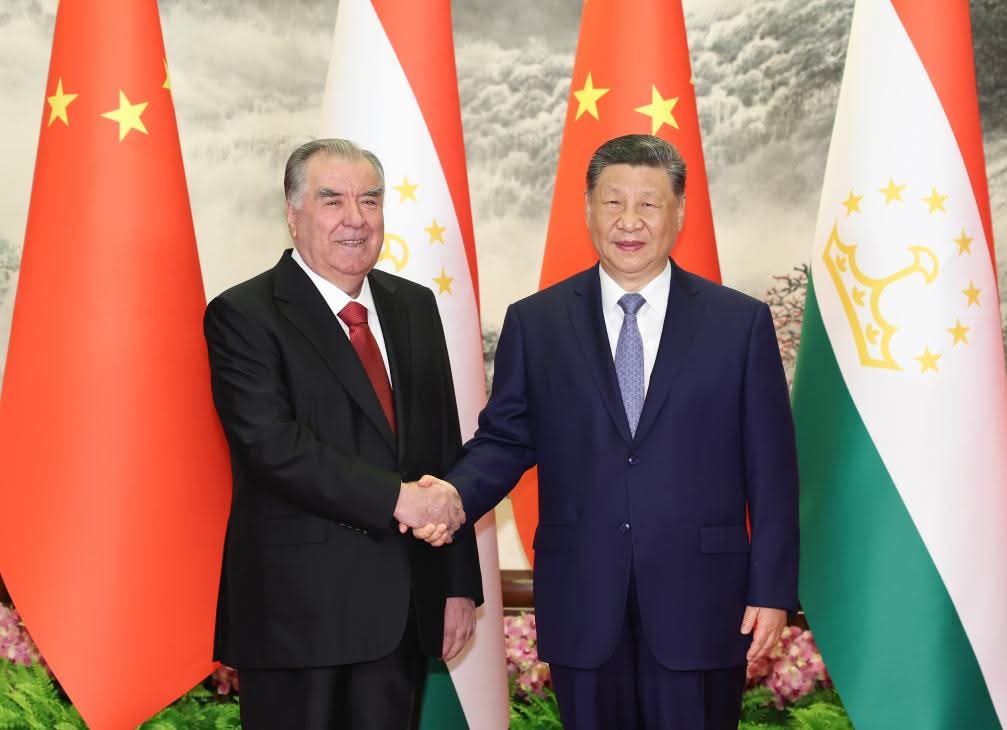
Dushanbe (AsiaNews) - Against the backdrop of global rivalry, China is strengthening its influence in Central Asia, and Tajikistan is becoming one of Beijing’s key partners in the region. The Tajik political scientist Mukhammad Šamsuddinov commented to Asia Plus on the recent state visit to China by the President of Tajikistan, Emomali Rakhmon, which was decidedly overshadowed by those of Donald Trump and Vladimir Putin during the same period, but which demonstrates how Central Asia is becoming an increasingly vital region for China.
The escalation in the Middle East, which led to the blocking of ships in the Strait of Hormuz, the ongoing tensions on the Afghan-Pakistani border that compromise safe access to Pakistani ports, and the rising tensions in the Indo-Pacific region (primarily around Taiwan) with the risk of a blockade of the Strait of Malacca, have highlighted the vulnerability of China’s access to global markets and its energy security.
In this context, Central Asia could play a very significant role for China, providing a means of overcoming its logistical isolation. Beijing is already promoting the Belt & Road Initiative, its global transport and logistics project, in Central Asia, and in the current international context, the region’s importance within this project could increase further. Thanks to its vast potential for natural resources, Central Asia could also play a key role in ensuring China’s energy security.
Beijing has already implemented several major energy projects in the region, enabling it to import large quantities of raw materials, such as via the Central Asia-China gas pipeline, which currently consists of three lines with a total capacity of 55 billion cubic metres per year and runs through Turkmenistan, Uzbekistan and Kazakhstan, through which China imports up to 35 billion cubic metres of gas annually. With the completion of the planned fourth line, total capacity could rise to 85 billion cubic metres. China imports nearly 19 million tonnes of oil per year from Kazakhstan via the Kazakhstan-China oil pipeline project.
Another factor making Central Asia a strategic region for China is security, primarily along the border between Tajikistan and Afghanistan and for stability along China’s north-western borders in general, where the potentially unstable Xinjiang Uyghur Autonomous Region is located. Last year’s attacks by Islamist forces based in Afghanistan against Chinese businesses in Tajikistan confirmed the need to strengthen China’s position in this area. As for Xinjiang, it is also worth highlighting the economic factor in ensuring stability in this region, which is heavily dependent on trade with Central Asia, accounting for over 50% of the region’s foreign trade last year.
As Šamsuddinov observes, the main factor in the development of bilateral relations between the Central Asian countries and China is geographical proximity, which allows the parties to deepen their ties without the transport and logistical barriers that Central Asia encounters with Western countries. Furthermore, Beijing invests in the economies of Central Asia without making such investments conditional on changes in the internal political life of the region’s countries.
There are certainly some risks: excessive dependence on trade and economic relations with China, as well as on Chinese investment (including loans), could lead to negative consequences affecting the independence of Central Asian countries. The presence of such a large industrial neighbour, particularly given Xinjiang’s economic policies and dependence on the Central Asian market, could pose risks to the region’s economies. The import of large volumes of high-quality Chinese products, which will make it difficult for regional products to compete, could lead to stagnation in Central Asia’s industrial base.

.png)
22/01/2024 10:45
12/06/2021 14:56










