








Russia's "literary rebels”
Faced with the crackdown on Moscow bookshops and publishing houses aimed at removing from circulation novels, essays or even literary classics now deemed “subversive”, some individuals are setting up small private libraries to share their books. People gather and talk about the war, without mentioning Ukraine, but by reading stories that would otherwise be impossible to find anywhere today.
Moscow (AsiaNews) - Strict book censorship has now taken hold in Russia, and publishers are forced to remove publications from sale and display warnings about prohibited content, even in volumes on Pushkin or classic literary subjects. In the most recent novels and non-fiction works, it is common to come across pages that have been removed for reasons of censorship. Writers declared “foreign agents” have effectively no chance of publishing their work, and inspections at independent bookshops are now almost a daily occurrence.
As is often the case, every action has a reaction, and a “book resistance movement” is emerging in Russia. Some organise clubs and libraries where people can read and discuss authors freely; others diligently seek to fill the gaps left by censorship; still others amass private collectionsM of ‘dangerous’ books. The website Veter (‘The Wind’) has sought to explore this alternative world in greater depth, with the help of Novaya Gazeta correspondent Irina Kravtsova.
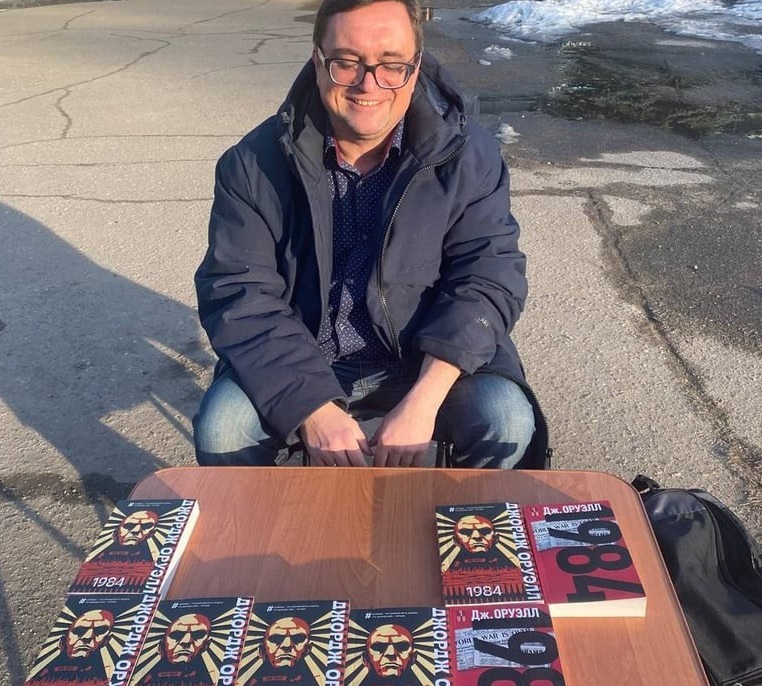
In the city of Ivanovo in central Russia, in an unassuming building in the city centre, the ground floor houses a few small shops and the first floor offices; amongst these, since 2022, a small library named after George Orwell has been hidden away, attracting many people of diverse backgrounds, including agents from the centre for combating extremism. Following the invasion of Ukraine, local entrepreneur Dmitry Silin was shocked, and began driving around with the song ‘We Don’t Need War’ by the band Nogu Svelo blaring at full volume, displaying a photo of his veteran grandfather on the street with the caption ‘My grandfather fought for peace’. Immediately after the tragic date of 24 February, he bought around a hundred copies of Orwell’s 1984 to “help people understand what is happening”, and distributed them to students across various faculties in Ivanovo.
A group of activists quickly formed around Silin, starting with 70-year-old Olga, who had spent her entire life teaching ancient Roman history at the university. Together they began encouraging anyone interested to read dystopian novels such as Zamyatin’s *We*, Huxley’s *Brave New World*, Tolstoy’s *Hadji Murat*, and the Strugatsky brothers’ *Hard to Be a God*. Olga would go out every afternoon at 4 pm until dark, strolling along the recently restored riverside promenade with many other citizens and handing out the books. With the arrival of the autumn chill, Dmitry and Olga, along with many others who had joined them, decided to open a private library, stating that ‘this situation in Russia cannot last forever, and we will need people capable of proposing alternative ways of viewing society’.
Silin was subsequently subjected to considerable pressure from the authorities, including fines, searches and arrests, until he was forced to leave Russia in 2023, but the library continues to exist and is supported by a great many people. Now the ‘George Orwell’ library holds around a thousand volumes, mostly collected by the founder, but also by activists in the years that followed. People gather and talk about the war, without mentioning Ukraine, but reading stories from books that would otherwise be impossible to find anywhere.
Kravtsova recounts many stories similar to that of the Ivanovo library, such as that of 25-year-old psychotherapist Elizaveta from St Petersburg, who was asked for her passport last February at a collection point for goods bought online, because among them was a book by the Argentine author Andrés Neuman, *Once Upon a Time in Argentina*, which describes the lives of several generations of emigrants in Latin America. She then discovered that almost all the books in her private collection are banned in Russia, “I couldn’t believe it”, and now she is trying to share them with as many people as possible. As Elizaveta says, “the library is our Bolotnaya”, referring to the Moscow square where Alexei Navalny’s major protests took place, which now find expression in the pages of the many books banned from a people who love to read, and who will not allow themselves to be deprived of this opportunity to discover new worlds.
Photo: Dmitry Silin with some copies of George Orwell’s 1984 (image taken from the Veter website)

.png)










