








Seoul’s rise in the arms market amid the war in Iran
The low costs and efficiency demonstrated by the Cheongung-II missile defence system in the United Arab Emirates are reviving South Korea’s ambitions, having more than doubled the volume of its arms exports over the last 15 years. But the conflict is also highlighting the opacity of the political agreements signed in 2009 with Abu Dhabi by then-President Lee Myung-bak.
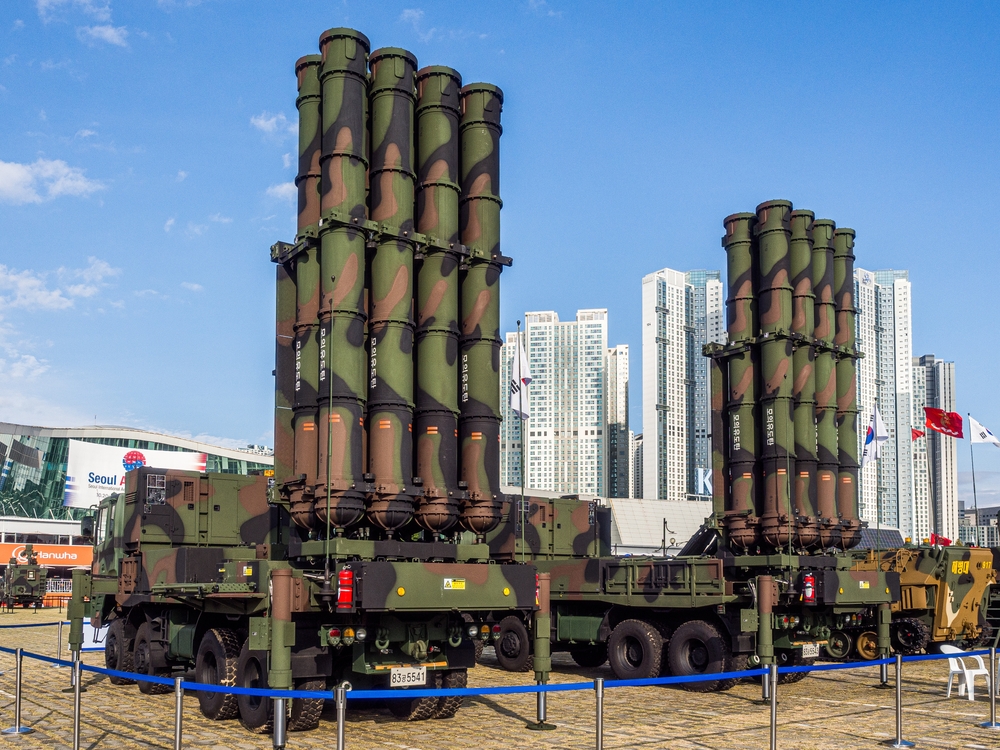
Milan (AsiaNews) - In the space of a few years, South Korea has become one of the world’s leading arms exporters, with a growth rate that is virtually unprecedented in the sector. The war in Iran has given this rise a further boost, offering the South Korean defence industry something that no defence fair or simulation could provide: real-world testing in a context of actual conflict.
The Cheongung-II anti-missile system, deployed in the United Arab Emirates against waves of Iranian ballistic missiles and drones, recorded an interception rate of over 96%, according to data provided by the South Korean parliament’s defence committee. This figure is comparable to that of the US Patriot and THAAD systems deployed in the same area, but with a substantial difference in price: each Cheongung-II interceptor costs around one million dollars, compared to nearly four million for the Patriot PAC-3 produced by Lockheed Martin. For Gulf countries rapidly depleting their anti-missile stocks, the combination of high performance and low cost has transformed the Korean system from an attractive alternative into an urgent necessity.
South Korea’s response to the UAE’s urgent requests for supplies at a time when they found themselves in difficulty was swift and politically significant. Seoul delivered some thirty interceptors to Abu Dhabi ahead of the contractual schedule, drawing directly from its own operational reserves and using South Korean Air Force C-17 military transport aircraft. This is a gesture that goes beyond a commercial transaction, as South Korea chose to temporarily reduce its own defensive arsenal at a time when the United States itself, also facing difficulties, was moving Patriot batteries and THAAD components from the Korean peninsula to the Middle East, leaving the country more exposed to North Korean threats.
An industrial ecosystem built over thirty years
The rise of the South Korean defence industry cannot be explained solely by the success of the Cheongung-II. The Iranian conflict has highlighted an integrated industrial ecosystem developed over many years, in which each end product is the result of the coordinated work of several companies, each responsible for a specific component. In the case of the Cheongung-II, LIG Nex1 is responsible for the overall architecture and the interceptors, Hanwha Systems supplies the radar, and Hanwha Aerospace, South Korea’s largest defence group, manufactures the launchers. This supply chain structure allows for faster production times compared to Western competitors, with the possibility of increasing production capacity within a year, or even less, by implementing double shifts. By way of comparison, delivery times for the US-produced Patriot PAC-3 are around 4–6 years.
The growth of South Korea’s defence industry extends not only to its production capacity but also to exports, which are accelerating steadily. South Korean arms exports reached a record .4 billion in 2025, up 60% on the previous year. According to the Stockholm International Peace Research Institute (SIPRI), South Korea has become the world’s ninth-largest arms exporter, with volumes more than doubling over the last fifteen years. The Seoul government has set itself the target of reaching fourth place by the end of the decade. Almost 60% of South Korean arms exports between 2021 and 2025 went to Poland, which, since 2022, the year Russia’s war against Ukraine began, has purchased Hyundai Rotem tanks, K9 self-propelled howitzers and Chunmoo rocket launchers from Hanwha Aerospace, as well as training jets from Korea Aerospace Industries, with a total value exceeding billion by 2025. The Polish orders have served as a bridgehead to a rearming Europe, and Norway signed a two-billion-dollar contract this year for the Chunmoo missile system, preferring it to the American Himars, whilst Estonia has ordered Chunmoo rocket launchers worth 290 million euros. The financial markets also reflect this transformation. Hanwha Aerospace’s shares have risen nearly tenfold in the space of a single year, and those of Korea Aerospace Industries have tripled in value.
The political price of success
The speed of this expansion, however, is presenting Seoul with political problems it had hitherto been able to postpone, and relations with the United Arab Emirates are the most concrete example of this. At the end of February, two days before the start of the bombing of Iran, the two countries signed a billion agreement, billion of which is in the defence sector, covering anti-aircraft systems, aviation and the navy. But military cooperation between the two countries goes back further. Since 2011, South Korea has maintained the Akh unit in the Emirates, a special forces contingent stationed at the Al-Ain base to train Emirati forces. It is the only South Korean military unit deployed abroad authorised to conduct operations independently and to participate in combat outside of peacekeeping missions. This link has its roots in the 2009 civil nuclear agreement and, according to findings from a South Korean prosecution investigation into former President Lee Myung-bak, is said to include a secret mutual defence pact that would oblige Seoul to intervene militarily in the event of a crisis. The agreement is said to have been concluded without parliamentary approval, and no official text has ever been made public.
The delivery of interceptors from its operational reserves to a country at war has brought questions about the true scope of such agreements back to the fore, at a time when Seoul’s network of military commitments continues to expand. The KF-21 Boramae fighter, the first production model of which was unveiled at the end of March with plans to produce 40 units by 2028, was developed jointly with Indonesia and is attracting interest from Saudi Arabia, the UAE and several Southeast Asian countries. This is a programme involving long-term industrial cooperation for the development, local assembly and co-export of future variants.
As the website The Diplomat noted in an analysis, South Korea has built its export strategy on the implicit premise that selling sophisticated weaponry and managing the political consequences of their use were two separable issues. In just a few weeks, the war in Iran has shattered this illusion. A country that supplies the systems defending an ally’s cities, maintains troops on its territory and provides emergency supplies in an active conflict zone is no longer merely an arms supplier, but an actor directly involved in the regional security balance.
The major historical arms exporters, from the United States to France, have taken decades to develop doctrines and institutional frameworks capable of managing the tension between commercial relations and involvement in conflicts. Seoul, a relatively new player in the global arms market, has not yet built an equivalent infrastructure, and the speed of its rise makes this shortcoming all the more difficult to ignore. The Iranian conflict has served as a global showcase for the South Korean arms industry, but also as a warning. Every contract signed, every missile delivered to a war zone, brings Seoul closer to a role it had hitherto preferred to leave to others.

.png)










