Vatican City (AsiaNews) – The Holy See today launched the mining divestment platform, aimed at promoting ethical finance within the framework of integral ecology, inspired by the Social Doctrine of the Church, and documents on ecology and responsible investment.
Pope Francis’s encyclical Laudato Si' was referenced extensively in the presentation held this morning at the Holy See Press Office.
The project – both a "call for collective participation" and a "space for information exchange" – aims to counter the "predatory extractivism" that harms Creation and "real communities," often Indigenous, across the globe, in Latin America but also in many regions of Africa, Asia, and Oceania.
The initiative, promoted by 45 organisations, seeks to highlight the "relationship between mining and the financial world," explained Fr Dario Bossi, a Comboni missionary with experience in Brazil in places affected by mining and coordinator of the Red Iglesias y Minería (Churches and Mines Network).
"All participating institutions can compare their ethical codes of divestment, or investment," he explained.
The Platform is a way to share the Church's critical view "of mining that violates rights," for this reason, "it is redirecting its investments." This is a concrete way to give "visibility to the symbolic and concrete weight of Church investments," said the Comboni missionary.
Father Bossi explained that the request is particularly felt in Latin America and the Caribbean, backed by bishops and Christian leaders of various denominations.
He cited "corporate strategies" that aim to maximise profits, and have a "violent impact" on society, often with public funds.
The Platform aims to divest from "mines that kill or violate rights, as an ethical response, attentive to social and environmental impacts," he added.
He urged “the Church, religious congregations, faith-based organisations, and social entities" to review where their financial resources are invested.
Cardinal Fabio Baggio, undersecretary of the Dicastery for Promoting Integral Human Development, also spoke this morning, stressing that the initiative stems "from a deep moral and spiritual conviction," which leads to a review of errors “at home”, i.e. in the Vatican's past decisions.
The cardinal highlighted a "decisive question": “What kind of world do we want to leave to the generation that comes after us?" This is not an "abstract question," he said, for it bears the face of peoples and families who "see their territories under threat” along with Creation, which is "God’s gift”, as well as the sight of the “mountains with open wounds and rivers turned into silent witnesses to contamination.”
“In many regions of the world, the expansion of the mining industry has generated profound social tensions and serious environmental impacts,” he said.
“We know that minerals are necessary for many aspects of contemporary life," but such activities have been undertaken “without listening to local communities, without respecting the rights of indigenous peoples, and without considering the limits of the ecosystems that sustain life."
The cardinal's appeal is to "listen" to the voices of wounded communities affected by "glaring injustices" who cannot "remain silent," for this is an "act of coherence with our faith, with the defence of human dignity."
Representatives of the peoples affected by the effects of mining activities were given ample space during the press conference.
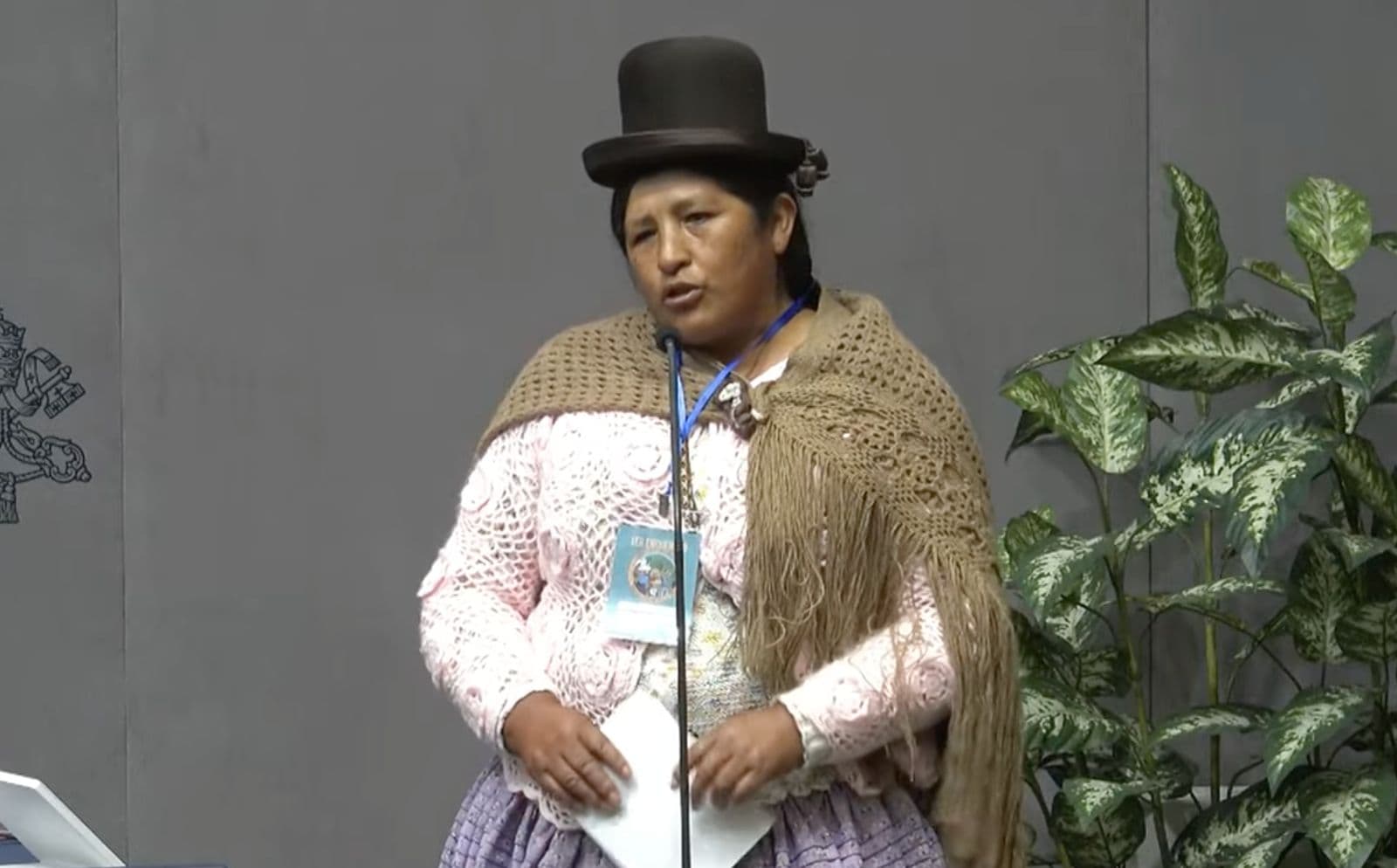
Yolanda Flores, an Aymara leader from Peru, was one of the speakers. She said that her people live in territories of great interest for minerals that are critical for technology and the energy transition.
Visibly shaken and emotional, Flores explained that mining contaminates water and land, the communities' lifeblood. “Who pays for this? Who gives money to poison?" were the key questions she asked, pointing to the disconnect between biblical teachings and practical healing.
Weeping, she said that institutions blame women for the spread of diseases, claiming they don't know how to cook. The truth is that the water and land are contaminated.
"We can't treat the effects of heavy metals with traditional medicine," she explained, adding an appeal to the clergy to not take care of the Sacraments alone. "We must have respect for our common home," she added, truly putting into practice "what Jesus said.”
The Platform is thus a precious and "very important" space for affected Indigenous peoples, allowing them to feel "included”, their voices heard and welcomed.
Cardinal Álvaro Ramazzini was also present at this morning's press conference. As bishop of Huehuetenango, Guatemala, he is known for his advocacy of human rights, Indigenous peoples, migrants, and social justice.
Ramazzini reiterated the concept of “integral ecology”, a cornerstone of Pope Francis's encyclical on the care of creation, Laudato Si'. In it, creation is called a "common home", a "special name”.
The document teaches that "everything is interconnected," including the economy, the foundation upon which the new Platform is based. From this conviction, it is now more urgent than ever to identify and support "solutions to the ecological crisis humanity is currently facing,” especially since it affects disproportionately the south of the world.