








The distorted use of the Bible in Israel that is setting Lebanon and its cedars ablaze
Whilst the third round of talks between the Israeli and Lebanese ambassadors is underway in Washington, people continue to die in the south. Reflections from the AsiaNews correspondent: “Faced with threats and provocations that seek to normalise war, today we need responses rooted in our deepest culture and ethical principles”.
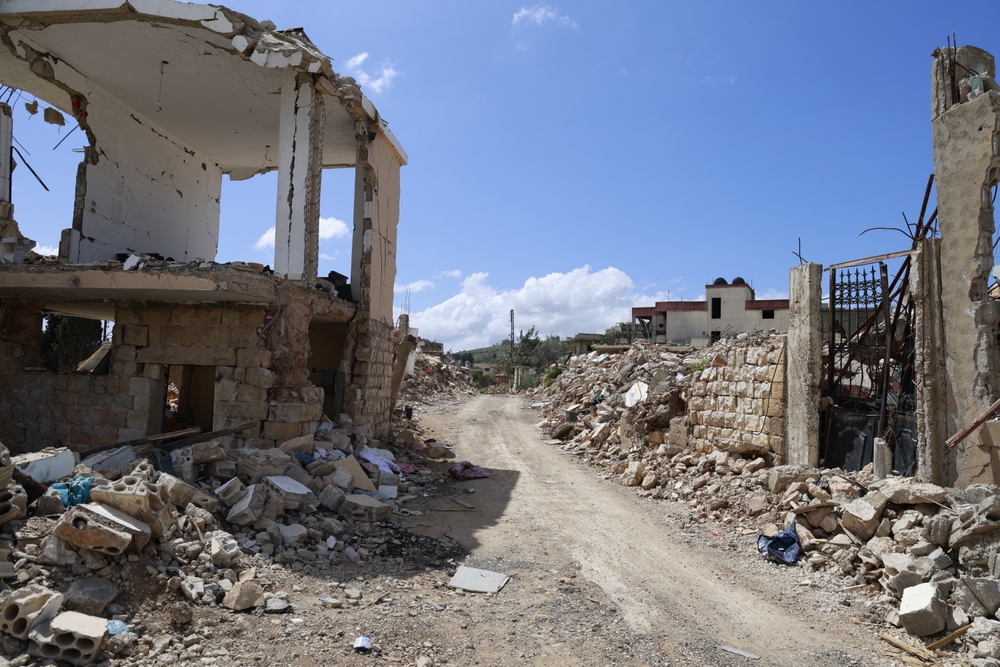
Beirut (AsiaNews) - The third round of direct talks between Israel and Lebanon began yesterday in Washington, mediated by the US State Department, in the presence of the respective ambassadors of the two countries. Discussions between the parties are continuing today, with the hope of breaking the deadlock in the negotiations and reaching an agreement that could bring an end to the conflict; US sources present at the meetings describe the talks as “productive and positive”, but no significant breakthroughs have yet been recorded. Meanwhile, attacks by the Israeli army continue; in recent days, it has struck southern Lebanon on several occasions, causing over 20 deaths and dozens of injuries. In response, Hezbollah has targeted Israeli positions, with a drone reportedly exploding near the border at Rosh Hanikra, injuring three people. Below is a reflection from our correspondent in Beirut:
What is one to say to Israel Katz, the Israeli Defence Minister, when he challenges Lebanon by claiming that “soon fire will devour its cedars”? What is one to say to Bezalel Smotrich, the Israeli Finance Minister, who mocks Lebanon and claims that his son asks him “to leave him something to destroy”? Israeli government officials should tone down their rhetoric. Words have consequences.
Israel Katz quotes the Book of Zechariah: “Open your gates, Lebanon, and let the fire devour your cedars […]. Wail, oaks of Bashan, for the impenetrable forest has fallen; the groans of the shepherds are heard; their splendid pastures are ruined. The roar of the young lions is heard, the luxuriance of the Jordan is ruined’ (Zech 11:1–3). In this passage, threatening the cedars symbolically threatens an entire country and its cultural and historical heritage. It is somewhat hasty to say this of a nation with such a long heritage as Lebanon.
As mentioned, these biblical references serve to normalise the war in Israeli public opinion, to legitimise it, to make people believe that it was prophesied. It is precisely for this reason that it is essential to respond to Israel Katz on a different level. Experience has in fact shown that bellicose rhetoric does nothing but reinforce the cycle of violence and builds neither justice nor lasting peace.
Instead, they risk fuelling escalation and animosity between the populations, precisely at a time when talks are beginning aimed, at the very least, at a definitive cessation of hostilities. A diplomatic response, invoking international law, national sovereignty and the need for dialogue, is therefore the fairest and most pragmatic way to protect future generations and regional stability, whilst avoiding the trap of mutual provocation.
The moral of the story
On an ethical level, it is also worth remembering that violence or threats directed at others are never a legacy to be passed on. When a public figure states that his son asks him to leave him ‘something to destroy’, he is positioning himself as an instigator of hatred and violence. The Israeli minister’s words are the last thing a father should utter in front of his son, who was seriously wounded in Lebanon. On the contrary, Israeli political leaders have a duty to protect, educate and instil in their people the principles of justice, responsibility and mutual respect, rather than adding further fuel to the fire.
Laughing at others’ misfortunes
It hardly needs saying how immoral it is to laugh at others’ misfortunes. As children, our elders would scold us when we made fun of someone else’s physical defect, such as a hunchback or some other abnormality, or a speech impediment. To teach us respect, they would warn that God would afflict us with the hump or defect we had laughed at. We thus learnt that there is an invisible justice, inherent in creation, which restores human balance when it is disrupted. Surprisingly enough, we find this subtle law of justice—or, let us say, of balance—in the Book of Proverbs, one of the most frequently quoted books of the Bible: “Do not rejoice at the fall of your enemy, and let not your heart exult when he stumbles,” the Book warns, “lest, seeing this (also translated as ‘your wickedness’), God change his mind” (Chapter 24).
The Book of Proverbs is perhaps one of the sources of our wisdom for living. In the civilisation shared by all the Semitic peoples of the region, words have consequences. This idea is, for example, very much present in the Psalms, where it is said that those who seek to harm others will find themselves trapped in their own schemes. Psalm 7 states that “whoever digs a pit will fall into it. And their own work will come back upon their own head”. The image itself reflects the idea that threats or violence will backfire on those who perpetrate them.
Psalm 37 advises: “Do not fret because of the wicked, nor be envious of those who do evil […]. The wicked draw the sword and bend the bow to bring down the poor and the needy […]. Their swords will pierce their own hearts, and their bows will be broken.” It is a poetic and moral way of reminding us that unjust violence does not triumph for long. The figurative language of these maxims of practical wisdom reminds us that wickedness, violence and destruction often backfire on those who instigate them. The Psalms often combine these two themes: the threat that backfires on the aggressor and the protection and/or reward of the righteous.
The memory of the villages
Moreover, beyond the symbols, Lebanon holds within it the centuries-old memory of the southern villages that Israeli bulldozers are destroying. This southern Lebanon is part of the land trodden by the feet of Christ and is worth, in the eyes of the Lebanese, particularly the Christians, as much as all the country’s other treasures put together, including the Holy Valley and the Cedars, Baalbeck and Beiteddine. Every Lebanese feels, in the face of the vanished villages, a deep sorrow, but also a call to resilience and a trust in the destiny of their country.
To visit the home of a Lebanese person is to return to one’s own home, but to come there as an enemy is to condemn oneself to misfortune.
The country emerged as an independent state after centuries of migrations, invasions, dominations and external and internal pressures. Today, it continues to protect a sovereignty and territorial integrity won through hard struggle. Threatening its people or its national symbols will not paralyse it. On the contrary, such statements strengthen its resolve, as well as that of its friends and partners, to continue with confidence to prioritise what constitutes its strength: dialogue, diplomacy and collective responsibility. To borrow the imagery of the prophet Zechariah, the time will come to call to account the bad shepherds who have left the sheepfold—that is, the country’s borders—defenceless.
Freedom and pluralism
In the face of threats and provocations, we therefore need responses rooted in our deepest culture. Diplomacy, prudence, circumspection and a sound understanding of our own issues, as well as of the current adversary, together with an appeal to ethical principles and the assertion of sovereign rights, constitute the best response to the inflammatory words hurled in our direction. Therefore, the true strength of the Lebanese will lie in their ability to resist provocations, to defend justice—including the Palestinians’ right to an independent state—in close coordination with all the states of the Arab League, and to convey to the world the values of freedom, pluralism and dialogue that lie at the heart of Lebanon’s historic mission.
The Beirut Synagogue
In a recent interview with the daily La Croix (20 April), Avraham Burg, former Labour Speaker of the Knesset, former head of the Jewish Agency and former president of the World Zionist Organisation, does not hesitate to speak of Israel’s “moral failure”, whose soldiers raze our villages to the ground, ransack our homes and desecrate our religious symbols. “Israel is currently completely morally corrupt,” Burg continues, expressing particular outrage at the death penalty law applied selectively to Palestinians found guilty of ‘terrorism’. “More generally,” he warns, “the government has compromised Judaism, the universality of justice and all the values on which Israel claimed to be founded.”
“Surprisingly enough,” adds the former Labour leader, “the only voice in favour of a sensitive and responsible humanity is that of the Pope. Leo XIV avoided politics as much as possible, but he cannot do so any longer. And that is why, in a very dialectical way, he represents my spirituality and my value system, and not the rabbis.” One is tempted to say the same of Lebanon, whose Constitution reserves a place for the Jewish community on the same footing as the country’s other seventeen community groups, and where the synagogue destroyed during the war has been restored and occupies a prominent place in the historic centre of Beirut.
(Article originally published in Levant Time)

.png)










