In the book *Church of Hitchhiking* by the Russian Orthodox priest Aleksej Uminskij and the journalist Ksenia Lučenko, published in April by *Vidim Books*, the dismissal of a priest, his suspension from ministry and his reduction to the lay state within the Russian Orthodox Church are presented as entirely arbitrary.
There is no preliminary investigation, no time to examine the allegations: the priest simply receives a notice signed by the president of the ecclesiastical court, devoid of any grounds, declaring his reduction to the lay state. This means he is no longer a priest and cannot celebrate the liturgy, hear confessions, administer communion, baptise, marry people and so on – in short, he is no longer the person he has been all his life.
The website Sistema has investigated how ecclesiastical courts are structured in Russia, how investigations are conducted, who the judges are, who drafts and interprets the laws, and, finally, whether priests can avoid judicial arbitrariness.
The public initiative ‘Christians Against War’ already includes at least 47 priests and deacons of the Russian Orthodox Church who have been subjected to various forms of repression, ranging from suspension from ministry to reduction to the lay state, for their pacifist positions and for refusing to recite the ‘Prayer for the Victory of Holy Rus’ prescribed by Patriarch Kirill, in which the priest informs the Lord that “behold, those who wish to wage war have risen up against Holy Rus” and asks for “victory through Thy power”.
From Vladivostok to Vilnius, priests are being defrocked. Father Uminsky says he regularly receives confused letters every week from former colleagues across the country. Many Orthodox priests find it impossible to pray for war, but fear denunciations and ecclesiastical trials. Uminsky was suspended from ministry on Christmas Eve 2024, and his subsequent demotion to the lay state did not follow a set procedure, but took place via telephone calls and informal meetings. Archpriest Vladimir Divakov, dean of the central district of Moscow for the Russian Orthodox Church, telephoned to say that he was expecting Father Aleksey at his Church of the Great Ascension on Nikitskaya Street the following day, to hand him a decree, without specifying what decree it was.
Divakov, one of Moscow’s most senior priests and rector of the famous ‘church where Pushkin was married’, is known among the clergy as ‘Koshchei the Deathless’, an evil hero from Russian fairy tales who spreads evil alongside the witch Baba Yaga.
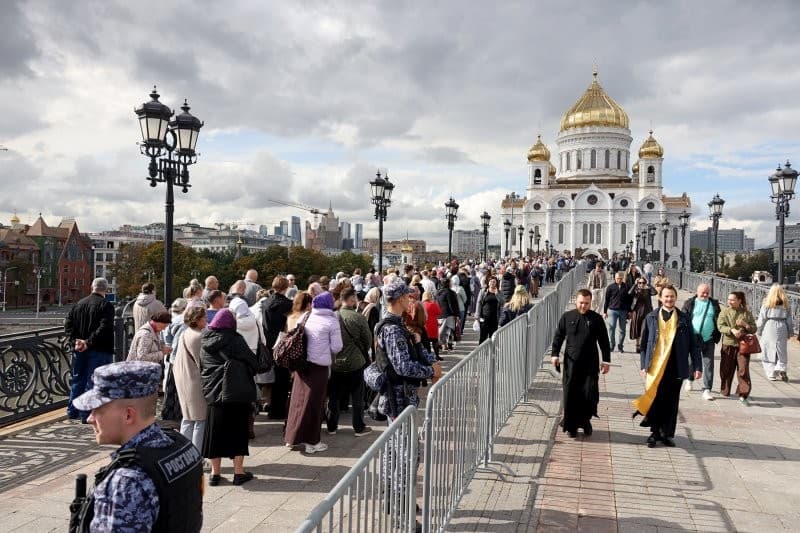
He has been rector of the Church of the Great Ascension since 1990 and regularly concelebrates with the patriarch on feast days at Christ the Saviour Cathedral, holding the rank of protopresbyter and boasting an impressive list of ecclesiastical honours: the Patriarchal Commemorative Cross with decorations, the Order of St Seraphim of Sarov, the Order of St Sergius of Radonezh, and the Order of Prince Vladimir, which he displays on his cassock like a general in the Russian army.
At noon on 5 January 2024, in the Church of the Great Ascension, Divakov handed Father Aleksey a decree of suspension from ministry, ordering him to report immediately to the disciplinary commission at the Church of the Archangel Michael on Pirogovskaya Street, and adding that he felt deep compassion for him. Less than an hour later, the disciplinary commission asked Uminsky several questions as to why he was not reciting the ‘Prayer for the Victory of Holy Rus’.
Upon receiving the reply – ‘I do not know what Holy Rus is’ – the commission announced to the priest his suspension from ministry and ordered him to remove his pectoral cross immediately.
A priest who knew him warned him that his arrest was scheduled to take place immediately after the ecclesiastical trial, this time by the secular authorities. Father Aleksey did not appear at the trial and left Russia immediately.
He received only the following notification by email: “His Holiness Patriarch Kirill of Moscow and All Rus’ has approved the decision of the Moscow Diocesan Court of 13 January 2024 to reduce him to the lay state in accordance with Canon XXV of the Holy Apostles, for having violated his priestly oath (perjury) by refusing to recite the patriarchal blessing for the prayer for Holy Rus’ during the Divine Liturgy”.
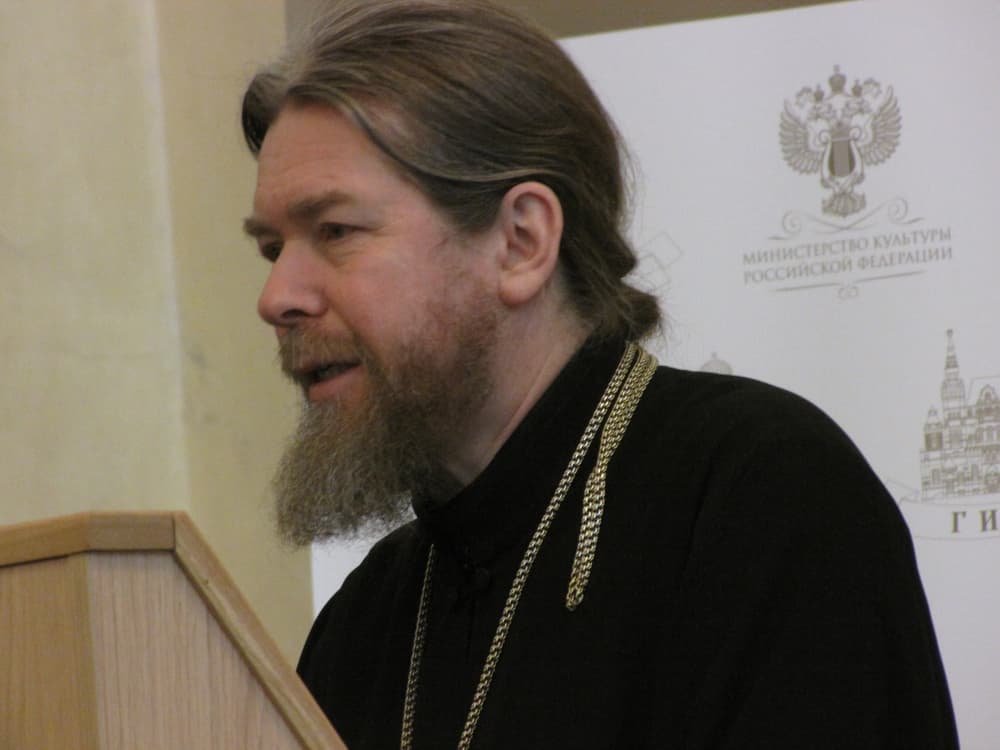
Deacon Andrei Kuraev, defrocked in 2020 for “blasphemy against the Church” and “publication of slanderous information”, namely criticism of church hierarchs, has written an 800-page book on ecclesiastical courts, “Paradoxes of Ecclesiastical Law”. Father Andrei explains to Sistema: "The ecclesiastical court is something of a novelty in the life of the Russian Orthodox Church. In the 19th century, ecclesiastical courts functioned normally, but the Soviet regime abolished this tradition. Formally, the court was restored in 2004, but in reality it only began to function under Gundjaev [Patriarch Kirill], who drafted the rules of the ecclesiastical court on the spot because it does not always suit him to deal personally with undesirable priests”.
The deacon explains that in overseas dioceses, the Russian Orthodox Church generally tries to maintain a flexible stance, turning a blind eye to the clergy’s anti-war statements, not insisting too much on the recitation of the ‘Prayer for Victory’, and compromising with local authorities to avoid losing parishioners.
This is what happened, for example, in Latvia: in 2022, the Riga parliament declared the Latvian Orthodox Church separate from the Russian Church. The Council of the Latvian Church amended its statutes, but Moscow offered no canonical response; it neither excommunicated the Latvian “schismatics” nor recognised Latvia’s autocephaly, merely expressing understanding for the difficult political situation and inviting the faithful to “maintain unity”.
In Lithuania, things turned out differently: the priest Vladimir Seljavko, who was defrocked in 2022, recounts that during the tenure of Metropolitan Khrizostom (Martiškin), until his death in 2010, the life of the Lithuanian Orthodox Church was practically independent of Moscow.
Metropolitan Innokentij (Vasilev), who succeeded Khrizostom and remains head of the diocese, is also known for his liberal views, but times are changing. “He is a gentle man, not bloodthirsty,” says Father Vladimir, who served as the metropolitan’s secretary for over seven years, speaking of Innokentij, “but he is a coward; he is afraid of everything. He is afraid to go to the doctor, he is afraid to drive on narrow roads; he always asks to be accompanied on the motorway. And above all, he fears his superiors.”
Father Uminsky recounts that his appeal to the Ecumenical Patriarch, his reinstatement and the search for a new post as a priest of the Patriarchate of Constantinople took more than a year. It is no simple procedure; it required personal contacts, the help of colleagues in France and Belgium, a personal meeting with Patriarch Bartholomew, the search for a parish willing to welcome a reinstated priest and, only then, the fresh start to his priestly life.
“It’s like hitchhiking between Churches,” says Father Aleksej, who, from the church in Paris where he now carries out his ministry, travels throughout Europe to tell his story and speak with the many Russians in the diaspora, to whom he recommends “living Russia in the present” wherever they now find themselves, because “there is no Russia of the future”. One must make a painful break with the past and “forbid oneself the future”, because hope lies not in changes that never come to pass, but in the witness of those who face life without being crushed by the tragedies of war and the shame of the Churches.
RUSSIAN WORLD IS THE ASIANEWS NEWSLETTER DEDICATED TO RUSSIA. WOULD YOU LIKE TO RECEIVE IT EVERY SATURDAY? TO SUBSCRIBE, CLICK HERE.