








The shifting alliance between Moscow and Tehran
Foreign Minister Abbas Arakhchi’s visit to St Petersburg has confirmed that, following the invasion of Ukraine, Iran has become an “irreplaceable supplier” to the Russian army, which has been weakened by problems with arms production and heavy losses at the front. Meanwhile, Moscow’s know-how is now making Tehran’s drone attacks more effective in terms of navigation and precision.
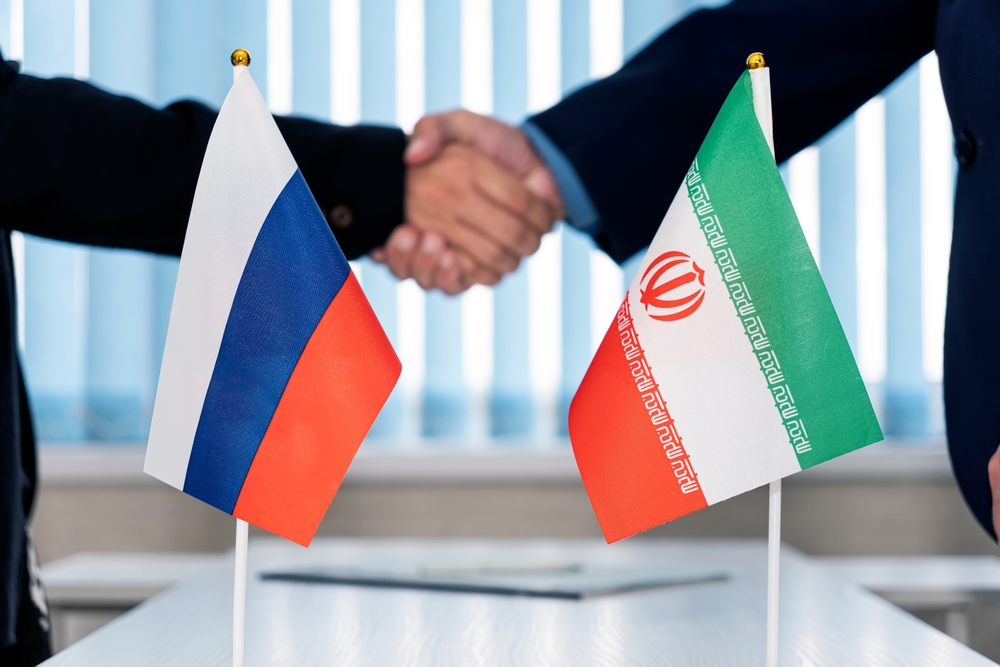
Washington (AsiaNews) - A consensus has emerged among American politicians and foreign policy experts regarding the alliance between Russia and Iran, which is no longer a mutually beneficial partnership but a kind of “fluid military alliance” – an axis that is more difficult to decipher and which determines the intensity of military actions in both the Middle East and Ukraine. The visit to St Petersburg by Tehran’s Foreign Minister, Abbas Arakhchi, has further fuelled concerns in this regard.
At the recent session of the Helsinki Commission, rhetorical tones alternated with intelligence briefings, and Congressman Joe Wilson described the situation as “a threat of global significance”, stating that “the United States must fight not only against Iran, but against the broad alliance between Russia and Iran”. In his view, the two states are not merely partners, but “a coordinated front opposing US global leadership” through arms deliveries, information sharing and schemes to circumvent sanctions.
The evolution of relations between Moscow and Tehran is becoming increasingly intense and diverse, and the director of the Iran programme at the Foundation for Defence of Democracies, Benam Ben Taleblou, describes it as “a shift from instability to pragmatism, and ultimately to constant change”. Since the Russian invasion of Ukraine in 2022, these ties—rooted in the early post-Soviet era—have received a particular boost, extending beyond the sale of Russian arms and Russia’s construction of Iran’s sole nuclear power plant. Iran appeared to be the junior partner, but has become the “irreplaceable supplier” for the Russian army, weakened by arms production problems and heavy losses at the front.
Elan Berman, Vice-President of the American Council on Foreign Relations, described this shift in relation to the last two months, during which Russia has been providing essential support in the confrontation with the US and Israel following the air strike on 28 February.
Russia provides the necessary information on the number of drones to be launched during attacks, and at what altitude, transforming Iranian tactics into Russian ones: initially waves of drones to engage air defences, followed by targeted launches of lethal missiles. This operational ‘know-how’ is enhanced by drone components increasingly perfected by the Russians, which improve navigation and precision in electronic warfare – techniques honed directly in the war against Ukraine.
“Russia is helping Iran to carry out precision strikes against American military personnel, whilst at the same time Ukraine is helping us to defend ourselves against these attacks,” states Senator Sheldon Whitehouse, and North Carolina Republican Tom Tillis suggests there is a direct link between Russia’s support and Iran’s successful attacks against American forces in the Middle East: “if Putin is responsible for the death of even a single American soldier, then he may well be responsible for five thousand”.
Senators and experts agree that Ukraine is not merely a recipient of aid, but has now become a key partner in international security, ensuring a “cycle of defence innovation” capable of deploying defence and drone strike specialists wherever needed, including for the United States. Aaron Zelin, a researcher at the Washington Institute for Near East Policy, has drawn attention to the development of Ukraine’s interceptor drones, the best response to the Russian-Iranian tactics that pose a serious threat to all countries in the Middle East. However, the sense of urgency felt in Kyiv is not always shared in Washington, and Republican Congressman Greg Murphy has expressed concern about the long-term consequences should Iran’s capabilities continue to grow: “Who can say what Iran will be like in five years’ time?” A question to which the whole world is called upon to answer.

.png)
12/02/2016 15:14










