








The twilight of Russian-Soviet power brokers
The death and retirement of two politicians who, for almost thirty years, led the local parliaments of Bashkortostan and Tatarstan offer a glimpse into their loyalty to every form of power during Russia’s transition of regimes. Icons of the process that, with the war, has now reduced the entire country to global isolation
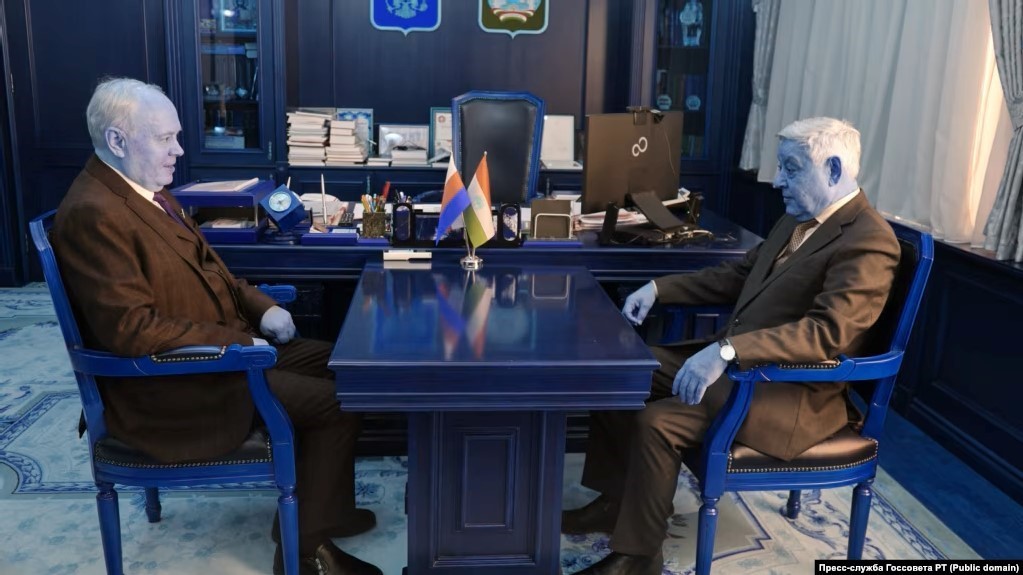
Moscow (AsiaNews) - In recent days, the funeral was held for the “eternal” speaker of the parliament of the Russian republic of Bashkortostan in the Urals, Konstantin Tolkačev. In March, his counterpart in Tatarstan, Farid Mukhametshin, who had also presided over the republican parliament since the 1990s, retired. The biographies of these two “pillars of the system” reveal much about the transition from the Soviet empire to the Yeltsin-Putin federal Russia, as analysed in detail in a report by Idel.Realii.
Tolkačev was born in 1953 in Novokuznetsk (then known as Stalinsk) in the Siberian region of Kemerovo, before studying at the militia school in Ryazan in central Russia, and between 1977 and 1996 “he held senior positions within the Russian Ministry of the Interior”, as his official biography states, notably teaching at the police academy in Ufa, the capital of Bashkortostan, before becoming its director in 1996. He remained in this post until 2003, rising to the rank of General of Internal Services and also earning a doctorate in legal sciences. He was first elected as a republican deputy in 1999, immediately becoming Speaker of the Parliament, and was continuously re-elected until 2023.
He stated that the proposal to become speaker was, for him, “an unexpected turn of events”, though in reality it was a choice made by Bashkir President Murtaz Rakhimov and his inner circle to bolster their credibility with a man capable of representing both the past and the future. As experts note, his candidacy was backed by the all-powerful local interior minister, Rafail Divaev, and in all likelihood the choice had been suggested directly from Moscow. Rakhimov intended to rid himself of the popular figure of the former mayor of Ufa, the liberal Mikhail Zajtsev, whom many wanted to see as the head of the parliament. This internal power struggle, in the late 1990s, signalled the direction not only Bashkortostan but the whole of Russia was taking, a year that saw Vladimir Putin’s rise to power in Moscow.
Tolkačev represented loyalty to every iteration of power during the transition of regimes, and it is no coincidence that he enthusiastically supported the invasion of Ukraine in 2022, even leading humanitarian convoys to the front to support the ‘heroes of the Svo’. The fate of Farid Mukhametshin unfolded in a similar vein. Born in 1947 in Almetevsk, one of Tatarstan’s main cities, he was a leading activist in the Komsomol and the Soviet Communist Party in his youth, rising through the political ranks to become city secretary. When Mintimer Shaimiev was elected president at the end of the USSR, he succeeded him as chairman of the republic’s Supreme Soviet.
He was one of the key figures in the negotiations with Yeltsin’s Moscow in 1992, when Tatarstan intended to declare its full autonomy from the federal centre. He was a ‘leading figure in the nomenklatura’, as the Tatar political scientist Ruslan Ajsin recalls, finding himself at the centre of the great changes of those years, choosing always to remain in the shadow of the leadership, first under Shaimiev, then under his successor and current President of the Tatar Republic, Rustam Minnikhanov. He held various roles in the Kazan government, before taking the chair of the parliament in 1998 for 28 years, until his retirement last month.
Under his leadership, MPs amended the republic’s constitution, relinquishing autonomy to become the region most loyal to Putin’s ‘vertical of power’, and today, in effect, the one most deeply involved in the war in Ukraine, both in terms of the number of soldiers killed at the front and the quantity of weapons and drones produced on its territory.
As Ajsin states, “there is a certain symbolism in the fact that these two dinosaurs have left the scene at the same time”, when the war has reduced the whole of Russia to global isolation, returning to the Soviet spirit they always cherished. At Tolkačev’s funeral, the official speech was delivered by Mukhametšin, and to many it seemed like a hymn to Soviet Russia, projected onto a future impossible to comprehend.

.png)
07/02/2019 17:28










