








Uzbekistan and the regional trade corridors to be re-established
Speaking at a seminar organised in Samarkand by the Asian Development Bank, the Deputy Minister of Transport from Tashkent recalled how, during the Soviet era, Central Asia was part of a single country where logistics chains functioned effectively. The challenge now is to overcome today’s borders through new digital infrastructure.
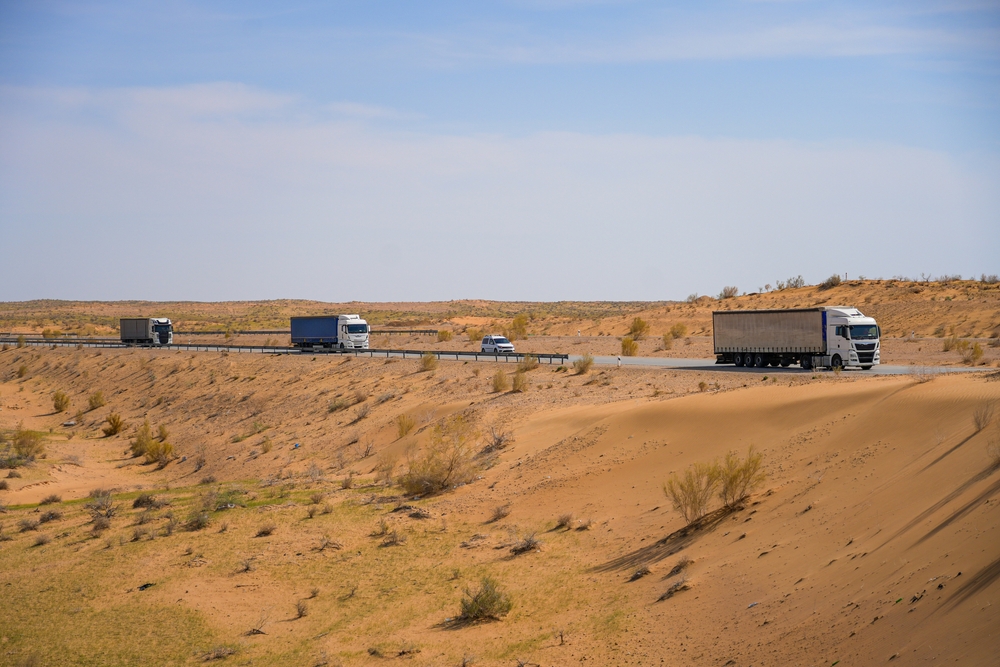
Samarkand (AsiaNews) - Uzbekistan’s Deputy Minister of Transport, Žasurbek Čoriev, stated recently that “Central Asia must return to using its historic trade corridors. The problems of delays caused by lengthy bureaucratic procedures at borders must be resolved; this is a consequence of the fact that, following the collapse of the USSR, these transit structures ceased to function as a single system, and only now is the entire network of relations and routes being rebuilt”.
Uzbekistan is developing digital solutions in the transport sector to reduce delays at borders, speed up the passage of heavy goods vehicles, and make the entire logistics process more efficient and sustainable. In recent days, a session of the Asian Development Bank was held in Samarkand, where Minister Čoriev answered questions from moderators and participants on how the new measures would be implemented and how to attract new investment in this area.
He recalled how, in the days of the Soviet Union, “we were a single country and coordinated everything”, and an industrial zone could easily work closely and successfully with companies as far as 5,000 kilometres away. There were supply chains and economic networks, with many geographical and structural corridors available, so “there were no problems at borders, or other physical barriers”.
Since gaining independence, the five Central Asian countries have focused on defining and defending their borders and security systems, making trade relations very difficult. “Everyone said: now we must think about security, independence, and how to make the economy as self-sufficient as possible from others, and this created great unease,” said Čoriev. Many of the historical foundations of these relations were destroyed, including railways and border crossings, which had previously been efficient. New infrastructure is now being built on both sides of the borders, so that each country has equal opportunities to receive and send goods and people.
Speaking of digitalisation, Čoriev emphasised that “crossing borders, whether by land or through an airport, should be convenient and predictable”. To achieve this, information sharing is required between border services, customs and other agencies. “If information is shared, if border services, customs and all the others know in advance what is arriving, when it will arrive, how quickly the cargo needs to be cleared and what obligations the parties have undertaken, then everything should function as a unified ecosystem,” said the deputy minister. “In other words, any cargo arriving in Uzbekistan should be faster. Whereas transit used to take four days, it should now take two. It’s like in a video game, when you activate fast-forward mode.”
Some initiatives are already fully operational, whilst others are in the process of being implemented. Choriev also stated that countries in the region should share modern technologies and experiences more actively, citing Singapore in the maritime sector and Japan in digital technologies as examples. In an interview with Gazeta, Uzbekistan’s acting Deputy Minister for Investment, Šokhrukh Gulamov, noted that the conflict in the Middle East is affecting freight transport costs for Uzbekistan, adding that the government in Tashkent is working to reroute shipments via alternative routes, including the Middle Corridor and Chinese ports.

.png)










