








Vicar of Arabia: The war against Iran has turned life in the Gulf upside down
Bishop Berardi describes the climate of tensions and concern among people, surprised by Iran’s response to the Israeli-American attack. From travel, celebrations, and migrant workers, a climate of uncertainty prevails, combined with the fear that water will be affected. Below the surface, relations between Shias and Sunnis remain tense, while relations between Christians and Muslims are strong. The Abraham Accords are in crisis.
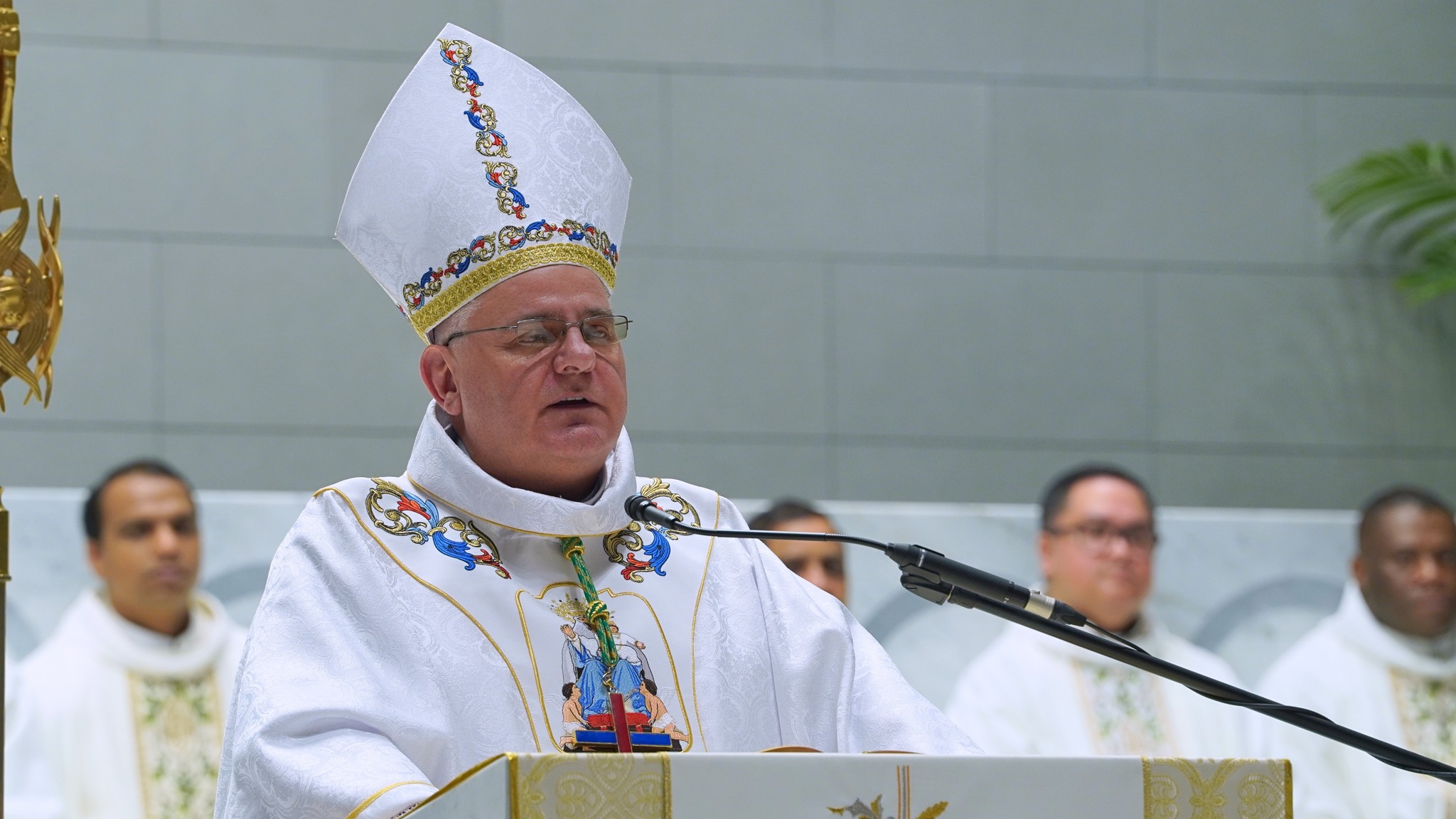
Milan (AsiaNews) – People in the Gulf "are wondering why, despite the money spent on protection, bases, and weapons, we have been attacked so hard" by Iran. This will inevitably lead to "a review of the geopolitics of this area" since "trust has eroded,” this according to Aldo Berardi, Apostolic Vicar of Northern Arabia.
The United States and Israel launched a military action "while talks were underway,” the prelate told AsiaNews. “First they said they wanted to reach a deal, then they bombed and killed (Iran’s) political and religious leader (Ali Khamenei). People understand that (Iran) is now trying to defend itself.”
The apostolic vicar is currently on a pastoral visit to Kuwait, one of the four countries that come his jurisdiction; the others are Qatar, Bahrain, and Saudi Arabia.
For the prelate, the war launched by Israel and the United States against the Islamic Republic is "based on revenge”. It is “different from 'traditional' wars as we have known them until now," whose objective was "the conquest of territory. We are witnessing a verbal escalation, followed by a material response.”
The war is affecting daily life, starting with travel. Unlike the past, the journey from Bahrain, the seat of the vicariate, to Kuwait, about an hour's flight, this time was overland, through Saudi territory.
Air traffic, in fact, is virtually paralysed due to the Israeli-American attacks and Iranian retaliation, which has repeatedly targeted the strategic interests of Gulf states.
“At first, it was thought that (the war) could be over in a week," the prelate noted, but Iran responded "violently," albeit "legitimately," to the attack, putting up "unexpected resistance.”
There is "uncertainty" because the refineries are "almost all closed," the oil wells "cannot produce," and "the closure of the Strait of Hormuz" has stopped traffic and trade. This is “a distressing situation," the bishop lamented. “The greatest danger is that they could target desalination plants and drinking water, causing a huge problem, even if that hasn't happened so far and we hope it doesn't."
Uncertainty among migrants
One of the greatest uncertainties related to the conflict is the presence in the Gulf countries of migrant populations, especially from South and Southeast Asia, who constitute an essential workforce for local economies.
“The Europeans and Americans have already left,” Bishop Berardi said, “but we haven't seen a massive outflow so far. The vulnerable, especially the sick, women and children, and families, have the most to fear, yet most remain, despite their doubts because it's unclear what the future holds, whether banks, factories, and refineries will close as well."
"Some have lost their jobs or aren't being paid; others are waiting for the end of hostilities." However, there is already evidence of "a rise in poverty and a demand for (economic) assistance, even within our communities."
"Doubts, questions, and fears abound that everything will stop and that we could see further escalation," the vicar said. "At that point," he added, "people will begin to leave, but these countries cannot survive without immigration; everyone is aware of that.”
“Our Christians pray for peace, solidarity, and help between communities, between parishes, and within them,” Bishop Berardi said.
“From our perspective, we see no willingness on the part of Israel to stop, while the United States continues its threats, meeting with a response from Iran, whose people have a long tradition and have shown a certain strength."
“We wait for the (leaders’) decisions and pray,” the prelate added, “hoping that they will be inspired by greater wisdom and logic, because if the entire Middle East goes up in flames, it will be the end.”
Confessional tensions
The new war that erupted on 28 February came just a few days before the start of Ramadan for Muslims and during Lent for Christians, but rather than dividing them, it has allowed them to strengthen relationships at the grassroots and individual levels.
"Our messages," Bishop Berardi noted, "were clear: we fast together, we pray during a special time for both religions," seeking greater "solidarity and generosity, strengthening our bond with God."
In a time of war and violence, "we expressed our solidarity as Christians," the vicar continued, "and this approach was appreciated" by majority Muslims.
Conversely, a certain tension prevails between Sunnis and Shias, whose relationship has long been problematic, but which the Gulf War has exacerbated. Still, governments "are trying to keep a low profile" or are sending signals of coexistence, comfort, and solidarity.
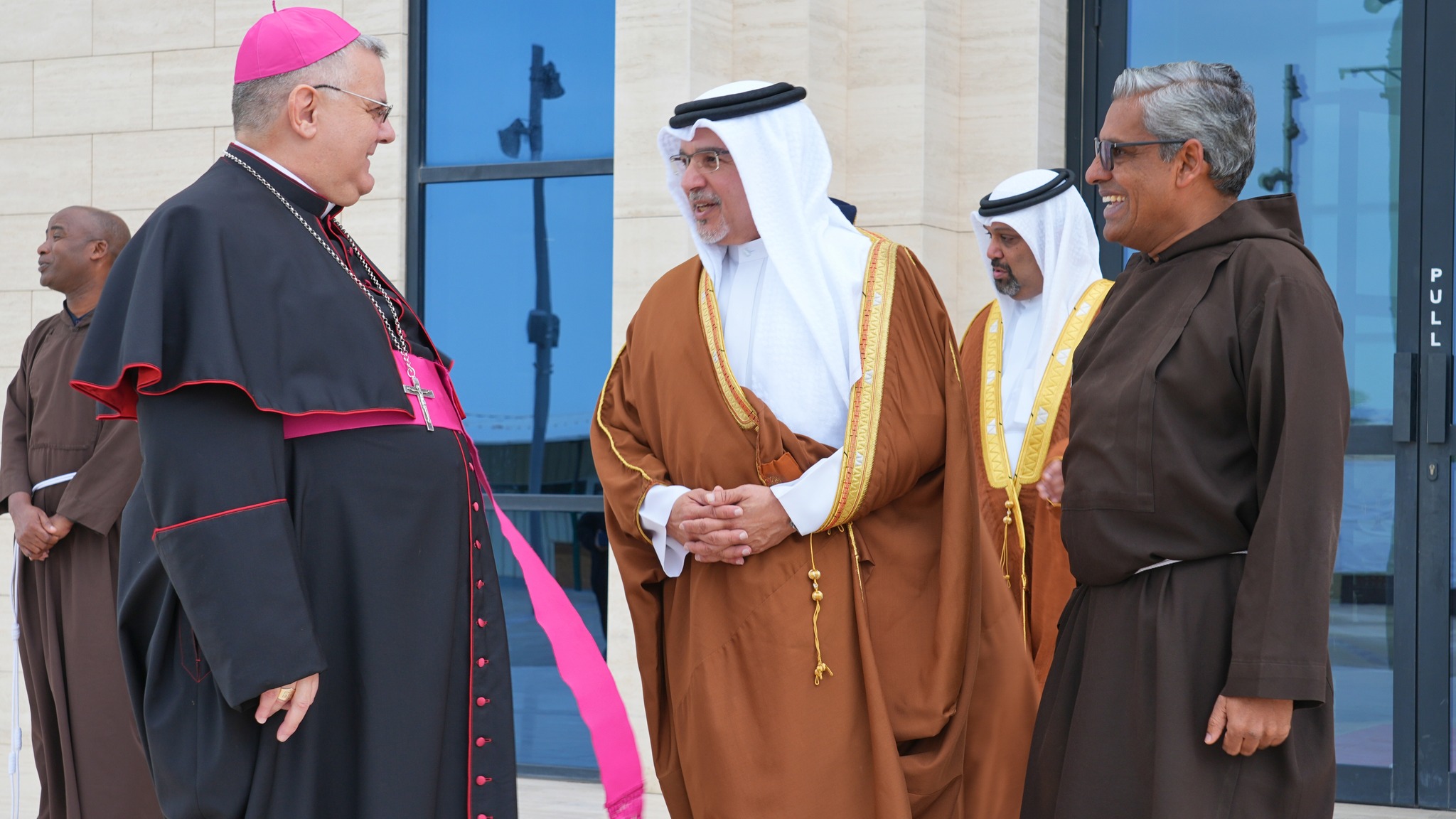
“For example, the crown prince of Bahrain, who is also prime minister, visited the [country’s] Shia and Sunni leaders, and together they prayed in Manama’s Grand Mosque.” He then visited the cathedral as a “show of unity" with Christians.
“Many efforts are underway," Bernardi stressed, "to ease tensions that remain unresolved and simmer at the core of relations."
Tensions and uncertainty are growing ahead of upcoming Easter celebrations, when restrictions and limits will be in place on gatherings and worship, with differences between countries, in an effort to ensure the safety of the faithful.
“We are reflecting," the bishop said, "on the procedures to adopt," starting with Palm Sunday and continuing during Holy Week.
"In Bahrain, outdoor ceremonies are prohibited, and it will not be possible, as in the past, to hold the Stations of the Cross in the courtyard of the Catholic school. Like at the end of Ramadan, outdoor gatherings are prohibited, even though services attract up to 4,000 faithful. We will hold the rites indoors, from the early hours of the morning until midnight in a continuous cycle,” the bishop said.
The situation is different in Qatar, "where everything has remained shuttered for weeks," and services, as at the time of COVID-19, were "broadcast online, and priests visited the faithful to bring them the Sacraments," even though "just today the green light came from the authorities" for the reopening of churches.
In Saudi Arabia, services continue online (the "miracle of the internet”, as the prelate called it in a AsiaNews report), while in Kuwait, Masses are celebrated inside places of worship, avoiding crowds at the end of Mass.
"I have told all priests that they are pillars on which people can lean in this difficult time. I thank God that none of them has asked to leave and return to their country of origin because of the war.”
The End of the Abraham Accords?
The developments in recent weeks finally seem to be undermining the Abraham Accords, which, had fostered a rapprochement in the recent past between Israel and some Gulf states, particularly the United Arab Emirates (UAE) and, for a while, Saudi Arabia.
"The conflict has thrown everything into question. Added to this is the shield factor, the protection that the Americans should have guaranteed with all their bases in the region. It is very clear that this has not been the case."
Governments have not issued any official statement, but images and news are heavily censored to avoid alarming an already worried public and to try to minimise the damage Iran has managed to inflict on its neighbours.
The prelate noted that, “ordinary people wonder about the significance of the huge sums spent on security, bases, and missiles, only to be attacked so massively. This is why it is widely believed that the geopolitics of this area need to be reassessed.”
"Israel is overdoing its defence objectives, from Gaza to Lebanon, with the loss of thousands of human lives and enormous destruction."
Now the question is how to restart dialogue and mediation, especially given the declining trust in diplomacy following the military escalation.
The question among the member states of the Gulf Cooperation Council (GCC) is "how to respond and defend ourselves" from this war between the United States and Israel with Iran, which is setting the entire region ablaze. This is not just a metaphor, since wells and other facilities are burning.
“Tehran has demonstrated a power no one expected, perhaps exaggerated in its response, and with a growing sense of hatred among the people toward the Jewish state, which has proven to be ferocious and violent.”
"It will take years to rebuild,” reshaping the power relations, ties, and connections in “a society that is about to change" in an economic context that is fragile. “This is why the Easter message, the hope of entrusting oneself to God even in a situation of death, becomes even more important and urgent.”

.png)
15/01/2025 15:18
10/09/2025 14:40
11/08/2017 20:05










