








Vicar of Istanbul: Turkish bishops had a ‘positive meeting’ with Erdoğan
Bishop Palinuro spoke to AsiaNews about the visit of a delegation from the Turkish Catholic Church to the president who “showed particular interest in the needs" of the local community. Both sides hope “to overcome a difficult past and open a new era of relations." Erdoğan asked for "prayers" for the success of the NATO summit.
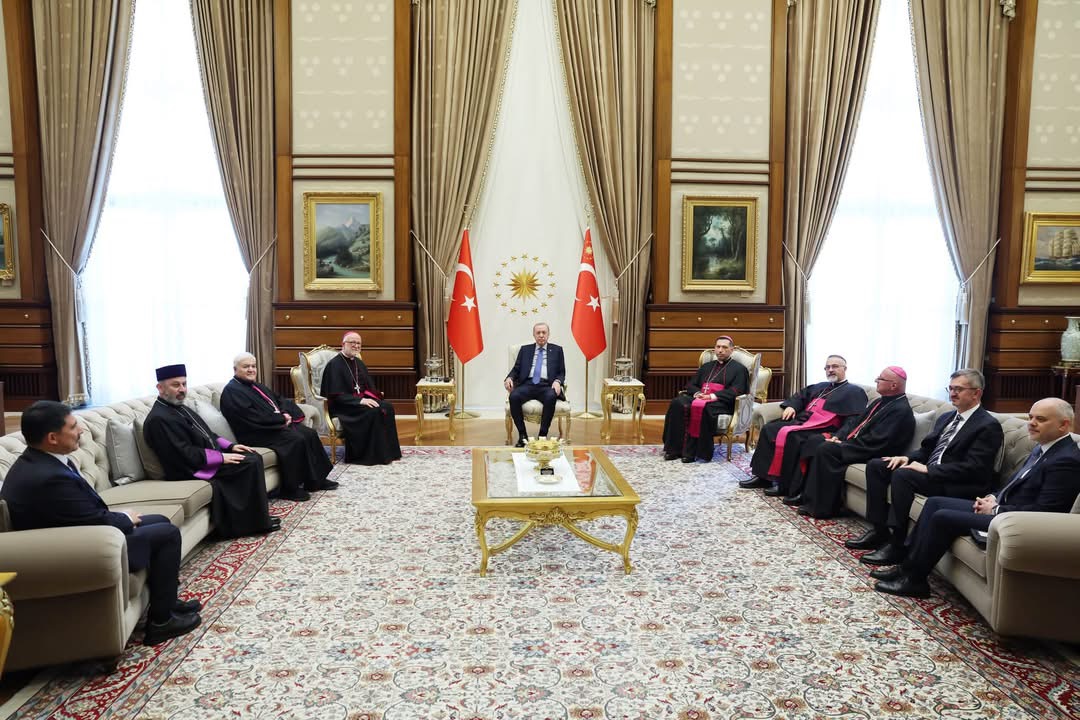
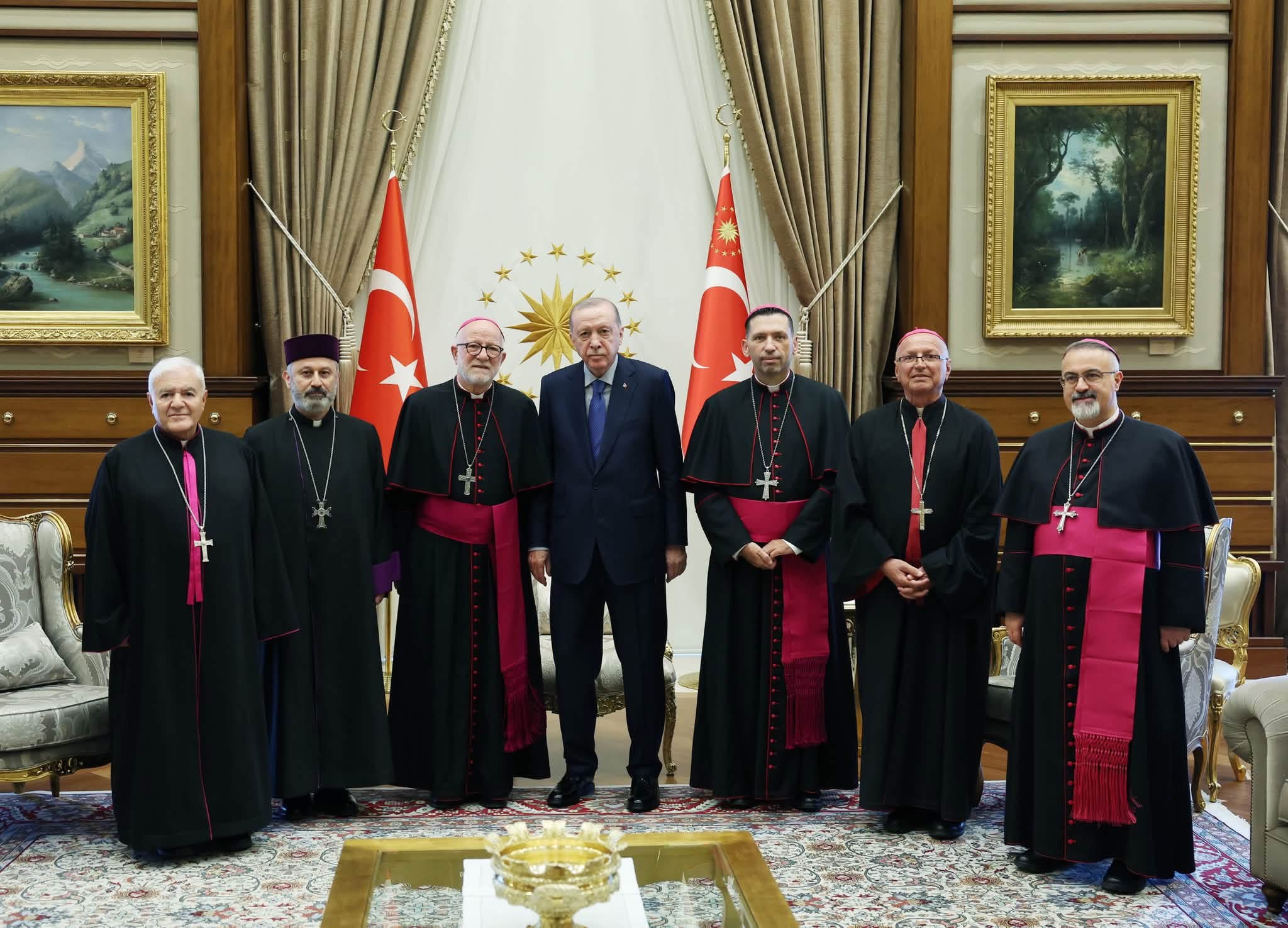
Milan (AsiaNews) – A delegation of Turkish prelates was received on Monday by Turkish President Recep Tayyip Erdoğan at the presidential complex in Ankara for a closed-door meeting of great significance.
The meeting was "very positive", said the Apostolic Vicar of Istanbul, Bishop Massimiliano Palinuro, speaking to AsiaNews. It covered a range of topics, such as the still unresolved issue of the legal recognition of the Catholic Church in Turkey and the NATO summit in Ankara next week, at a time of regional and global conflicts and tensions.
“The president showed particular interest in the needs of the local Church,” the vicar noted. “A joint Turkish-Vatican commission has already been established to study the problems related to the lack of legal recognition."
The Turkish press covered extensively the meeting, attended by senior aides to the president and several Turkish bishops, including the Vicar of Anatolia, Bishop Antuan Ilgıt.
Although no official statements were released nor any closing remarks made, both parties unofficially expressed satisfaction and renewed their promise to continue along the path of dialogue and discussion.
Pope Leo XIV's apostolic visit late last year was also discussed, still vivid in the memory, not only among Catholics, but also among the country’s leaders, including the president.
“The president," explained Bishop Palinuro, "devoted considerable time to listening to our needs: the six ordinaries who make up the Catholic Bishops’ Conference of Turkey were each able to express their hopes and concerns for the future of the Church in this situation."
At the same time, “we were able to express our gratitude because we witnessed firsthand the government’s commitment during the papal visit” of the pontiff. “The great respect that the government and Turkey in general showed towards the pope and the Catholic community” was clearly visible.
For its part, the Catholic delegation "expressed hope that the positive era now beginning will lead to a solution to the lack of legal recognition of the Catholic Church," a long-standing and critical issue.
In fact, the issue of recognition is not merely a formal matter; it is fundamental to placing Catholics' activities within the framework of relations between the state and religions.
It is also the basis for the full exercise and enjoyment of religious freedom, as well as protection for the operations of organisations and institutions operating in the welfare, educational, and social sector, in accordance with applicable laws.
Erdoğan and his aides “expressed their willingness to pursue this discussion, consistent with the requirements of Turkish law,” the prelate said.
Relations between the Church and the government have been difficult and tense in the past, while local Christian communities have faced critical issues. Nevertheless, both sides have recently engaged in productive discussions that could bear fruit in the near future.
“It was truly a delightful conversation, which lasted over 45 minutes. It wasn't just a formality, but a very concrete, constructive meeting that addressed sensitive issues and questions that remain open,” the vicar said.
“Hopefully, we shall be able to recover many assets that have been lost in recent years or are at risk of being lost (from churches and monasteries to educational establishments and buildings that are part of the national historical heritage), precisely because of the fragility of the Church's legal position.”
Recent cases involve the Halki seminary and the library temporarily housed in the historic Agios Nikolaos Church in Adana, to name just a few, but the goal is to ensure the community's future and safeguard its heritage.
At this stage in the relationship between the Church and Turkish sate, both parties hope to continue along the path of dialogue and discussion, so as to “overcome a difficult past and open a new era of relations”
For Bishop Palinuro, “proof of this is Erdoğan's request to the Catholic delegation to pray for the NATO summit that will be held here in Ankara starting 7 July”.
This is an event of great political and strategic significance, at a time of regional and international conflicts, compounded by internal difficulties within the Atlantic Alliance, not least US President Donald Trump's threat to reduce US support.
All 32 NATO leaders will attend the two-day summit scheduled in Ankara, along with officials from the Gulf and Asia-Pacific regions (the participation of South Korean President Lee Jae Myung was confirmed today), to discuss ties, commitments, defence spending, and the Hormuz crisis.
NATO is adapting to a "changing" security landscape, and the United States does not intend to leave the alliance, Turkish Defense Minister Yaşar Güler told Reuters recently.
“NATO continues to be an unparalleled and fundamental platform for Euro-Atlantic security and defence. We evaluate the period we are going through not as a crisis, but as a process of adjusting to the changing security environment,” he said.
Internal relations and global tensions certainly remain, but the Church's prayers and the contribution of Vatican diplomacy in the many sectors can provide Erdoğan valuable support.

.png)










