








Tehran recruiting minors for police and security operations
Stories of children employed at checkpoints or in police work are emerging from various parts of the country. The regime fuels war propaganda by displaying weapons and equipment in schools. Some see this as a sign of the Islamic Republic's "economic collapse", while others view it as an attempt by the regime to pass on its ideology and propaganda to future generations.
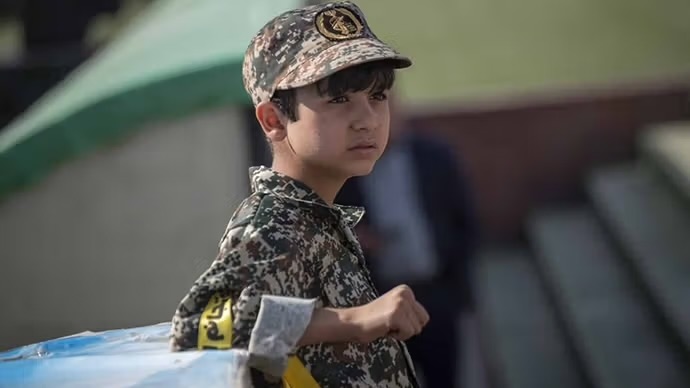
Tehran (AsiaNews) – Children in military-style uniforms equipped with riot gear are being used as guards at checkpoints or in specific army and police activities. Minors are also being forced to participate in war-related programmes and initiatives, Iran International reports, citing witnesses in Iran, anonymous for fear of reprisals.
Reports of this kind have come from various provinces across the country, describing how children and teenagers are deployed at checkpoints or allowed to handle weapons at state-sponsored rallies.
This practice, which is not new, has increased in the past year of war (alternating with periods of truce) with the United States and Israel, despite international conventions, and common sense, urging governments to keep minors away from involvement with the military and police.
“Recession, inflation, poverty, and hardship are rampant, and this (children in uniform) is a sign of economic collapse," a resident of Fereydunkenar, in northern Iran, told Iranian International. “They have set up checkpoints with children aged 10 to 12 and gather people around city squares with food and payments to show strength.”
A resident of Tehran province described what he called the growing presence of minors at checkpoints in Shahriar, near the capital. Pictures are also being posted online of children dressed in military-style uniforms at public gatherings in Iran.
“Almost all the checkpoints in Shahriar are run by children under 16 holding flashlights. It is truly absurd,” the source said.
Residents also describe state-sponsored events where children are given firearms and military training.
In Tehran a resident reported that minors had recently been deployed at checkpoints during public events, and that authorities had set up tea and refreshment points. Similar reports have emerged from other parts of the country.
“At the entrance to Bastak in Hormozgan province, they hand rifles to children every night,” one resident said. Another in Kelardasht, Mazandaran province, reported seeing children being taught how to handle weapons and ammunition.
The use of minors in military and security activities has a long history in Iran since the Islamic Republic was established, which has had no qualms about using them even in open war zones.
During the bloodiest phases of the Iran-Iraq conflict, the regime sent thousands of teenagers to the front lines, where many were killed.
After the war, military-style education continued through school programmes with defensive preparation training and student activities by the Basij, a volunteer militia within the Islamic Revolutionary Guard Corps (Pasdaran).
Basij student organisations and their affiliated university groups have been operating for years, recruiting young people into entities linked to the security apparatus.
For human rights groups, linking formal education to military and paramilitary activities risks normalising violence and militarise children and teenagers, to the detriment of a proper education and children’s development.
Iran is a signatory to the United Nations Convention on the Rights of the Child, which requires states to protect children from involvement in military activities and to ensure a safe environment for their development and education.
However, in recent weeks, during the most violent phases of the war with the United States and Israel, the Pasdaran leadership said that it was legal to recruit children as young as 12 for war support and logistics operations.
Furthermore, witnesses’ reports coincide with a widespread increase in the public display of military equipment across Iran, in a campaign to glorify the war.
In recent months, images have circulated showing missiles, military equipment, Revolutionary Guards motorboats, and light and heavy weapons displayed in public spaces, schools, state-organised rallies, and media.
Child rights advocates view these as part of a broader effort to normalise the presence of weapons in children's daily lives and militarise the public space.
Children’s increasing involvement in government-organised activities, checkpoints, and military programmes may reflect efforts aimed at nurturing future generations of supporters ideologically aligned with the regime.
(Photo Credit: Iran International)

.png)
29/11/2019 13:36










