








149 children dead in Bangladesh measles outbreak
An uncontrolled outbreak has caused dozens of deaths since 15 March. Among the victims is Risa, aged 7 months; her twin sister Ruhi is in a critical condition in Dhaka. Hospitals under pressure and structural shortcomings are exacerbating the crisis. The government has launched an emergency vaccination campaign. Fr Costa: ‘Measles requires specialised wards and staff’.
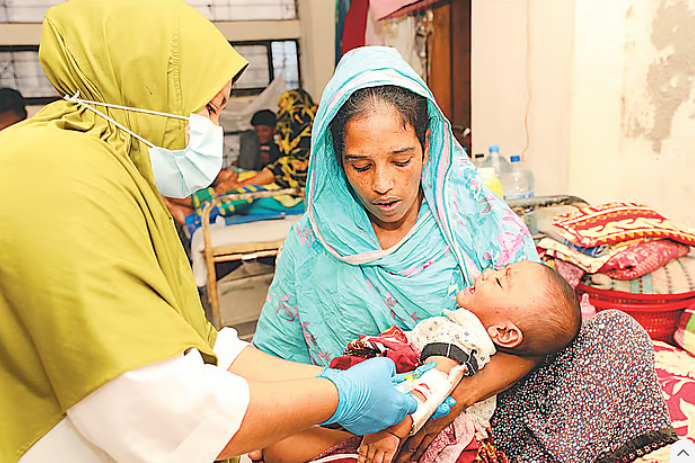
Dhaka (AsiaNews) - The twins Risa and Ruhi were like two flowers on the same stem. Just seven months old, they were the only daughters of Zakir and Kanika, a young couple from the Jaina Bazar area, in the Sreepur upazila, Gazipur district, near Dhaka. Parents who had many dreams for them, all shattered by the measles epidemic currently sweeping through Bangladesh.
The two girls fell ill with measles about ten days ago. Initially treated at a local hospital, they were transferred last week to the Bangladesh Shishu (Children’s) Hospital in Dhaka as their condition worsened. They were in critical condition. Risa was taken to intensive care, but attempts to save her failed: she died yesterday morning in her mother’s arms. Ruhi has been placed in the same bed: her condition remains critical as she continues to fight for her life.
Risa was one of 11 children who died in the last 24 hours, up to 8 am on Tuesday, from measles and measles-like symptoms, according to the Directorate General of Health Services (DGHS). Of these deaths, one child died from laboratory-confirmed measles, whilst the other 10 died with symptoms.
These latest deaths bring the total number of child deaths since 15 March 2026 to 149. Official figures show that 21 children died from measles, whilst others died with related symptoms, often before laboratory confirmation could be completed. The authorities reported that nine of the children who died in the last 24 hours were from the Dhaka division, whilst the other two deaths were from the Rajshahi and Sylhet divisions.
The rapid rise in infections and deaths has sparked a heated debate in the Bangladeshi parliament. On Monday, the Minister of Health and Family Welfare, Sardar Md Sakhawat Hossain, harshly criticised the country’s two previous governments, accusing them of being responsible for the current vaccine crisis and the worsening measles outbreak.
“Over the past five and a half years, no vaccination campaign against measles and rubella has been conducted, compounded by short-sighted decisions regarding vaccine stocks,” the minister told parliament. He added that the current government had launched an emergency vaccination campaign starting on 5 April 2026.
The minister was responding to a motion on a matter of urgent public importance raised by Akhtar Hossain, MP for Rangpur-4. Hossain drew attention to the spread of measles across the country, the shortage of isolation wards and intensive care facilities, and the rising number of infections among children as young as six months old.
Under the emergency plan, health authorities will prioritise measles vaccination in 30 upazilas across 18 districts identified as high-risk areas. The upazila of Barguna Sadar currently tops the list due to its high infection rate. The campaign targets 1.2 million children aged between six months and five years.
Meanwhile, the Directorate General of Health Services (DGHS) has suspended all forms of leave for doctors and healthcare workers nationwide during the emergency period. In an official order issued yesterday, the Directorate stated that the decision aims to ensure uninterrupted medical services and the smooth distribution of vaccines, whilst hospitals struggle to cope with the influx of patients.
Speaking to AsiaNews, Fr Lintu Francis Costa, executive director of St John Vianney Hospital run by the Archdiocese of Dhaka, said that many smaller hospitals are not equipped to handle severe cases of measles. “Measles is a highly contagious disease and requires isolation wards and specialised staff,” he explained. “When children with severe measles symptoms are referred to us, we send them to Dhaka Children’s Hospital, where state-of-the-art treatment facilities are available.”
Fr Costa noted that not all hospitals in Bangladesh have the capacity to treat measles patients safely, although his hospital is considering setting up dedicated services in the near future. As hospitals fill up and parents wait anxiously outside overcrowded wards, the stories of Risa and Ruhi reflect the fear spreading across the country: an epidemic which, doctors warn, could claim more young lives unless vaccination efforts are rapidly scaled up and sustained.

.png)
04/09/2023 11:34










