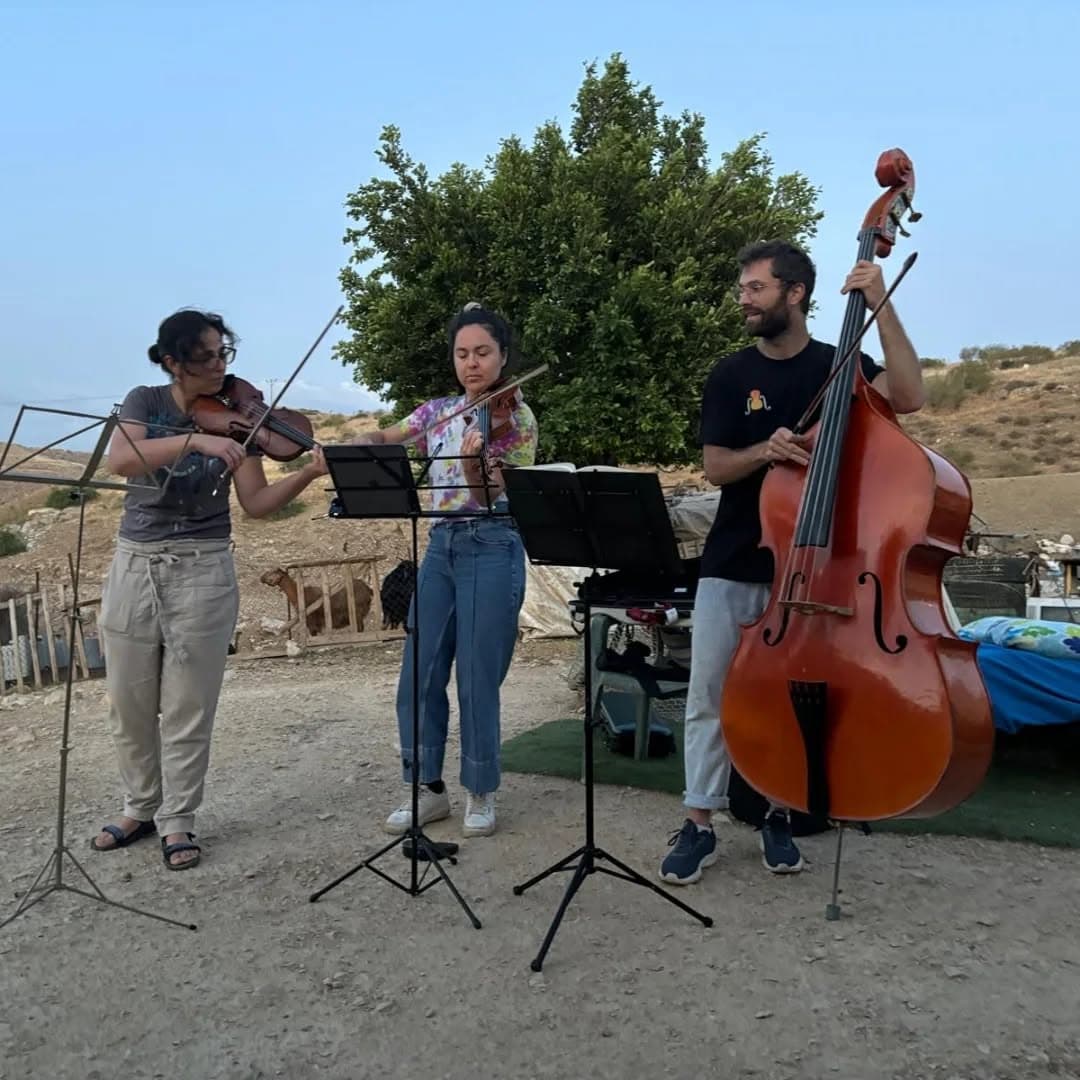
Every Thursday afternoon, in the hills south of Hebron, the sound of the news, political discussions, and missiles launched from Iran is drowned out by the sound of violins and the rhythm of percussion.
In Umm al-Khair, a village in one of the areas in the West Bank experiencing rising Israeli settler violence against the Palestinian population, two activists have started a small music school called Sotna, which in Arabic means “our voice”.
“The children,” says Amalia Kelter Zeitlin, one of the two founders, smiling at the memory, “sing a song when we arrive. It was entirely their idea, but they have a song they associate with us, and they sing it when we get there. It’s like… their anthem.”
Amalia is 30 years old, born and raised in Las Cruces, New Mexico, United States, into a Jewish family where the passion for music has always gone hand in hand with the values of “equality, justice, and human rights,” she told AsiaNews.
“These have always been the most important elements of my identity: being a Jewish woman, a lover of music, and of justice,” she adds.
She trained as a professional violinist, earning a bachelor’s degree from Boston University and a master’s degree from New Mexico State University, and later studied at the Jerusalem Academy of Music and Dance as part of a residency abroad.
“It was here, living here, that I began to learn much more about the political reality,” she says.
Her first trip to the West Bank changed her views about the conflict. “I was against the settlements and in favour of a peaceful solution, but I had no idea how complicated life here was.”
At the suggestion of a friend, she visited the Palestinian part of the city of Hebron (al-Khalil in Arabic) with a local tour guide, but what she saw did not match the simplistic narratives she had heard around her.
“I started to see parts of reality I had never been exposed to before,” she says. “For example, I knew nothing about the massacre carried out in 1994 by Baruch Goldstein inside the mosque where the Tomb of the Patriarchs is located,” she admits. “And many people I still meet today know nothing about it.”
After that visit, Amalia began to spending time with young people opposed to the occupation, but she realised that they were extremely marginal in Israeli society.
A question began to obsess her: “How can I use my talents for the causes I believe in? For many people, these are separate things: first work, then social engagement.”
This was the case until she met Kai Jack. Born in 1994, he is a double bass player and music teacher who grew up between Norway and the United States.
“When I came to Jerusalem to study at the music academy eight years ago, I didn’t really know much about the conflict, but I wanted to learn. And as a Norwegian - neither Jewish, nor Muslim, nor Christian - it was easy to simply befriend everyone. And so also to listen to many stories. I studied in West Jerusalem but taught music to children in East Jerusalem and in the West Bank,” Kai explains.
After a while, he began to engage in activism, particularly protective presence with Rabbis for Human Rights, one of the many Jewish organisations promoting peace in the Occupied Territories.
Eventually, Kai began spending his free time with Palestinian families, trying to protect them from settler and army attacks, filming abuses, and trying to reduce the levels of violence.
In Masafer Yatta, in the southern West Bank, much of the work involves staying on the ground and jumping into cars if there are any attacks.
“At night, activists split up to sleep in the homes of different communities most at risk of settler attacks,” Kai continues.
While in the Jordan Valley, further north, the situation is different. Here “The communities are much smaller. They’re not even villages. It’s one or two families in one place, and then five minutes down the road there are another two or three families. There’s no plumbing, and electricity is only produced by solar panels. Almost all the communities rely on herding, so our work consists of accompanying shepherds from 6 in the morning. And then we stay with them.”
After a while, a dream began to take shape in Kai's mind: to create a youth orchestra, modelled on existing organisations like the Jerusalem Youth Chorus, which unites Jews and Palestinians in Jerusalem through song.
Another inspiration was the Venezuelan movement El Sistema, through which street kids can join an orchestra and, in many cases, become some of the world's best classical musicians, an organisation Kai had already worked with in the past.
Amalia and Kai thus began to work together on plans for an orchestra in the West Bank. Things changed after the killing of Palestinian activist Awdah Hathaleen in the village of Umm al-Khair in July last year by Yinon Levi, who was only indicted for manslaughter in February.
“I had only met Awdah once,” Amalia says. “But we had already started building relationships with this community. It wasn’t the first time violent incidents had happened, but for us it felt much closer to home.”
That feeling marked a turning point. “We both realized we had to invest much more effort in the West Bank, and specifically in Umm al-Khair. We said: ‘Why don’t we go to this village and create an orchestra there with these children?’”
This is how the Sotna initiative was born. Not a conference or an academic panel, no grand declaration. Just a weekly visit, which could soon become two. And a group of children in a circle playing different instruments purchased thanks to international donations.
Kai and Amalia started with general lessons and then selected a smaller group of students for string instruments, which requires more patience. The children of Umm al-Khair listen, play, develop attention and rhythm.
“Families would like us to come at least twice a week, but we can’t manage because of our commitments,” Amalia says.
Even after the outbreak of war against Iran at the end of February, Sotna's lessons continued even though the West Bank does not have bomb shelters like in Israel. In the meantime, Kai and Amalia have now launched a fundraising campaign (donations can be made at this link).
“When the alarms go off, we have three options: ignore them and not look up, or watch the missiles and enjoy the spectacle, or pray to God,” Amalia says. Still, rockets are not the Palestinian population's main concern.
“The war is the perfect cover to intensify settler attacks, which in turn push more and more herding communities off their land.”
On 13 March, a settler ran over Sawar Salem al-Hathaleen, a five-year-old Palestinian girl and a student of Amalia and Kai. After she received medical treatment, the little girl returned to her family and will recover, but the incident also marked a turning point for the activists, who had feasted with families in Umm al-Khair the previous evening, sharing the Iftar meal, the daily breaking of the Ramadan fast.
“Three activists stood in front of the settler’s car, trying to prevent him from fleeing. He called the police, claiming the activists were damaging his car – which wasn’t true. The officers arrived and, blindly following the settler’s instructions, arrested the activists. One of those activists, who is also one of my closest friends, was deported and won’t be able to return to Israel for ten years, even though she is Jewish,” Amalia noted.
Settler violence in the West Bank has spiralled out of control since the outbreak of the Iran war.
In early March, brothers Mohammed and Fahim Moammar were killed in the village of Qaryut, near Nablus.
Between 7 and 8 March, in Khirbet Abu Falah, a village near Ramallah, at least three Palestinians were killed, while around the same time, 27-year-old Amir Shanaran was killed in the Masafer Yatta area.
Between 22 and 23 March, coordinated settler raids targeted several villages, setting homes and vehicles on fire and injuring several people.
The young musician does not describe herself as someone who will end the occupation, reshape Israel's national policies, or resolve the conflict. But she feels she cannot remain indifferent to the suffering of the Palestinian people because if she is here today, it's thanks to the fact that strangers helped her ancestors escape persecution in Europe shortly before the outbreak of World War II.
“My family line continued thanks to the protection of a few non-Jews, as well as the resilience of my community. I owe my existence to people outside my group who helped my group. They are not people who stopped the Holocaust, but it would have been worse if they had done nothing.”
“I don’t think I can change the situation,” she says speaking about her work. “But every soul you affect… really contributes to a better overall picture. I want to use my abilities to facilitate a bit of healing, in the hope that it might help build a better reality.”
Her work of raising awareness continues today in Jewish communities, often in the United States, despite the difficulties caused by the wounds of 7 October.
“Tensions and emotions are extremely high, and many people don’t have space in their hearts to open up to those they perceive as enemies.”
But even in this case, music helps her. “When I talk about my experience,” she says, “I like to start, for example, with a song sung together because it allows people to feel safe enough to open their minds a little.”
Her goal is not to convert anyone, but "to complicate the perspective a bit, while staying in a relationship with everyone."
In the end, Sotna, which in the meantime has around 20 volunteers, reveals itself to be much more than a music project. It is the insistence that something human can still be built, slowly, with care, in a landscape shaped by often brutal power relations.
“We are simply people carrying violins,” Amalia repeats, almost as if to remind herself of the simplicity of her actions. And every Thursday, when her car enters the village, the children sing. Not because the music erases their reality, but because it helps them cope.