








A year after his election, Pope Leo will visit Pompeii and, like Francis, Lampedusa
The Vatican has released the list of the pope’s upcoming pastoral visits to six Italian cities between May and August 2026. A trip to Algeria, the land of Augustine, is eagerly awaited. In his homily at the start of Lent, the pontiff evoked the ashes of "international law" and "justice among peoples”. This morning, speaking to the clergy of the Diocese of Rome, he urged them to pass on the faith by engaging young people in new ways.
Vatican City (AsiaNews) – Cardinal Robert Francis Prevost, who ascended the Loggia of Blessings in St Peter's Basilica as Pope Leo XIV on 8 May 2025, mentioned in his famous first speech the Supplication to Our Lady of Pompeii, which fell on that day. “Our Mother Mary always wants to walk at our side,” he said. Exactly one year later, on 8 May 2026, he will personally travel to the famous Marian shrine in Campania to preside over the celebrations and then reach Naples in the afternoon.
The Prefecture of the Papal Household announced the event today, presenting a schedule of six pastoral visits by the pope in Italy between now and the end of summer 2026.
The first visit, to Pompeii and Naples on 8 May, will be followed by a visit to Acerra (Naples), on 23 May, to meet with the "faithful of the Lands of Fires”, an area sadly known for its illegal landfills that have seriously damaged the environment and the health of the local population.
On 20 June, Leo XIV will visit Pavia, the city in the Lombardy region where the tomb of Saint Augustine is venerated, the inspiration for the Augustinian religious congregation from which he hails.
On 4 July, it will be the turn of Lampedusa, Sicily, where he will follow in the footsteps of Pope Francis, who made his first trip as pontiff to the island on 8 July 2013. As Italy’s southernmost point, it has become a symbol of both openness and indifference toward migrants, who continue to die in the Mediterranean. During his visit, Pope Francis spoke out against the “globalization of indifference," stressing the "need for a preferential option for the least," which Jesus revealed to his disciples.
Leo will be in Assisi on 6 August to meet with young people gathered for the 800th anniversary of the Transitus of Saint Francis of Assisi, followed by Rimini on 22 August, where he will take part in the 47th Meeting for Friendship Among Peoples. Promoted by the Catholic movement Communion and Liberation, the event has not hosted a pope for 44 years: the first and hitherto only visit was by Saint John Paul II in 1982.
The announcement of these six Italian visits comes as the Vatican is set to make public Leo’s next international apostolic journey, expected in April after Easter, to Algeria – in what will be the first visit by a pontiff to the land of Saint Augustine – and then on to sub-Saharan Africa, including Cameroon, Equatorial Guinea, and Angola.
The Vatican delegation charged with preparing papal trips is currently completing onsite inspections in these countries.
Meanwhile, yesterday, Ash Wednesday, in his afternoon homily in the Basilica of Santa Sabina (Rome), Leo shared his thoughts about the meaning of the ashes placed on the head at the start of Lent.
Today, it is possible to “perceive in the ashes imposed on us the weight of a world that is ablaze, of entire cities destroyed by war.” This is also reflected in “the ashes of international law and justice among peoples, the ashes of entire ecosystems and harmony among peoples, the ashes of critical thinking and ancient local wisdom, the ashes of that sense of the sacred that dwells in every creature," Pope Leo XIV said.
“[H]istory, and even more, our own conscience, asks us to call death for what it is, and to carry its marks within us while also bearing witness to the resurrection," Leo noted. “We recognize our sins so that we can be converted; this is itself a sign and testimony of Resurrection. Indeed, it means that we will not remain among the ashes, but will rise up and rebuild.”
This symbolises the Easter Triduum and its "beauty”, which will be experienced at the end of Lent, with the "passage from death to life, from powerlessness to the possibilities of God," the pope explained.
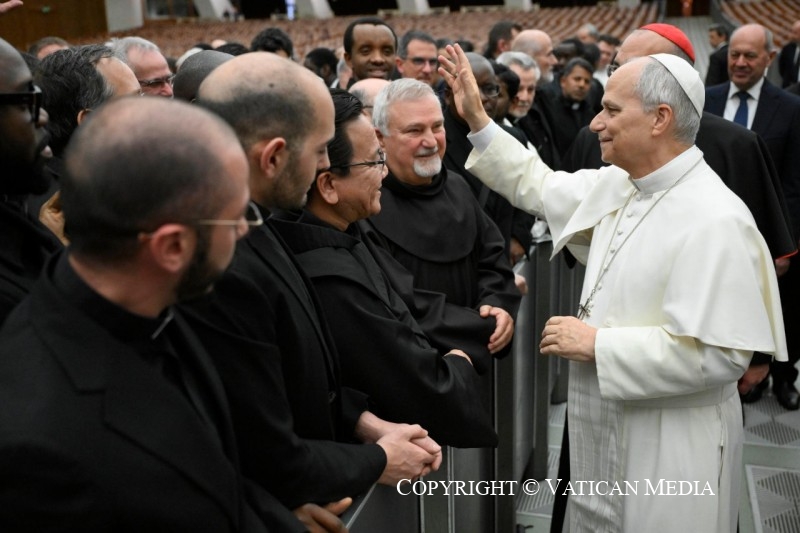
Today, at 10:00 am, the Holy Father met with the clergy of the Diocese of Rome in the Paul VI Hall. In his lengthy address, he spoke about the importance of "rekindling the flame" of the "gift" received, interpreting it with "creative responsibility” and without considering it merely as immersed in the "river of tradition”.
The need to "rekindle" the fire occurs against a backdrop of “cultural changes”, “weariness”, "the burden of routine," and “growing disaffection with faith and religious practice.”
Such need also exists in some areas of pastoral life. Leo XIV mentioned "the ordinary pastoral care of parishes." In this regard, a "clear U-turn" is needed, he said.
In a "classical model" concerned with administering the Sacraments, the transmission of the faith, which is taken for granted, must also be remembered. As a result of "cultural and anthropological changes that have occurred in recent decades," we are witnessing "a growing erosion of religious practice."
For Leo XIV, the “priority" is “returning to proclaiming the Gospel." The city of Rome is marked by "permanent mobility" and "increasingly plural and sometimes frayed relational and family structures," he explained. "Therefore, parish ministry must put proclamation back at the centre, to seek ways and means to help people reconnect with Jesus’s promise”.
Thus, Christian initiation "modulated on school rhythms" needs "to be revisited. We need to experiment with other ways of transmitting the faith, even outside of traditional paths, to seek to engage children, young people, and families in new ways," the pontiff said.
Leo also urged Roman priests to work together in "communion” and “give primacy to evangelisation in all its many forms,” for “we cannot think and act in isolation”. Indeed, “The parish alone" is no longer sufficient for an evangelization that reaches "those who cannot adequately participate,” he added.
In addition, “We must overcome the temptation to self-absorption,” Leo stressed, “which breeds overwork and distraction, and work increasingly together, especially among neighbouring parishes, sharing our charisms and potential, planning together, and avoiding overlapping initiatives.”

.png)
07/02/2019 17:28
24/10/2019 17:56










