








Beijing’s ‘strict control’ of the Catholic Church in China
The second part of a reflection by an AsiaNews source with first-hand knowledge of the Church’s journey in China, marking the year since the death of Francis and the start of the pontificate of Leo XIV. “Silence on the Pope; political study activities dominate. Controls and regulations stifle missionary work”.
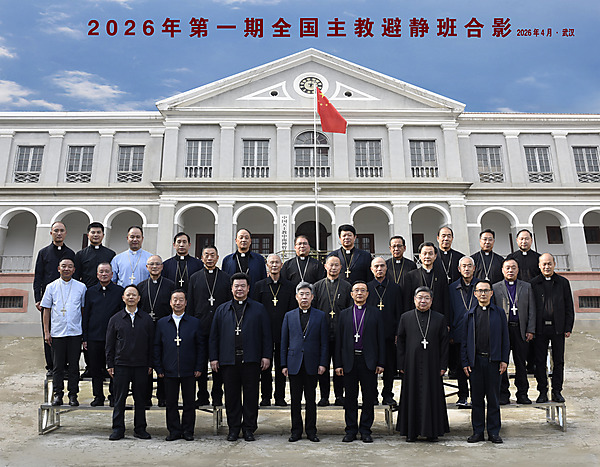
Milan (AsiaNews) - We publish the second part of a reflection on the Catholic Church in China one year after the death of Pope Francis and the election of Pope Leo XIV. Following the first part dedicated to the Vatican’s view of China, this final part focuses on certain trends that have emerged in China over the past year.
Considering that in 2025 the universal Church experienced numerous significant events – the Jubilee of Hope, the succession to the Holy See and the election of the new Pope Leo XIV – the behaviour, by comparison, of the Patriotic Association and the Bishops’ Council in China and of the country’s main dioceses appears extremely low-key. Even on the “Wanyou Zhenyuan” platform, which is widely used among the faithful, news on the subject is rarely found. So far, only a brief note from the Xinhua news agency, republished by the Xinde website, has been identified; consisting of just 36 characters, it reports that the “Association and Conference” sent a message of congratulations on the election of “Pope Leo XIV”.
According to informed sources, there are two reasons behind this silence: on the one hand, the relevant authorities are still observing the new Pope’s stance; on the other, the effects of the “Shi Yongxin incident in the Vatican” (the visit by the abbot of Shaolin who later fell from grace in China, ed.) which took place in early 2025, persist. This episode led to a drastic tightening of the authorisation system for foreign affairs, resulting in local communities and religious organisations adopting a policy of collective silence when dealing with news concerning the Pope, based on the principle that “in foreign affairs, nothing is insignificant”.
Although the provisional agreement between China and the Vatican has seen progress in the appointment of bishops, it has not, however, led the Chinese Church to align itself deeply with the universal Church on procedural matters. Despite four bishops from mainland China participating for the first time in the Synod of Bishops, the spirit and practices of ‘synodality’ promoted by such meetings are not visible in the national context. Furthermore, the participating bishops do not appear to have strengthened unity within their dioceses: for example, a photograph of a bishop with the Pope was interpreted by some priests as a sign that he had obtained a sort of “imperial sword”, with which to strike down “uncooperative” priests.
The tightening of internet controls is just one of the challenges. Since the “Sinicisation of religions” was promoted, political study activities have multiplied: from the 2018 “Four Introductions” campaign (the national flag, the Constitution and laws, the core values of socialism, and the excellence of traditional Chinese culture in places of worship), to the 2021 campaigns on the “Three Loves”
(patriotism, love for the Party, love for socialism) and on the “five stories”, right up to the 2025 movement to “study regulations, observe discipline, strengthen practice, build an image”, accompanied by initiatives such as “promoting frugality and combating luxury, maintaining correct faith and practice”. All this has overwhelmed local communities with studies, reports and exhibitions.
As the saying goes: “If an extra measure of severity is imposed from above, it is applied ten times more harshly from below.” Bishops holding posts in the “Association and Conference” often promote superficial projects in the dioceses. A member of the clergy commented privately: “In recent years we have attended countless meetings and must also write study reports. Pastoral and missionary work is already extremely demanding. If one truly wishes to promote frugality, one should first eliminate these costly exhibitions and meetings, which serve only for year-end reports.”
Many faithful report that, since last Christmas, platforms such as “Wanyou Zhenyuan” (as well as others before it) have stopped broadcasting papal Masses; furthermore, major Catholic websites require registration using one’s real name and much content has been removed.
In Shanghai, following the installation of the new Bishop Shen Bin, measures have been further tightened: summer catechism courses have been banned and, since last year, minors have been barred from entering churches. Even at the Marian Basilica in Sheshan, despite being a tourist attraction, children are not permitted to enter, prompting frequent protests from visitors. Faithful from other regions state that the ban on minors has been in place for some time, but that checks have intensified over the past year.
As a key Church, Shanghai is also showing changes on other fronts. It is reported that, with the exception of the 90-year-old and ailing Fr Zhu Yude, the other five ‘underground’ priests signed, before last autumn, a ‘letter of commitment’, the content of which stipulates acceptance of the Party’s leadership, patriotism, respect for the law and a ban on celebrating sacraments in non-religious venues. Another religious figure has signed a “request for transformation”. The more than ten nuns belonging to underground communities, unable to sustain themselves in the big cities, have been dispersed; their current situation is unknown.
A priest from the north states that, although no large gatherings attended by officials are held in his diocese as in Shanghai, the recent “strict instruction” has led to comprehensive checks. From the management of ecclesiastical appointments and documents for emigration, to campaigns on frugality, right through to routine checks on security and finances, filling in forms and attending meetings has become the norm. Although in 2018 the religious offices were integrated into the United Front Work Department, administrative intervention has not diminished and some decisions lack a professional basis. For example, based on the rule that “religious activities generally take place in places of worship”, some regions prohibit priests from conducting funeral rites in mortuaries.
Under the slogan of “strict governance”, Protestant house churches have also been severely affected. Following the raid on the Church of Zion in Beijing on 9 October 2025, the lawyers involved in the defence faced the most intense pressure since the “709 incident” of 2015: of the 40 lawyers involved, over half face the risk of unemployment and restrictive measures. However, due to internet censorship, little information has emerged.
Of course, the “strict teaching” also has its own practical logic. For historical reasons, the calibre of the clergy is uneven. On 2 April 2026, the media reported on an economic case within the Catholic Church in Hunan: for embezzlement and the sale of church property, three key figures were sentenced – Bishop Qu Ailin and Father Li Hongwei (director of the Catholic Administrative Committee) to six years’ imprisonment, and Hu Yali (chairman of the Patriotic Association) to seven years.
A Catholic researcher commented: the Church is a mirror of society. As the fight against corruption intensifies, more and more cases are emerging, and they are becoming increasingly serious. This prompts reflection: in an increasingly strict rule of law, society is forcing the Church to ‘turn the blade upon itself’; but what contribution can the Church offer to society?
Looking back at history, in 1926 Pope Pius XI consecrated the first six Chinese bishops in Rome. On 11 April 1946, Pope Pius XII established the ecclesiastical hierarchy in China, marking a moment when “Chinese bishops enjoyed the same powers as other bishops throughout the world… with identical responsibilities and duties”.
Today, however, the Church in China seems isolated: it knows little of either the spirituality and practice of synodality, or Pope Francis’s 2019 motu proprio “You are the light of the world”, aimed at combating abuses of power and protecting the most vulnerable, which has not been implemented.
An elderly bishop from the north told the priests: canon law is not suited to the Chinese reality. A bishop from the south explained: we have received no communications from the Holy See; many things are unknown to us.
Perhaps the Church in China has become accustomed to a model consisting of “notifications, meetings and summaries”. But, whatever the context, we must not forget that Gospel saying: “You are the light of the world!”.
(2. End)

.png)
28/07/2021 13:06










