








Cambodia slams Thailand for listing disputed temples in its heritage registry
Cambodia rejects Thailand's unilateral decision to register border sites as national heritage. Over the years, the area has been the scene of armed clashes, the latest a few months ago, when a temple suffered damages. Phnom Penh slams Bangkok’s action as a violation of its territorial integrity without any validity under international law.
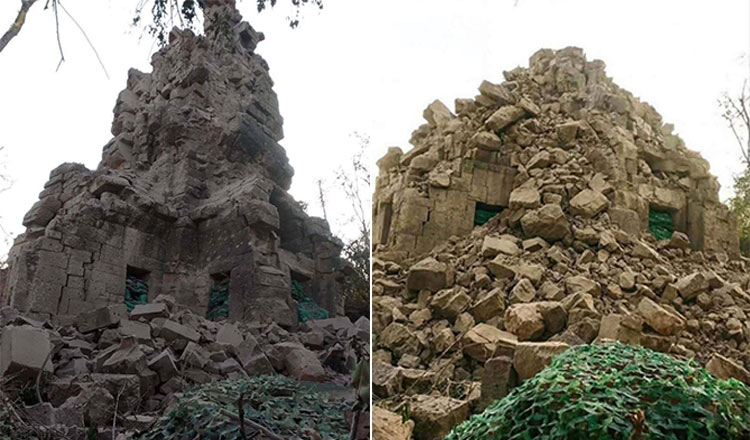
Phnom Penh (AsiaNews) – Culture is becoming another source of tensions between Cambodia and Thailand, following armed clashes that broke out on their borders after the Thai government unilaterally listed sites and temples on the same border as part of its national heritage, a step Cambodia has criticised and rejected.
For the Cambodian government, the neighbour’s initiative constitutes a violation of the country's territorial integrity and lacks legitimacy under international law.
On Tuesday, Thailand’s Fine Arts Department published in the Royal Gazette the updated list of heritage sites, including the Ta Krabey Temple and the Ta Moan Temple complex. To justify the decision, it cites the Ancient Monuments Act of 1961 and historical lists for parts of the complex dating back to 1935.
Over several years, the area has been the scene of armed clashes between the two countries, raising fears of an all-out war.
In a statement released yesterday, the Cambodian Ministry of Culture and Fine Arts expressed its disapproval of the inclusion of both temple complexes in Thailand’s national registry, along with the Knar Temple and other archaeological sites along the border under Cambodian sovereignty.
“This unilateral action is illegal, null, and without legal effect,” the ministry says. “Such registration is entirely baseless and cannot, in any way, serve as evidence of territorial sovereignty or as an instrument for border delimitation.”
The ministry added that all issues related to the land border dispute between Cambodia and Thailand must be resolved solely in accordance with international law and other existing binding agreements and mechanisms.
These specifically include the 1907 Franco-Siamese Treaty, the 2000 Memorandum of Understanding (MoU), the 2003 Terms of Reference (TOR), and the mandate of the Joint Boundary Commission (JBC).
The Cambodian Ministry of Culture has called on the Thai government to immediately remove the above-mentioned sites from the list and “refrain from any unilateral actions that undermine Cambodia’s efforts towards a peaceful settlement through bilateral mechanisms”.
The ancient Khmer temples of Ta Krabey and the Ta Moan complex are among many historic sites located along the disputed border, in the Dangrek mountain region.
Although less well known internationally than Preah Vihear, these sites hold historical, archaeological, and geopolitical significance given their location in a sensitive border area.
Likely built between the 11th and 12th centuries during the Angkorian period, Ta Krabey is a modest yet significant ancient Khmer temple.
Ta Moan was instead part of a larger complex that served as a key stop on the ancient Khmer Road, an important route connecting Angkor, the capital of the Khmer Empire, to its administrative centre at Phimai (now in Thailand).
The temple, built of laterite and sandstone in the 11th century, has a rectangular layout with a south-facing entrance, with an enclosure that measures 46 by 38 metres, centred around a main sanctuary of pinkish-grey sandstone, preceded by a long, chambered hall (mandapa) and an antechamber or foyer (antarala).
Both Ta Moan and Ta Krabey were severely damaged in last year's border confrontation (8-12 December). Cambodian authorities have reported that Ta Krabey temple was hit multiple times, describing the structure as severely damaged, with parts of the ancient sandstone architecture destroyed or collapsed.
Cambodia has accused Thai forces of targeting the site, calling it a violation of international heritage protection laws.
Prior to the clashes, Phnom Penh had formally called on Bangkok to pursue a legally binding territorial agreement on the temples through the International Court of Justice (ICJ) should talks fail.
Kin Phea, director general of the International Relations Institute of Cambodia, agrees with the government's firm protest, explaining that Thailand cannot use the registration to validate its claim or ownership, since all these temples and archaeological sites are located within Cambodia's sovereign territory.

.png)
25/07/2025 17:45
02/06/2018 07:43
28/07/2025 18:31










