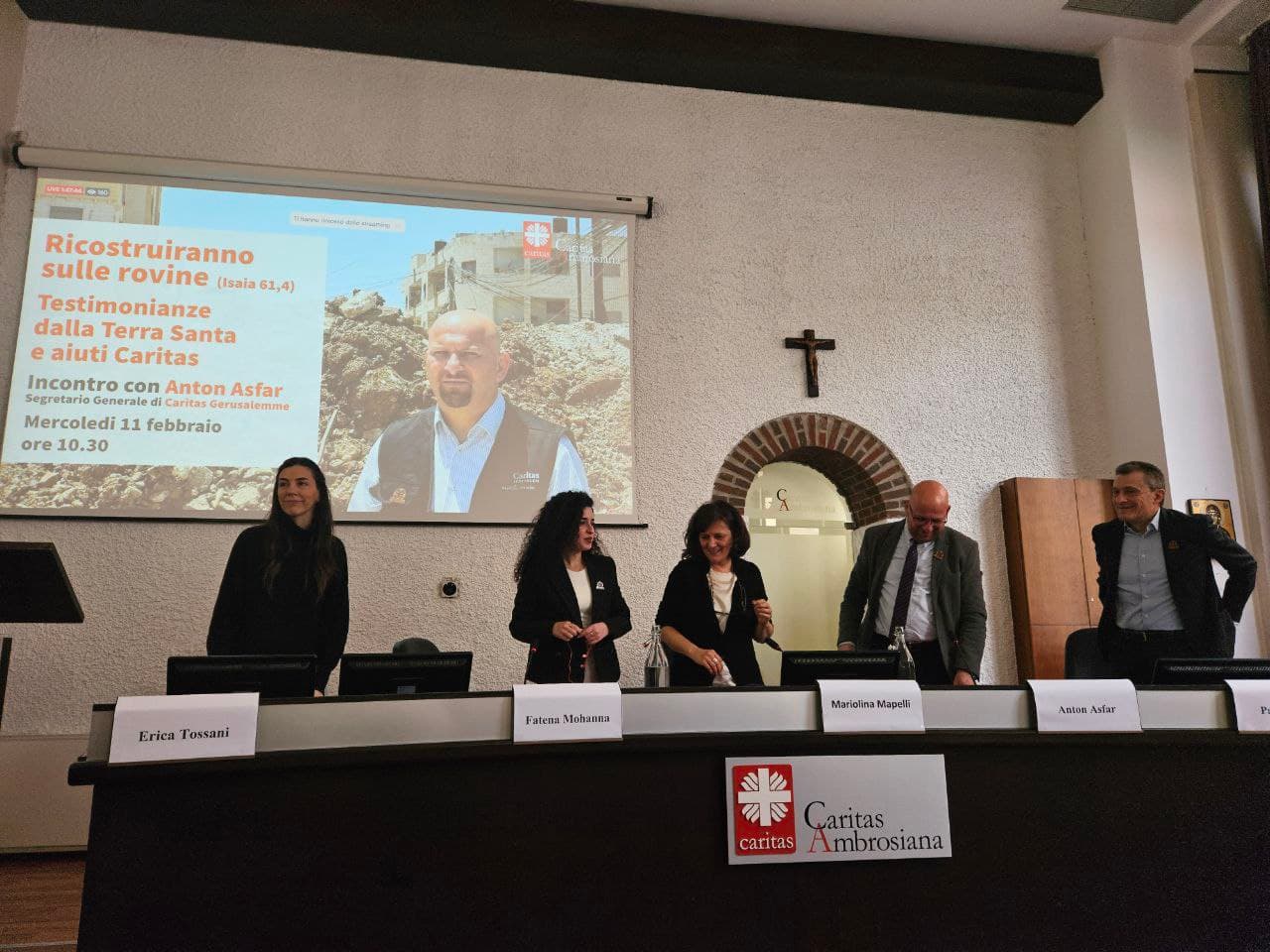
Milan (AsiaNews) – When Israel published a list of 37 NGOs that were supposed to cease working in the Gaza Strip in December 2025, it was a "shock" for Caritas Jerusalem, this according to Anton Asfar, the organisation's secretary general, who was a guest of Caritas Ambrosiana for a public meeting entitled "They will rebuild on the ruins”, held today in Milan.
"Registration of international organisations has been transferred from the Ministry of Welfare and Social Affairs to the Ministry for Diaspora Affairs and Combating Antisemitism, and Caritas International and Caritas Jerusalem were also on that list," Asfar explained to AsiaNews.
"Today, however, I can announce that the Israeli inter-ministerial committee has reviewed the situation, and everything has been cancelled." The measure confirms that no further re-registration procedures are planned, thus putting an end to any administrative uncertainty.
Caritas, the social, humanitarian, and development arm of the Catholic Church in the Holy Land, will continue to operate in the Gaza Strip, as it has done since 1967.
In Gaza, Caritas "provides primary healthcare and life-saving services," explains the secretary general, a Jerusalem native with a background in economics and finance. Since 7 October 2023, "we have never stopped operations. But we are part of its people, so our staff has also been internally displaced from one place to another.”
The agency manages eight medical units (including one permanently based in Gaza City) and two psychosocial support units. It has 127 staff in the Strip, and 28 in the West Bank. As explained during the meeting, in 2024 and 2025 it issued two emergency appeals for €7.5 million and launched an €8 million appeal for 2026, while Caritas Ambrosiana has developed several bilateral projects worth €1 million.
Before May 2024, Caritas also worked in Rafah "in makeshift tents”, Asfar noted, but "after the invasion of Rafah in May 2024, we were forced to move further north and settle in Khan Yunis, Deir El Balah, and Nuseirat. In July of last year, there was a military operation in Deir al-Balah, and we had to evacuate our medical centre... then we returned.”
“In September, the invasion and evacuation of Gaza City began." At that time, Caritas had 125 people on duty, and "102 were forced to evacuate south again. Imagine the strain on the mental health of our teams, their families, and their children. They had to care for their families while providing life-saving services to the community."
Returning to their homes, however, does not mean the end of the suffering. After the ceasefire was announced on 10 October, those returning to Gaza City found “neighbourhoods swept away, homes damaged, and infrastructure completely destroyed.”
Caritas also faced the deaths of two employees. “I remember an extraordinary colleague of ours, Viola, a laboratory technician, and her newborn daughter. They were bombed while seeking refuge. Viola, her husband, their two-month-old baby, her sister, and her children lost their lives: 12 victims from the same family," Asfar said.
He cited a second case. “Another colleague, a pharmacist, was also killed. Due to an evacuation order, he had to move with his family to a building with 30 people, which was then hit. Only a three-year-old daughter survived. All of this was heartbreaking and deeply traumatic.”
After this news, "we didn't know what to do," added Asfar, who took on his current role in September 2022 after being appointed by Cardinal Pierbattista Pizzaballa.
“We prayed to find inner strength, understand what was happening, and move forward. In that moment, I understood the meaning of fraternal cooperation,” he said. “We received so many messages, prayers, and Masses celebrated for us all over the world. Don't underestimate the value of your prayers and continue to support us: it means a lot to us."
Alongside Anton Asfar is Fatena Mohanna, originally from Gaza City, part of the local staff. She arrived in Siena, Tuscany, a few months ago, where she is studying Italian before enrolling in a master's programme at the same university.
“Caritas is made up of people who come from the communities we serve. We experience the same suffering, but who helps those who provide aid?” Her response is a tribute to the staff: "I am convinced that the Caritas staff is made up of heroes."
“Being in Italy is like a dream for me,” she said, speaking to AsiaNews. “I'm still in shock. Every day I wake up and think: How did I get here? I walk normally on the streets, there's nature all around me, and when I need something, I go to the supermarket and everything is easy,” she said.
“Psychologically, it's becoming more difficult because my family has remained in Gaza. Every time I drink or eat, or even just sleep in my bed, I feel guilty. At first, I couldn't sleep because it seems too quiet here after two years of bombing. I still have problems eating canned food, and here I drank clean water for the first time in two years.”
Anton Asfar explains that, due to the destruction of infrastructure, the supply of clean water remains one of the biggest challenges in Gaza City. “The capacity now is only 6,000 cubic metres out of 14,000.” Despite the ceasefire, aid is still arriving intermittently. Yet there have been "glimmers of hope”, the aid worker noted.
"We were terrified by the spread of famine, and we worked hard to provide aid to children. On 12 October, we managed to get in 10,000 cans of infant formula, which were distributed throughout Gaza." However, new, already assembled mobile clinics "are not yet authorised to enter Gaza."
This is also why, according to Fatena Mohanna, a computer engineer by training, "exhaustion" prevails in the population. “The suffering is still there despite the ceasefire. But I keep my faith. Our people are strong. They are simple people who love art, life, music, and want a normal life."
Due to the ban on entry to foreign journalists, her audiovisual work has been used by several international media and has earned her two journalism awards.
Yet, she acknowledges that images can't convey everything. “They can't capture people's feelings. You see children queuing for water and food, but the image doesn't tell you that until two years ago those children were going to school. You see old and young, but they can't convey the shattered dreams of those who had a job, a home, a city, and now have lost everything. Images can't convey the sense of loss and the profound pain of these two years."
Anton Asfar, for his part, explains where the motivation to stay comes from. “It's part of Caritas's DNA," focusing on healthcare and immediate assistance, but also peace and reconciliation. A mother-and-child health centre will soon be expanded in Gaza to accommodate more mothers, many of whom have been left alone due to the war, and for minors.
The political aspect of the conflict between Israelis and Palestinians is the most problematic. "Societies are torn apart and paralysed by extremism," Asfar noted. But there are also "small groups working for dialogue and reconciliation," a bit like "salmon swimming against the current."
But a long-term resolution requires prepared leadership that can lead to a "leap forward to reconciliation, equality, justice, and peace."
The Church's presence is crucial. “Activities of dialogue don't resolve the conflict, but they allow us to replant seeds of hope. My love for Jerusalem and the Holy Land made me stay."
"It's not easy to live here, start a family, and raise children. People often don't understand all the 'graces' they have in their lives and tend to take them for granted. We Christians of Jerusalem are honoured to live in the sites of Christianity, but this also entails a heavy burden. It's our little cross to bear.”