








Afghan activist Zarqa Yaftali receives the Zayed Award for Human Fraternity
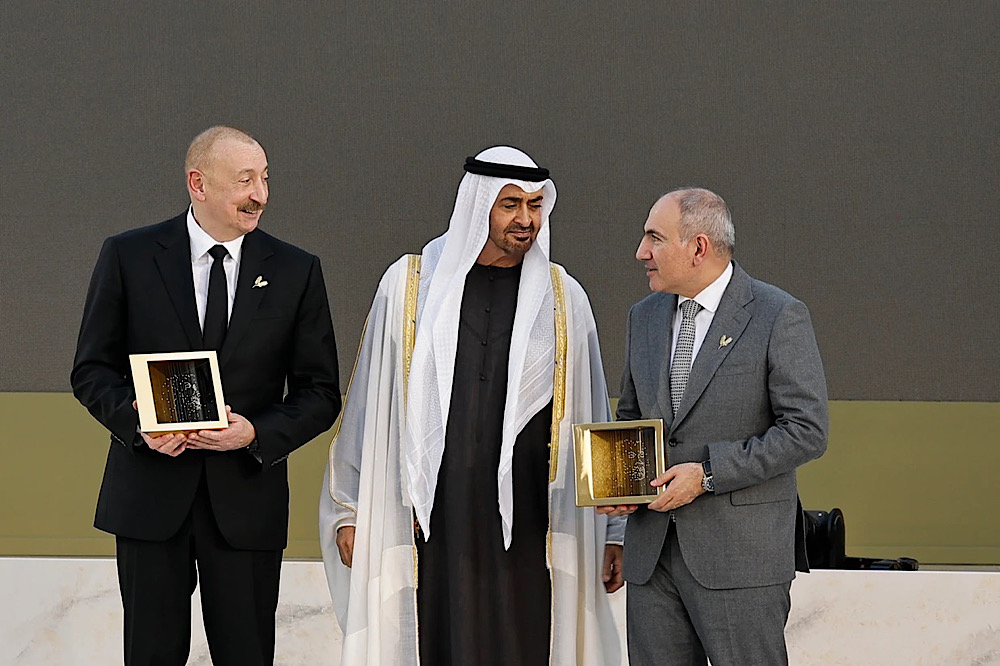
The award was also given to the leaders of Armenia and Azerbaijan for their peace process and to the Palestinian NGO Taawon for its humanitarian work. In his message, Pope Leo XIV said that fraternity is “not a distant ideal, but an urgent necessity.” Yaftali’s work for girls’ education, which has been severely restricted under the Taliban after they returned to power in 2021, was recognised. Her appeal is for the world not to forget Afghan women.
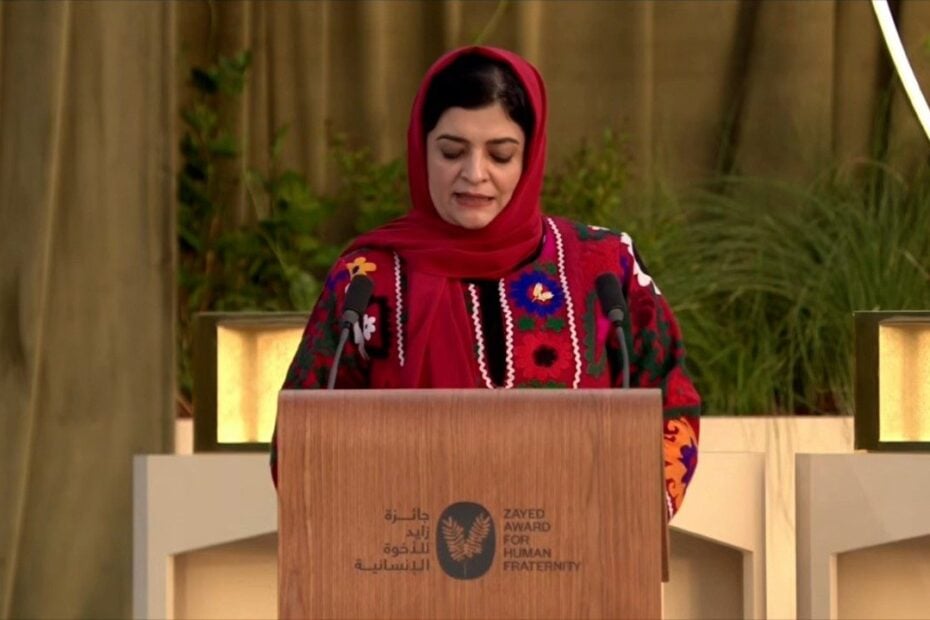
Abu Dhabi (AsiaNews) – Afghan activist and lawyer Zarqa Yaftali received the 2026 Zayed Award for Human Fraternity yesterday at the Founders Memorial in Abu Dhabi, United Arab Emirates (UAE).
In her acceptance speech, Yaftali made an appeal that her country's women, and their suffering, not be forgotten, and that more be done for their right to education, which has been largely denied since the Taliban returned to power.
This award is inspired by the Document on Human Fraternity signed in 2019 by Pope Francis and Grand Imam of al-Azhar Ahmad Al-Tayyeb. This year, the Palestinian nonprofit organisation Taawon, and the countries of Armenia and Azerbaijan were also recognised.
In a message sent for the occasion, Pope Leo XIV mentioned the seventh anniversary of the signing of the document, underlining how, today, “fraternity is not a distant ideal but an urgent necessity. We cannot ignore the fact that too many of our brothers and sisters are currently suffering the horrors of violence and war.”
“[W]e must proclaim with conviction that human fraternity is a lived reality, stronger than all conflicts, differences and tensions. It is a potential that must be realised through a daily, concrete commitment to respect, sharing and compassion.”
For the pontiff, the winners – Azeri President Ilham Aliyev, Armenian Prime Minister Nikol Pashinyan, Zarqa Yaftali and the Palestinian NGO Taawon – are “sowers of hope in a world that too often builds walls instead of bridges.”
Of particular significance is the awarding of the 2026 Zayed Prise, along with a cash donation of one million dollars, to Afghan activist Zarqa Yaftali, who has been at the forefront of the fight for girls' education, denied under Taliban rule.
Over time, she has supported more than 100,000 women and children in Afghanistan, deprived under the current regime of fundamental rights taken for granted elsewhere in the world.
As executive director of the Women and Children Legal Research Foundation (WCLRF), which was founded in 2003, she works in several provinces across the country to expand support networks through legal research, rights advocacy, educational initiatives, and community-based services.
The organisation has played a crucial role in establishing more than a hundred schools and expanding access to education for girls in conflict-affected areas.
The activist notes how the progress made by Afghan women in the two decades after 2001 was reversed by the Taliban’s return to power in 2021.
The ban on female students attending schools and universities was one of the many restrictions imposed by the Taleban after they seized power again following the withdrawal of US-led international forces.
In addition to the ban on education, the draconian measures imposed include prohibiting women from working, appearing in public without fully covering their bodies or wearing the niqab, travelling without a mahram (male guardian), and participating in sports.
Zarqa Yaftali’s commitment is closely tied to her personal history. During the Taliban's first rule (1996-2001), she was denied the opportunity to continue her education, and was only able to resume her studies after their overthrow.
According to UNESCO, approximately 2.2 million girls in Afghanistan currently have no access to formal education beyond primary school.
Yaftali’s organisation also runs the Kabul Online School, which provides distance learning to girls in seventh through eighth grade, who are not allowed to attend in-person classes.
The WCLRF also supports young women who were previously university students in fields such as law, political science, journalism, and medicine, helping them continue learning and developing skills despite being forced to abandon formal education.
“This award is not a personal honour for me,” she said. “It is recognition of the resistance and courage of Afghan women. It sends a clear message of solidarity and shows that the world has not forgotten Afghan women.”
The Zayed Award for Human Fraternity was established in 2019 to honour individuals and organisations whose work embodies human solidarity, coexistence, and compassion.
The list of past honourees include Pope Francis, the Grand Imam of Al-Azhar Ahmed El-Tayeb, United Nations Secretary-General António Guterres, Egyptian heart surgeon Magdi Yacoub, and the American humanitarian organisation World Central Kitchen.
The 2026 recipients also include the leaders of Armenia and Azerbaijan (a high-level delegation from the two countries was present at the event), and the Palestinian NGO Taawon.
Receiving the award on behalf of Azerbaijan, President Ilham Aliyev spoke about the more than 30 years of conflict between the two countries, but, at the same time, noted that the last six months have ushered in a new era of "peace" between them. "We are learning to live in peace,” he added. “I can tell you, it's a special feeling."
For his part, Armenian Prime Minister Nikol Pashinyan called it a “great honour” and a symbol of support between the Christian and Muslim worlds. “It is in truth an achievement that belongs to all peoples,” he said.
Last but not least, Taawon's recognition is linked to its humanitarian work for more than a million Palestinians each year in the West Bank, Gaza, and refugee camps in Lebanon.
Through its programmes in education, healthcare, culture, and community development, the NGO has sought to preserve human dignity and foster resilience in a context of grave hardship.

.png)
01/02/2021 14:10
28/11/2019 16:18
21/10/2021 17:59
04/02/2019 19:13










