








Changes in Astana's institutions according to Tokaev
Speaking at the fifth national assembly in Kyzylorda, the president presented the fundamental parameters of constitutional changes to free the country from the clans that have dominated it for over thirty years. He insisted on the need to prioritise administrative discipline, with technological acceleration at its service.
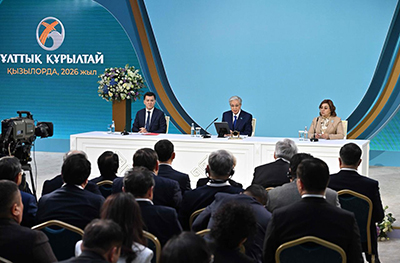
Astana (AsiaNews) - Kazakh President Kasym-Zhomart Tokaev addressed the fifth national Kurultaj (Assembly) in Kyzylorda, announcing the choice of ‘a new historical path’ for the country of steppe nomads and presenting the fundamental parameters of constitutional changes, which will then be put to a national referendum.
This is an attempt to definitively break free from the dominance of the economic power clans that have ruled for over thirty years, which have always greatly influenced the president himself, and which he now intends to eliminate in favour of the sovereign people.
The main motivation for the reform is actually the international scenario, with the “uncontrolled growth of global turmoil”. According to the president, to face this challenge, Kazakhstan does not so much need corrections to the institutional system as a “moral overhaul of social consciousness”.
In short, the country must move towards “modernisation in two dimensions, structural and psychological”, and while the former translates into the language of laws and reforms, the latter is a challenge in every sense: “to stop playing the role of a nation that has not overcome its historical traumas, and to learn to look ahead without necessarily seeking out those responsible for the past”.
Tokaev's intention is to ‘build the future in its entirety’, offering an image of Kazakhstan as a state that is strong in character and mentality, in responsibility and discipline, in ‘work ethic’, courageously embracing technological progress in a spirit of ‘mature patriotism’.
In today's world, politicians often seek consensus with “patriotic slogans” rooted in resentment for past offences and a desire for revenge, in reproaches and the struggle for “historical justice”, while the Kazakh leader proposes a different path, overcoming all these negative feelings rooted only in the past.
It is an authoritative stance that seeks to address the most complicated aspects of current society, collective emotions and self-enclosure, without being carried away by “narrative constructs”.
All this while insisting on the importance of “not being a country without memory”, but ensuring that memory “does not become an excuse for remaining passive”, because “immersing oneself in endless discussions about one's sad fate means looking only at the relics of the past”.
These presidential theses aim to express a true “philosophy of progress”, in which history is necessary to “unleash forces, act and create”, repeatedly reiterating the call to “move forward” with a national character focused on building a “mature country”.
Another leitmotif of Tokaev's speech and many of his recent interventions is that “the future should not be considered merely as a beautiful metaphor”, but, however paradoxical it may seem, “the future is the reality that is beginning”.
For this reason, great attention must be paid to new technologies and artificial intelligence as tools for “overcoming archaisms” in order to bring politics, economics and social progress truly up to date.
However, digitalisation should not be seen as a “panacea or magic solution” capable of automatically solving every problem, but should become a stimulus to “improve administrative culture” by developing new practices and skills, above all by raising the quality of state services.
Otherwise, there is a risk of “digitising the chaos of bureaucracy”, whereas Kazakhstan is proposing a different approach, putting administrative discipline first, with technological acceleration at its service.
Only in this way can the country become truly competitive at national and international level: according to Tokaev, reforms “must not be cosmetic, but systematic”, not limited to changing “the decor”, but the logic of responsibility and decision-making. There is a big difference between “patriotism as pathos and patriotism as creative work”, the president concludes.

.png)
02/01/2026 10:10
09/01/2017 14:52










