








Chinese Catholics on Pilgrimage to Padua for Our Lady of Sheshan
On 24 May, more than 400 faithful from Chinese Catholic communities across Italy gathered in Padua to mark the Day of Prayer for the Church in China, established by Pope Benedict XVI. At the same time, at the Marian shrine of Our Lady of Sheshan in Shanghai, many of the faithful took part in Mass despite heavy rain. The celebration was presided over by Bishop Shen Bin, with prayers offered for peace and prosperity in the country.
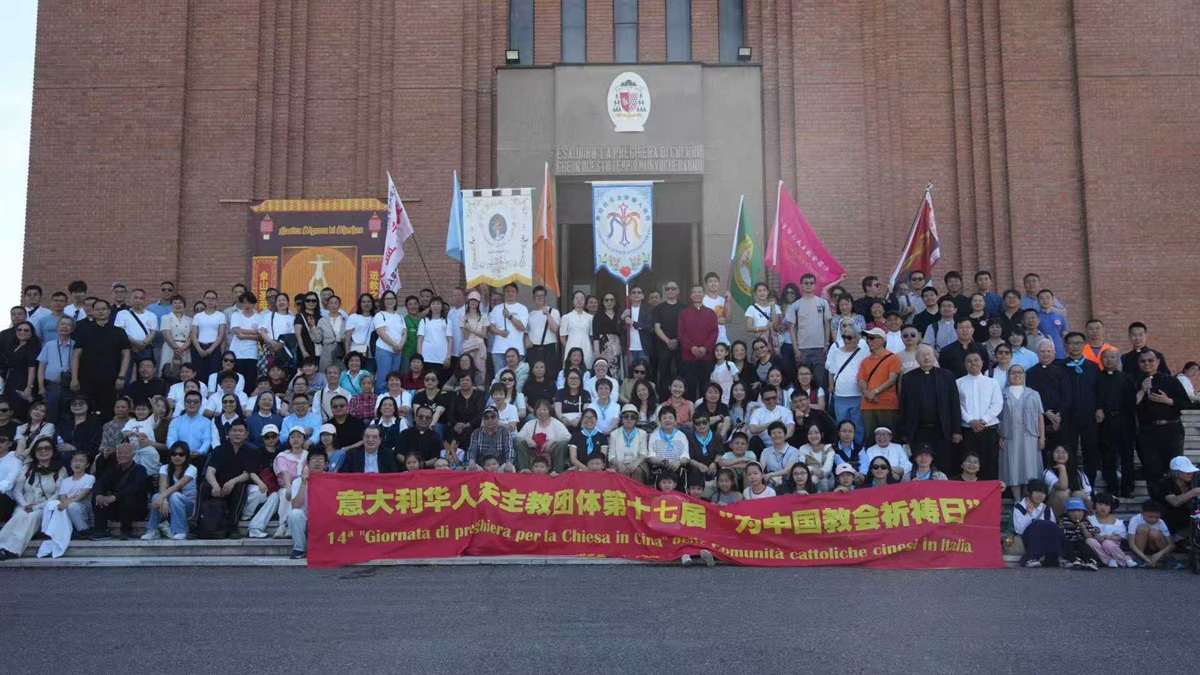
Padua (AsiaNews) – On 24 May 2026, the “Day of Prayer for the Church in China” was celebrated by the Chinese Catholic community in Italy in the city of Padua. More than 400 Chinese pilgrims living in Italy (Rome, Naples, Prato, San Miniato, Reggio Emilia, Turin and other places) and in other European countries gathered in the historic city of Veneto to pray together for the Church in China.
This year, the day coincided with Pentecost: the convergence of the two feasts overflowed with grace. The celebratory procession set off from the Basilica of St Anthony in the centre of Padua and continued on foot towards the venue of the event on the northern outskirts of the city: the Church of the Sacred Heart of Jesus. The temperature was close to 30 degrees and the sun was scorching, but the Chinese pilgrims from various places held aloft the flags of their respective local church communities, reciting the Rosary together along the way. The procession included 77-year-olds and even small children, sitting in pushchairs or on their fathers’ shoulders. A woman, elegantly dressed for the pilgrimage, recounted with emotion: “Today I deliberately chose to wear high heels to walk the entire route, encouraging friends along the way who could no longer walk. Through this concrete act of mortification, I wish to show my urgent desire to pray for the Church in China.”
The celebrations had already begun on the afternoon of 23 May with the Vigil Mass of Pentecost, presided over by the Bishop of the Diocese of Vittorio Veneto, Monsignor Riccardo Battocchio. The main Mass on 24 May was celebrated by Monsignor Claudio Cipolla, Bishop of the Diocese of Padua. In their respective homilies, both bishops emphasised the importance of “unity”.
Bishop Riccardo recalled how the world is constantly faced with the temptation to build a “Tower of Babel”: it seeks to eliminate diversity and create a uniform and orderly order, a temptation to which the Church must resist. He encouraged everyone with the faith of St Paul, inviting them to face the violence of states and wars with a spirit of peace. Affirming that “unity in the Holy Spirit” is the hope of the Church, he invited everyone to invoke it by asking for the intercession of Mary Help of Christians.
In his homily during Mass, Bishop Claudio outlined a concrete vision and a path towards unity, looking specifically to Pentecost: the descent of the Holy Spirit does not serve to eliminate differences, but to embrace diversity, transform chaos into meaning, and bring unity and peace.
The bishop used the image of bamboo – characteristic of Eastern culture – to explain this concrete manifestation of unity. This plant always grows in groups, with its roots intertwined and supporting one another; when strong winds blow, it bends with flexibility but never breaks. The strength of bamboo derives precisely from this true connection. This is also the mystery of the Church’s unity: the Church is never a single, standardised entity, but a communion united in diversity. When the Risen Lord appeared to the disciples, the first words he spoke were: “Peace be with you”. He did not rebuke the disciples for their past weakness, but bestowed his blessing upon them, breathing new life into them.
Bishop Claudio also expressed great hopes for the faithful of the Chinese Church in Italy, associating them with the beatitude of the peacemakers. “You are becoming an integral part of Italian society and have given a fine witness to the faith in various fields of work, in family life and in the upbringing of your children,” he said. He also cited the example of the Italian-Chinese international school in Padua, which has become a meeting place for different cultures, a practical foundation for unity and shared growth, as well as a microcosm of the future communion of the world.
The bishop added that Matteo Ricci’s evangelising model from 400 years ago should not remain merely a historical memory: it is an example of the real encounter between the Gospel and concrete culture. Throughout history, Chinese Catholics have not sought fame or worldly attention, but have quietly preserved this authentic relationship within family life, passing on the faith from generation to generation through the reading of Scripture, prayer and ecclesial activities. This steadfastness and purity deserve to be regarded by the universal Church with prayer and respect.
Finally, he recalled the “Prayer to Our Lady of Sheshan” which Benedict XVI wrote in 2007, entrusting the Church in China to the intercession of Mary Help of Christians. He prayed that the Chinese faithful, like Mary gathered with the disciples around the Easter table, might receive the Holy Spirit in fullness, have greater sincerity and less mistrust in their faith, live an authentic and courageous faith in their daily lives, and pass it on like a torch to the next generation.
Since Pope Benedict XVI established the “Day of Prayer for the Church in China”, Chinese Catholic communities in Italy have responded actively. In 2008, the first edition of the event took place successfully in Naples, and subsequently the organisation rotated among the various Chinese communities. With the exception of the two years of the pandemic, during which large gatherings could not be held (in 2021 only a small prayer service took place in Rimini), the event has now reached its seventeenth year. The next edition will be held in Naples.
On the very day of the pilgrimage, many faithful in China shared an old video of the ‘smoke above Sheshan on the feast of Mary Help of Christians’. The reference is to an event that took place in 2008, the year following the decision to establish the Day, contained in the pastoral letter to the Catholic Church in China published on Pentecost (27 May 2007). In the spring of 2008, the Basilica of Sheshan was closed for major renovation work and for the installation of spherical surveillance cameras throughout the area; the road up the mountain was completely blocked and not open to pilgrims. The video recounts that, on the day when the prayer for the Church in China was celebrated for the first time in the world, even though there were no public liturgies in the basilica, for three consecutive days smoke was seen enveloping the statue of Our Lady. The fire brigade went up to check but found nothing out of the ordinary. In the years that followed, the phenomenon reappeared occasionally, and many of the faithful interpreted it as a sign of the miracles and the Our Lady’s continued protection over China.
This year, on 24 May in Shanghai, there was torrential rain accompanied by lightning and thunder. Nevertheless, the Basilica of Our Lady of Sheshan was still packed with people, and Bishop Shen Bin presided over Mass. The faithful gathered together to thank Our Lady of Sheshan for her loving protection over the Diocese of Shanghai and the Church in China, whilst also offering fervent prayers for world peace, the prosperity of the nation and the happiness of the people.
As previously reported by AsiaNews, on that day in the Vatican, Pope Leo also prayed for the Church in China in St Peter’s Square and expressed his deepest condolences and blessings for the victims of the mining disaster in Shanxi. He said: “May the intercession of the Queen of Heaven obtain for the believing community in China the grace of unity and grant everyone the strength to bear witness to the Gospel in their daily labours, so as to be a seed of hope and peace. In particular, I invoke eternal peace for the victims of the accident that occurred in recent days in a mine in northern China”.

.png)










