Milan (AsiaNews) – From Asia to Europe, sports newspapers and other publications across half the world are currently celebrating the sporting feat of the German footballer of Kurdish and Yazidi origin, Deniz Undav, who has a background as a semi-professional player and factory worker, and who scored two goals against the Ivory Coast at the World Cup.
The Stuttgart striker, the first person of Yazidi ethnicity ever to represent Germany in the world’s top football tournament, had scored – as well as providing an assist – in the opening match against minnows Curaçao.
What’s more, in the second match, the 29-year-old – born on 19 July 1996 in Varel and raised in Achim, near Bremen – needed just over 30 minutes to turn the match around and deservedly – and with no small amount of pride – claim the award for best player.
The striker’s dance
Undav is a natural talent and can boast a record that no one can take away from him: he is, in fact, the first player of Kurdish and Yazidi ethnicity to score a goal (actually three) in a FIFA World Cup. He is the grandson of a Turkish migrant who fled his country of origin following the 1980 military coup.
His parents come from the village of Işıklı, in the district of Viranşehir, a region home to a significant population of this ethnic minority. In addition to his Kurdish roots, he also has ties to the Yazidi community, another Kurdish-speaking religious minority whose beliefs blend elements of ancient Mesopotamian religions.
Their history is marked by dozens of attempts at genocide, the most recent of which was the attack in the summer of 2014 by ISIS in the Sinjar region of Iraq, resulting in the massacre of men and women – including very young girls – who were abducted and exploited as sex slaves by the militants.
To pay tribute to his roots, the German international celebrated his first goal with the ‘govend’, a circular dance central to Kurdish festivals and cultural traditions, from weddings to harvest celebrations.
Real Madrid defender Rüdiger, himself originally from Sierra Leone and a naturalised German citizen, joined in the dance, paying tribute to a tradition rooted in a culture other than his own. Both the Kurdish and German media appreciated the gesture, giving it extensive coverage and, for once, speaking of the Kurdish minority in a positive light – rather than evoking wars, massacres or persecution.
Furthermore, the dance itself was already part of Undav’s public image because, after scoring a goal for Stuttgart against Eintracht Frankfurt in April 2024, he had performed the same moves, attracting the attention of the German press.
According to Bild, the striker had first introduced the dance in the changing room, after which his teammates encouraged him to perform it on the pitch. For young Kurdish-Yazidi people and children in Germany, Turkey, Iraq and scattered across a global diaspora, watching Undav dance after scoring at the World Cup represents a moment of unimaginable pride, a point strongly emphasised by Undav himself.
Hate campaign
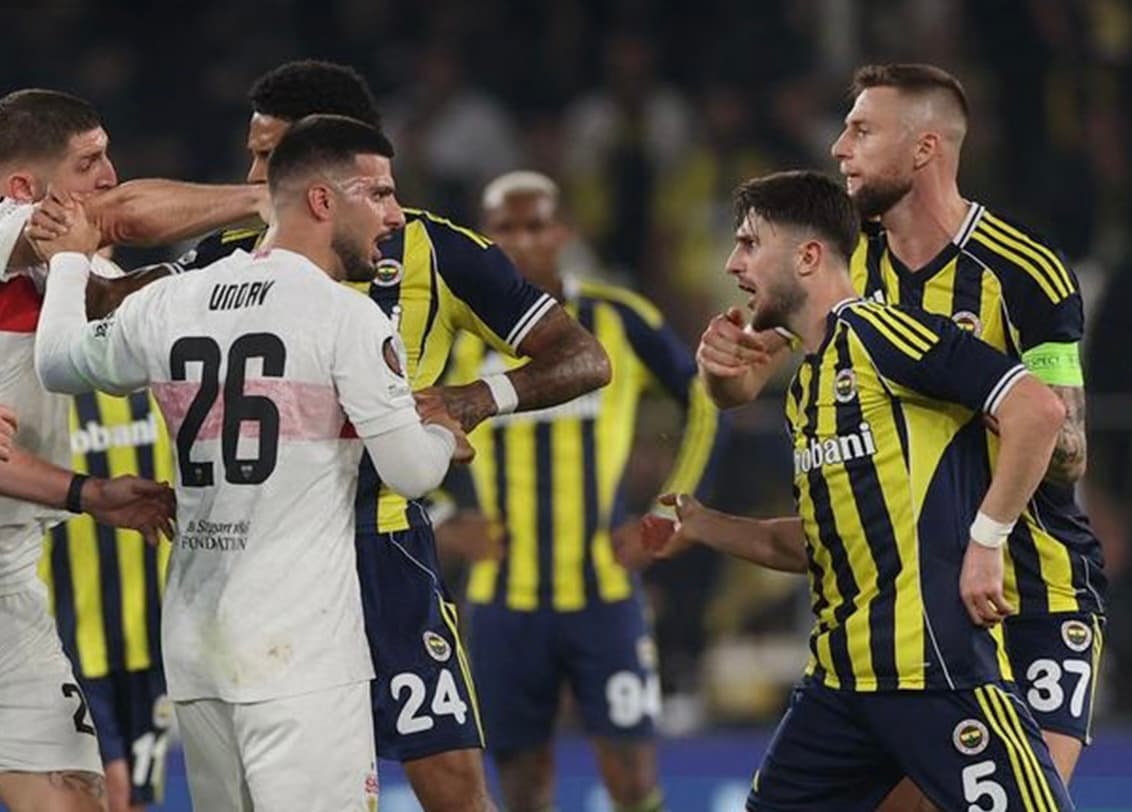
Now in the headlines for his sporting achievements, the player has also been the target of a hate campaign and attacks in the recent past. In October last year, he was subjected to a barrage of racially motivated insults and abuse during a Europa League match played in Istanbul between the home side, Fenerbahçe, and VfB Stuttgart, for whom the German international plays.
What happened during and after the match has reignited the debate on racism and violence – sometimes not just verbal – against the Kurdish minority in this country straddling Asia and Europe, in sport as well as in society, right through to politics and institutions.
Videos shared online and on social media, as well as eyewitness accounts, have shown entire sections of the Şükrü Saracoğlu Stadium hurling insults at Undav throughout the match, which ended 1–0 in favour of the Turkish side. Some fans were heard chanting obscenities about the striker’s family, whilst others reportedly used insults such as ‘traitor’ and ‘terrorist’.
According to the Information Centre on Anti-Kurdish Racism (IAKR) and the Central Council for the Human Rights of Kurds in Germany (ZMRK), the international player had been the target of racist and ethnically motivated attacks for months following his public identification as a Kurdish Yazidi.
The abuse was preceded by a heated exchange between Undav himself and Fenerbahçe midfielder İsmail Yüksek, a clash that helped to inflame tempers and prompted sections of the stadium to target the Stuttgart player.
What happened in Europe’s second-tier club competition was certainly not the first time Undav had faced hostility: for months, the player had been subjected to online abuse for publicly identifying as Kurdish [Yazidi, one of the minorities most persecuted by Islamic State in Syria and Iraq at the time of the jihadist uprising] and for rejecting the label of ‘Turkish footballer’.
In a 2023 interview, he explained his decision to play for Germany by stating that “after two or three poor performances for Türkiye [Turkey, ed.], I would have been insulted”.
Since then, social media platforms have been inundated with hate speech, including comments calling him a “traitor”, “terrorist” and “stateless dog”. Posts featuring the wolf emoji – a symbol associated with Abdullah Öcalan’s ultra-nationalist Grey Wolves movement – have frequently appeared under his name.
For many Kurds in Türkiye, daily discrimination is a familiar reality, and football stadiums reflect these tensions. Clubs from predominantly Kurdish regions, particularly Amed SK of Diyarbakır, have been targeted by nationalist chants, hostile banners and even sanctions from the football authorities.
These incidents go beyond sport, revealing deep-rooted ethnic divisions and persistent intolerance within Turkish society. “When a player like Deniz Undav is attacked simply for embracing his Kurdish identity,” explains Kurdistan24, “it shows that football remains a mirror of the country’s unresolved ethnic tensions”.
Kurdish pride
Among those who have praised the Kurdish-German player’s performances is the Israeli ambassador to Georgia, Walid Abu-Haya, who stated in a post on X: “One of my favourite players among the stars of the ongoing World Cup is Deniz Undav”, whom he describes as a “proud German of Kurdish-Yazidi origin whose footballing journey embodies the ideals of perseverance, humility and determination”.
“By proudly embracing both his German identity and his Kurdish roots, he has become – concludes the diplomatic representative of the State of Israel – a symbol of diversity and success in modern European football.”
The Mannschaft striker is one of nine players of Kurdish origin, representing four different national teams, taking part in the 2026 World Cup, reflecting the growth of the football movement within these communities.
In the past, players such as Ismail Mohammed in Iraq, Eren Derdiyok in Switzerland and Bakhtiar Rahmani in Iran have distinguished themselves, alongside other teammates of Kurdish origin in the national teams of Turkey and Iran.
In the current tournament, according to the sports platform Yariga Sport, there are nine players: in addition to the aforementioned Undav for Germany, Turkey – which has effectively already been eliminated – has two defenders in its ranks: Zeki Çelik, 29, from Bursa, who plays for Roma, and Ozan Kabak, 26, from Mardin.
Iran’s squad includes 33-year-old goalkeeper Alireza Beiranvand, who was the star of the match against Belgium, where he preserved the scoreline – keeping it at 0–0 – with world-class saves.
The team with the highest number of Kurdish players is Iraq, which has no fewer than five: defender Merchas Doski, aged 26, born in Zakho and holding dual German-Iraqi citizenship; 26-year-old Akam Hashim, born in Erbil; and Dario Namo, a 21-year-old defender from Qaladze, who holds Finnish and Iraqi citizenship.
In midfield is 22-year-old Youssef Amyn, from Darbandikhan, who holds both German and Iraqi citizenship. Rounding off the list is Marco Faraj, a 22-year-old midfielder from Sulaymaniyah, who holds both Norwegian and Iraqi citizenship and plays for Venezia.
Analysts and experts point out that the presence of nine Kurdish players at the World Cup highlights their growing visibility in international competitions and reflects the diverse paths through which players of Kurdish origin have reached the world stage.