








Ever-closer ties between Central Asia and Germany
In a region where over 100 million people will be living by 2025, the traditional model of trade in raw materials and finished goods is being superseded, with an increasing focus on the coordinated creation of added value. Berlin is able to offer cutting-edge solutions for the green transition and make a vital contribution to the development of human capital.
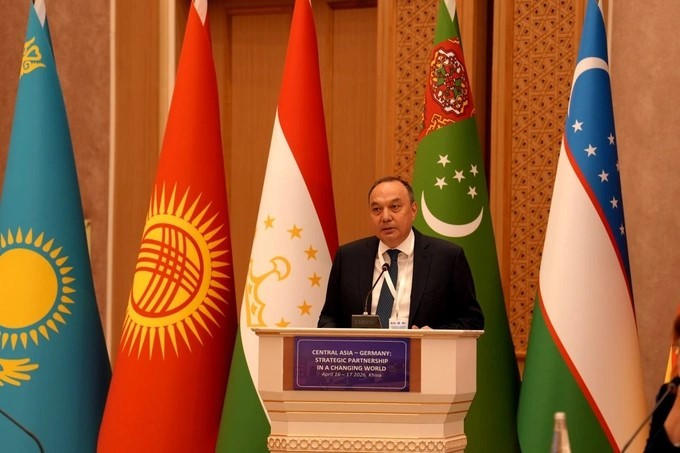
Tashkent (AsiaNews) - A forum of experts on “Central Asia-Germany” relations was held in Khiva, Uzbekistan, in recent days, and the Gazeta website spoke to the director of the Institute for Strategic and International Studies in Tashkent, Eldor Aripov, about how these relations are evolving and where the interests of Germans and Central Asians converge, which “are moving towards new levels in the current context”.
As the expert explains, “today the very logic of cooperation is changing: whereas the emphasis used to be on expanding contacts and implementing specific projects, a deeper and more constructive model of collaboration is now taking shape, focused on long-term results”. Aripov highlights several priorities being emphasised in this context, starting with economic and technological cooperation.
The traditional model of exchange between raw materials and finished products is being superseded, with an increasing focus on the coordinated creation of added value. This entails a shift towards technological partnership, which requires the participation of countries in the region in increasingly complex and advanced production chains.
According to Aripov, “Central Asia already possesses the necessary foundations for such a transition”, with a regional GDP exceeding 0 billion and steady growth rates of around 6% per annum.
In addition to quantitative dynamism, a structural transformation is underway that is broadening the industrial base, with the modernisation of infrastructure and the growth of domestic demand. For its part, Germany boasts an exceptional engineering tradition, a rich industrial culture and advanced manufacturing technology, enabling the development of highly complex industrial systems.
The convergence of all these factors forms the foundation for ever-deeper collaboration, and major projects are already underway involving companies such as Siemens and Bosch, aimed at modernising infrastructure, developing an automated industry and increasing productivity.
The next stage requires a shift from attracting technologies to their establishment, through the localisation of production, the formation of industrial synergies and an active presence in foreign markets, as a fully operational production hub.
A second priority is the transition to a ‘green economy’ with proper resource management, a prospect of great strategic value. These are issues related to water and energy resources in the face of climate change, to which Central Asia is one of the most vulnerable regions.
In this field too, Germany can offer extensive expertise, ranging from the deployment of alternative energy sources to complex solutions for energy efficiency and regulation in general. Here too, programmes are underway with institutions such as KfW and GIZ, and companies such as Lahmeyer International.
Another fundamental issue is the development of human capital, which is of systemic importance for everything else. As the researcher states, “no economic model can be sustainable without a corresponding institutional workforce”, given that Central Asia has very significant demographic potential.
By 2050, the region’s population is likely to reach 100 million people, with a very large youth demographic, and this is the most important resource for its development, which requires high-quality education and training systems right from now, with a high number of skilled professionals at work.
German vocational training can be of great help with its dual system, which ensures a close link between education and industry. A significant milestone in October 2025 was the opening of the German Medical Academy in Tashkent.

.png)
24/07/2023 12:18
05/05/2017 13:49










