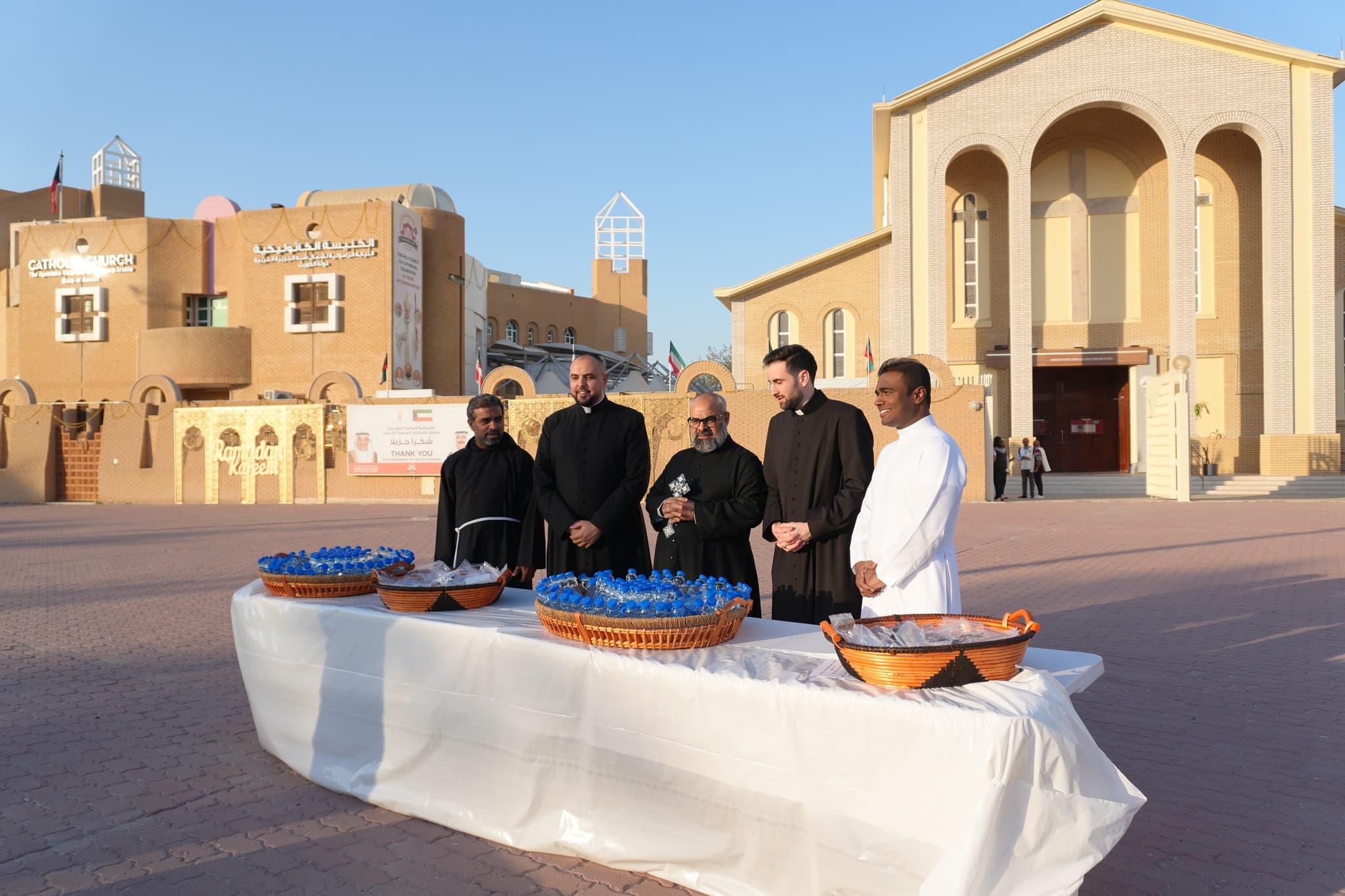
Milan (AsiaNews) – The Church is "home" and becomes a safe place in a situation of "uncertainty" experienced "with great human dignity," while people sense that "this is not a distant crisis, but something that affects their daily life,” said Father Sliman Hifawi, assistant parish priest and head of the Latin Arab, Hispanic, Italian, and neocatechumenal communities, and spokesman for the Catholic Church in Kuwait, speaking to AsiaNews the about the war launched by Israel and the United States against Iran on 28 February, which has spread to the Gulf nations.
The 37-year-old priest of the Latin Patriarchate of Jerusalem (LPJ) was born in Jaffa, Israel, and had already served in the Gulf in the three years prior to his ordination as a deacon in 2017. He previously served as assistant parish priest at Christ the King Parish in Misdar, Jordan, and as assistant parish priest at Holy Family Parish in Ramallah, West Bank.
Among the emirate's Catholics, mostly economic migrants from Asia, there is "fear, especially for those far from their families," says the priest, but many expats "feel a real connection to this land. Over the years, “Kuwait has been a place of work, relationships, sacrifice, and even lived faith; for this reason, many do not perceive it simply as a place of passage."
The clergyman appeals to our readers: "Let us not get used to war. Every war is a wound to humanity."
Meanwhile, Kuwait's Interior Ministry has officially banned gatherings, concerts, theatrical performances, other types of entertainment, and weddings during Eid al-Fitr, the holiday marking the end of Ramadan, the Islamic holy month of fasting and prayer.
The authorities prioritise security amid instability and fear. A few days ago, a drone attack from Iran caused significant damage to the US Ali al-Salem Air Base.
Below is the priest's full interview with AsiaNews:
Fr Sliman, how are you experiencing the escalation of the conflict?
We are experiencing it with a strong sense of uncertainty, but also with great human dignity. Ordinary people sense that this is not a distant crisis, but something that affects their daily lives.
Families follow the news with apprehension; many have relatives in other countries in the region, and everyone senses how fragile the balance of power in the Gulf is at present. Since the war began on 28 February, the conflict has affected several Gulf countries with missile and drone attacks. Kuwait has also been affected. Life is a mixture of caution, fear, and prayer.
People are trying to maintain a normal life: work, family, relationships. But in their hearts, they sense that we are living through a special time. In moments like these, we understand more clearly that peace cannot be taken for granted, that it is a gift invoked and protected every day.
Kuwait, among other things, is one of the places most exposed to Iranian retaliation. How has the situation changed in the past two weeks, including in religious terms?
The situation has changed very rapidly. At first, there were fears that the conflict might spread; then it became clear that this was already happening. In Kuwait, there have been attacks and moments of real alarm, and the authorities have significantly strengthened defence and civil protection measures. Beyond the military aspect, however, there is also great human and psychological intensity.
Uncertainty weighs on people's lives, and many live with the feeling that everything can suddenly change. This creates internal tensions that demand not only security, but also hope and trust, while in daily life, no overt religious tensions have materialised.
The war certainly touches deep sensitivities in the region, and everyone can have different interpretations of events. However, there is also great awareness of the risk that the conflict could divide the country. Precisely for this reason, many feel responsible to preserve unity and not allow themselves to be dragged down by hatred. In such trying times, we see a desire to protect coexistence and mutual respect. It is a challenge, but also a sign of civil and religious maturity.
How is the Catholic community in Kuwait experiencing this moment? Which is stronger: fear or hope?
Deep emotions are running through the Catholic community. On the one hand, there is fear, because many Catholics are foreigners, far from their families. On the other, there is a hope born of faith. What Catholics ask of the Church, first and foremost, is not to be left alone; they ask for prayers, closeness, and a listening ear.
Catholic need to feel that the Church is home, a place where they can find consolation and strength. These days, a spiritual need is emerging above all else: to pray together, to entrust one's fears to the Lord, and to find peace in one's heart.
Father, are religious services taking place regularly, or have activities ceased?
We have tried to maintain, cautiously and with responsibility, the liturgical life of the community. In hard times, people need the sacraments and communal prayer. Some pastoral activities have been adapted to the situation.
Masses continue, while remote methods are being used for the catechism and some meetings at this stage. It is a choice made to protect people and, at the same time, avoid interrupting their journey of faith. This too is a way of caring for God's people.
In the Gulf, religious believers are living Lent and Ramadan against a background of war and violence: Does this boost cooperation?
I believe so, in part. When suffering affects everyone, we better understand that we cannot remain closed within our own selves. This coincidence of Lent and Ramadan, in a context of war, can also become a time of purification and solidarity.
Faced with fear and uncertainty, many people feel the need to support one another. We rediscover that true faith leads to compassion and responsibility towards others. In this sense, even trying times can become a lesson in brotherhood.
The overwhelming majority of Catholics in Kuwait are expats from India and the Philippines. How are they experiencing this period of war? Do they want to flee or do they feel a connection to this land?
Expatriates are living through this moment with mixed feelings. On the one hand, there is fear, especially for those far from their families; on the other hand, many feel a real connection to this land. For many years, for them Kuwait has been a place of work, relationships, sacrifice, and even a lived faith; for this reason, many do not perceive it simply as a place of passage.
The Church and the faithful who feel this land is their home, a place characterised by respect and tolerance, are praying for Kuwait, for its emir, Mishal Al-Ahmad Al-Jaber Al-Sabah, for its government, and for all its people. This is a very beautiful sign; it means that the presence of foreign Catholics is also a human and spiritual presence.
Fr. Sliman, you are responsible for relations with the authorities. Have you had the opportunity to meet with any government officials? Are there any particular areas of concern?
Dialogue with the authorities these days is marked above all by a sense of responsibility. The authorities are very attentive to the safety, stability, and protection of the population. They appreciate the Church's role in maintaining a climate of calm and responsibility. In times of crisis, the Church is also called to serve the common good, encouraging prudence, avoiding alarmism, and offering spiritual support to people.
In January, you had a visit from Cardinal Parolin and celebrated the elevation of the first minor basilica. After the celebration, the drama of war: How do we look "with hope" at this situation of grave tensions and violence?
Precisely because of this event, we understand even more that Christian hope is not superficial, but is also born in trying times. Cardinal Parolin's visit and the elevation of the Church of Our Lady of Arabia to a minor basilica were a moment of great joy.
Today, in the context of war, that memory becomes a sign. It reminds us that God continues to act in history even when everything seems dark. Christian hope does not deny suffering, but helps us look beyond, trusting that the Lord can still open paths of peace.
Finally, to AsiaNews readers, I would like to say: Let us not get used to war. Every war is a wound to humanity. I ask you to pray for Kuwait, the Gulf countries, Iran, Lebanon, Palestine, the Holy Land, and the entire Middle East.
Praying does not distance us from reality; instead, it helps us bring it before God. We wish to continue to be a Church, present through prayers; even in times of trial, we want to preserve a small light. And often, precisely in the most difficult nights, a small light can become a great sign of hope.





.webp&w=3840&q=75)