








Hanoi and New Delhi strike deals in Tô Lâm's latest diplomatic success
Vietnam and India want to increase trade to US$ 25 billion by 2030, through greater cooperation on defence, rare earths, energy, and supply chain security. As part of his country’s “bamboo diplomacy”, Tô Lâm's visit to New Delhi confirms the Vietnamese leader's diplomatic activism to diversify Vietnam’s economic and strategic relations beyond China.
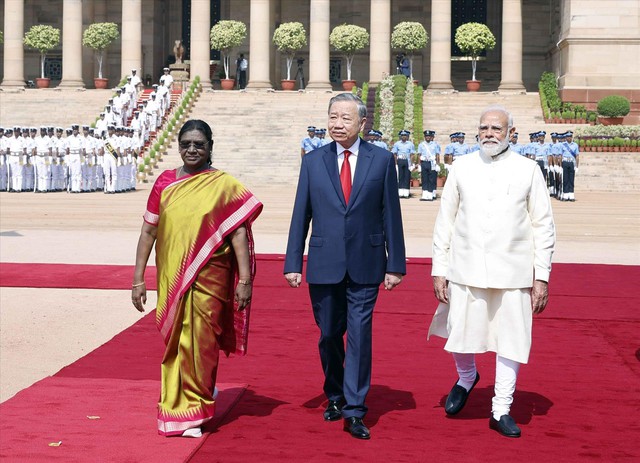
New Delhi (AsiaNews) – India and Vietnam want to strengthen their ties, focusing on defence, rare earths, energy, and supply chain disruptions.
For Vietnam’s Tô Lâm, who has centralised power in recent months by assuming both the positions of president and general secretary of the Communist Party of Vietnam, this is yet another step undertaken this year to diversify his country’s diplomatic ties and (especially) trade.
In New Delhi on a state visit, Tô Lâm yesterday announced Vietnam’s intention to expand bilateral cooperation and increase trade with India to US billion by 2030.
For his part, Indian Prime Minister Narendra Modi said at the end of the meeting that, “Today, we are taking our ties to an enhanced comprehensive strategic partnership level,” adding that the two Asian countries intend to strengthen collaboration across all sectors, from security and sustainability to shared cultural and economic initiatives.
The memoranda of understanding exchanged cover various areas, including financial innovation, digital payments, pharmaceutical regulation, tourism, and education.
In the past decade, bilateral trade between the two Asian countries has doubled, reaching US$ 16 billion. To boost it over the next four years, the two sides have expressed support for a review of the India-ASEAN trade agreement, expected to be held by the end of the year.
One of the most significant aspects of the agreement concerns rare earths, which are crucial for the energy transition, the production of semiconductors and batteries, and technology companies in general.
Thanks to this cooperation, “we will ensure economic security and supply chain resilience,” Modi reiterated.
India considers Vietnam a key partner in its "Act East Policy”, a strategy designed to strengthen political and economic ties with Southeast Asia and consolidate its presence in the Indo-Pacific.
Modi called Hanoi "a key pillar" of this vision and stressed that the two countries share "a common outlook" on regional security, a likely reference to China's ambitions in the South China Sea and tensions related to Beijing's expansion into areas of South Asia bordering India.
The joint statement released at the end of the meeting also mentioned an expansion of military cooperation, which should include the purchase of defence systems, joint exercises, shared production of new military technologies, maritime security, and search and rescue operations.
The two governments also agreed to enhance port calls by each other’s naval vessels and visits by their respective air force aircrafts.
President Tô Lâm also emphasised the need to remove trade barriers and expand mutual market access.
The Vietnamese leader, who visited more than 10 countries in a year (for the first time without delegating foreign relations to others), is seeking to make Vietnam an upper-middle-income country by 2030.
This diplomatic activism is aimed at attracting high-tech investments, diversify alliances (according to its well-known "bamboo diplomacy"), and project a sense of internal stability after a period of major domestic political upheaval.
For his first foreign visit as president, Tô Lâm chose China in mid-April, with which he strengthened strategic cooperation and signed numerous bilateral agreements, a sign that Vietnam cannot ignore the Asian giant, which remains its primary trading partner.
Before leaving for Beijing, he welcomed Slovakian Prime Minister Robert Fico, who came with a hundred businessmen. At the end of the meeting, the two countries signed 16 agreements in sectors such as defence, nuclear energy, healthcare, and culture, while bilateral relations were elevated to a "strategic partnership”, making Slovakia the main gateway for Vietnamese goods into Central Europe.
At the end of January, António Costa, President of the European Council, travelled to Vietnam to boost economic ties following the success of the European Union-Vietnam Free Trade Agreement (EVFTA). The latter, which entered into force in 2020, eliminates tariffs, boosts Vietnam’s ties with the West, and allows it to position itself as an alternative to China for European supply chains, thus counterbalancing Beijing’s influence.
In March, somewhat surprisingly, Tô Lâm also attended the inaugural ceremony of the Board of Peace for the Gaza Strip, set up by US President Donald Trump.
During his visit, Costa visited the construction site of Hanoi Metro Line 3 (partly funded by the EU) and laid a wreath at the Heroes and Martyrs Memorial (Bac Son Monument), dedicated to the Vietnamese who lost their lives during the Vietnam War.
Japanese Prime Minister Sanae Takaichi also chose Hanoi for her first foreign visit since her election victory. In addition to technological cooperation and the green transition, Takaichi gave a major speech at the Vietnam National University, highlighting the importance of the Southeast Asian nation for a "free and open Indo-Pacific" amid regional tensions, another reference to Beijing's ambitions.

.png)
05/02/2025 18:35










